
Apr 28, 2026 New research suggests constructing a simple building from interlocking subunits should be mechanically feasible and have a much smaller carbon footprint. (Nanowerk News) Robotically assembled building blocks could be a more environmentally friendly method for erecting large-scale structures than some existing construction techniques, according to a new...
Tiny magnetic robots grip, snap and swim with a wave of a magnet
Apr 28, 2026 Researchers' new fabrication technique can produce soft, microscopic structures with magnetically activated moving parts. (Nanowerk News) Under a microscope, a bouquet of lollipop-like structures, each smaller than a grain of sand, waves gently in a Petri dish of liquid. Suddenly, they snap together, like the jaws of...
Ordinary nail polish turns surfaces into removable nanogenerators
Apr 28, 2026 Commercial nail paint can be brushed onto surfaces to create removable triboelectric generators that harvest small mechanical energy for low-power electronics. (Nanowerk Spotlight) Electric charge is easy to create but hard to put to work. A rubbed balloon sticks to a wall, clothes cling after tumbling in...
Turning plastic waste into clean fuel using sunlight
Apr 28, 2026 Scientists are advancing a promising solution to two of the world's biggest challenges - plastic pollution and clean energy - by transforming waste plastics into valuable fuels using sunlight. (Nanowerk News) A new paper led by Adelaide University PhD candidate Xiao Lu explores how solar-powered technologies can...
New nanocomposite enables removal and detection of radioactive iodine in water
Apr 28, 2026 A MOF-based nanocomposite for removing and detecting radioactive iodine, supporting nuclear wastewater treatment and environmental cleanup of long-lived isotopes. (Nanowerk News) Researchers from Hefei Institutes of Physical Science, Chinese Academy of Sciences, have developed a silver-decorated, metal-organic framework (MOF)-derived TiO2-x nanocomposite enriched with oxygen vacancies, enabling both...
The reason nanoscale gaps can produce terahertz radiation
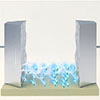
Apr 28, 2026 Plasma forms in gaps ten times smaller than classical theory predicts possible, driven by electron cascades on the substrate surface, enabling 2 W terahertz generation on a chip. (Nanowerk Spotlight) Radio transmitters, microwave ovens, infrared cameras, visible lasers: every major band of the electromagnetic spectrum has its...
Scientists build a reusable DNA computer that works below the 2nm chip barrier
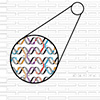
Apr 28, 2026 A new DNA-based transistor overcomes the single-use limitation of molecular circuits, enabling both computation and memory storage at the molecular scale. (Nanowerk News) A research team at KAIST has built a DNA-based molecular circuit that can compute, store results, and accept new inputs without ever needing to...
Ultra-thin nanotube film blocks 99.999% of electromagnetic waves and absorbs neutrons
Apr 28, 2026 A stretchy, 3D-printable composite thinner than a human hair combines carbon and boron nitride nanotubes to shield against both electromagnetic waves and neutron radiation. (Nanowerk News) Shielding materials are essential in key modern industrial settings-such as spacecraft, nuclear power plants, semiconductor equipment, and advanced medical devices-to protect...
Origin of the stellar Fe Ka line revealed
Apr 27, 2026 Tandem superflare observations uncover the mechanism behind an astronomical mystery. (Nanowerk News) The Fe Kα line, or iron Kα line, is often used in astronomical research to understand the physical composition of astronomical objects. This line is produced when a K-shell electron of an iron ion in...
Raman spectroscopy maps protein profiles in living cells without destroying them
Apr 27, 2026 Researchers used Raman spectroscopy to infer proteome profiles from intact E. coli cells, revealing conserved protein ratio patterns that also appear in human cells. (Nanowerk News) Scientists can now read the full protein composition of a living cell by analyzing scattered laser light, eliminating the need to...