| May 11, 2026 |
Researchers use microcomb-based photonic chips to generate ultralow-noise microwave and millimeter-wave signals with record stability for 6G and radar.
(Nanowerk News) A chip-scale photonic system has achieved record low-noise microwave signal generation using optical frequency combs, known as microcombs. Researchers at KAIST demonstrated two complementary techniques that together solve the core obstacles to producing stable, high-frequency signals from compact photonic hardware. The work points toward practical frequency sources for 6G communications, radar, and precision sensing.
|
Key Findings
- A transfer oscillator technique achieved fractional frequency stability at the 10⁻¹⁸ level and phase noise of −125 dBc/Hz at 100 Hz offset from a 22 GHz carrier, an 80 dB improvement over a free-running microcomb.
- Perfect soliton crystal states enabled repetition-rate multiplication to 44 GHz and 66 GHz while preserving timing jitter of approximately 3 femtoseconds.
- Together, the two studies establish a practical route toward compact photonic signal sources that combine optical-level stability with high-frequency operation.
|
|
High-frequency signals in the tens to hundreds of gigahertz range underpin emerging technologies such as next-generation wireless networks, advanced radar systems, and high-precision sensors. Generating these signals with both low noise and high stability, however, remains difficult for conventional electronic sources.
|
|
Photonic approaches based on microcombs offer a promising alternative, but two technical barriers have limited their use: transferring the stability of an optical reference to a microcomb and maintaining noise performance as the signal frequency scales upward.
|
 |
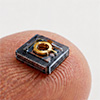
| Ultra-compact optical resonator chip with noise suppression based on an optical reference signal and increased frequency via fully solitonic waves. (Image: KAIST) (click on image to enlarge)
|
|
The first study, published in Laser & Photonics Reviews (“Optical‐to‐Microcomb Stability Transfer for Ultrastable Timing and Microwave/Millimeter‐Wave Generation”), targeted the problem of locking a microcomb’s output to a stable optical reference.
|
|
Direct stabilization is difficult because high-repetition-rate microcombs lack a way to detect the carrier-envelope offset, a parameter that links the optical and microwave domains. The team solved this by introducing a mode-locked laser as an intermediary, or transfer oscillator, and synchronizing it to the microcomb through electro-optic sampling. This allowed the optical reference’s stability to pass directly to the microcomb’s repetition rate.
|
|
The stabilized system achieved fractional frequency stability at the 10⁻¹⁸ level and phase noise of −125 dBc/Hz at a 100 Hz offset from the 22 GHz carrier, an improvement of more than 80 dB over the free-running microcomb in the low-offset-frequency regime. That performance represents the current state of the art for microcomb-based low-noise microwave signal generation.
|
|
The second study, published in Optica (“Preserving ultralow timing jitter in microcombs with repetition-rate multiplication via perfect soliton crystal formation”), focused on a separate limitation.
|
|
Microcombs built from larger optical resonators naturally produce lower repetition rates and better noise characteristics. Reaching the millimeter-wave band requires higher repetition rates, but increasing them typically degrades noise performance.
|
|
The researchers showed this tradeoff can be avoided by operating the microcomb in a perfect soliton crystal state. In this mode, multiple equally spaced pulses circulate inside the resonator, multiplying the repetition rate while retaining the noise properties of the underlying lower-rate comb.
|
|
Using perfect soliton crystals, the team generated millimeter-wave signals at 44 GHz and 66 GHz with timing jitter on the order of 3 femtoseconds. This confirmed that a microwave-rate microcomb’s low-noise performance survives scaling into the millimeter-wave range, a requirement for deployment in high-frequency systems such as 6G backhaul links and high-resolution radar.
|
|
The research was led by Dr. Changmin Ahn and Professor Jungwon Kim at KAIST, in collaboration with Professor Hansuek Lee. The first study provides high-fidelity transfer of optical-reference stability to a chip-scale microcomb. The second preserves that stability during frequency scaling through soliton crystal formation.
|
|
What remains is integration of both capabilities on a single chip and testing under real operating conditions, steps that would bring compact photonic frequency sources closer to practical use.
|