| Jun 08, 2026 |
Twisted laser light distinguishes mirror-image molecules by producing handedness-dependent ion signals, offering a simpler route for chiral detection.
(Nanowerk News) In the molecular world, “handedness” matters. Many molecules exist in two mirror-image forms—like left and right hands—that look identical but can behave very differently, especially in biological systems and pharmaceuticals. Distinguishing between these forms, known as enantiomers, is a longstanding challenge in science and technology.
|
|
A useful analogy is that of a screw and a nut: a right-handed screw fits only into a right-handed thread, while a left-handed one will not engage properly. A research team has now illustrated how light itself can be engineered to behave like such a threaded probe, selectively interacting with molecules depending on their handedness.
|
|
Researchers from Tata Institute of Fundamental Research, Indian Institute of Technology Mumbai, and Indian Institute of Technology Hyderabad have demonstrated a new optical method to distinguish molecular handedness using specially structured laser light.
|
|
The study, published in Science Advances (“Enhanced chiral discrimination in mass spectrometry with orbital angular momentum beams”), shows that light can be shaped not only to spin, but also to twist as it travels, forming a helical structure that carries what is known as orbital angular momentum. When such twisted light interacts with chiral molecules, the outcome depends sensitively on how the “twist” of the light matches the intrinsic handedness of the molecule.
|
 |
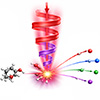
| Schematic illustration of twisted-light interaction with chiral camphor, resulting in molecular ionization and fragmentation into constituent atomic and ionic species. (Image: Courtesy of the researchers)
|
|
In the experiments, ultrashort laser pulses (a few-hundred fs) with controlled spin and twist were directed at gaseous samples of R or S-Camphor, a well-known chiral molecule. The interaction caused the molecules to break apart into charged fragments, which were then analyzed using a time-of-flight mass spectrometer. This instrument measures how quickly ions travel to a detector, allowing their masses to be identified.
|
|
Crucially, it was observed that the number of fragments produced depended on the combination of the light’s twist and the molecule’s handedness. By simply comparing these fragment counts, it became possible to distinguish between mirror-image molecules.
|
|
Traditional techniques for detecting chirality often rely on measuring very small differences in how molecules absorb light or on tracking the angular distribution of emitted electrons, both of which can require complex setups and careful alignment.
|
|
In contrast, the new approach reads out chirality directly from ion signals, without the need for angular measurements or coincidence detection. This simplifies the experimental requirements while enhancing the sensitivity of the measurement.
|
|
Another important aspect of the study is that it probes molecules in the gas phase, where they are isolated from external influences such as solvents or surfaces. This allows the intrinsic interaction between light and molecular structure to be observed more directly. The use of structured light further amplifies this interaction, producing stronger differences between enantiomers than those typically seen in conventional optical methods.
|
|
The findings suggest a new way to “match the threads” between light and matter, using twisted laser beams as probes of molecular handedness. This approach could open new possibilities for analyzing chiral molecules in chemistry, biology, and pharmaceutical science, where identifying the correct enantiomer is often crucial.
|
|
By combining advanced laser shaping with mass spectrometry, the research points toward a simpler and more scalable route for chiral detection, with potential applications in both fundamental science and practical chemical analysis.
|