
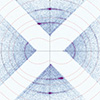
Jun 05, 2026 New soft X-ray momentum microscopy directly images magnons in 2D reciprocal space, offering a sensitive platform to study spin waves for future computing. (Nanowerk News) An international team lead by the Max Born Institute has developed a new type of momentum microscopy to image magnons — the...
Scientists identify the origin of noise in spin qubit quantum processors

Jun 05, 2026 Recent study clarifies the potential origin of microscopic noise in spin qubits and the conditions that can alleviate its effects. (Nanowerk News) A spin qubit, in which quantum information is encoded in the spin state of an electron, is one of the most promising platforms for quantum...
Understanding the path towards practical applications
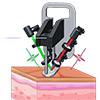
Jun 05, 2026 Researchers summarize the recent developments and future research directions toward the broader implementation of terahertz biophotonics. (Nanowerk News) Biophotonics is a multidisciplinary field that involves the development and application of light-based technologies to study, monitor, and treat biological systems. The ability to directly image cells and molecules...
Fish-scale sensor gives robots a better sense of touch

Jun 05, 2026 Fish-scale-like gaps help soft robotic grippers sense bending, texture, and firmness through small contact changes. (Nanowerk Spotlight) A fruit-picking robot can see a fruit before it picks it up, but vision cannot reliably tell how the fruit will respond to a squeeze. Firmness, subtle surface texture, and...
‘Don’t scare the cat!’ Engineers find smarter way to measure quantum systems

Jun 03, 2026 Engineers have riffed on the famous Schr�dinger�s cat analogy to demonstrate a more efficient way to eliminate errors in quantum computing. (Nanowerk News) âImagine youâre trying to find your cat hiding in one of eight identical cardboard boxes, in a dark and noisy room,â says UNSW Scientia...
Physics-trained digital ‘super-brain’ speeds up technology development
Jun 04, 2026 A digital 'super-brain' with built-in knowledge of the fundamental laws of nature can speed up the development of optical components for everything from quantum computers to eyeglass or camera lenses. (Nanowerk News) “When we fed the super-brain information about the laws of physics, it immediately got much...
AI-designed material wrinkles enable programmable surface patterns
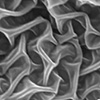
Jun 04, 2026 AI-guided material wrinkles could create low-cost micro- and nanoscale surface patterns for anti-counterfeiting and flexible electronics. (Nanowerk News) Surface wrinkles, folds, and dents are usually treated as flaws, signs that a material has aged or failed. A new review argues the reverse. Researchers led by Lingnan University...