| Apr 29, 2026 |
Review highlights strategies to control negative thermal expansion in atomically thin systems like graphene and boron nitride for next-generation devices.
(Nanowerk News) When you heat a typical material, it expands. But a class of ultrathin materials, known as two-dimensional (2D) materials, defies this common-sense rule, actually shrinking when temperatures rise—a property known as negative thermal expansion (NTE).
|
|
A comprehensive new review synthesizes recent breakthroughs in understanding and controlling this unusual behavior, paving the way for designing ultra-stable next-generation technologies.
|
|
The review, published in Nano Research (“Negative thermal expansion of two-dimensional materials: A review”), consolidates research on NTE in a wide range of 2D materials, from the well-known graphene and hexagonal boron nitride (h-BN) to emerging magnetic sheets and synthetic frameworks. The authors dissect the physical mechanisms behind the phenomenon and outline practical strategies to tune it, highlighting its potential to solve thermal mismatch problems that plague modern nanoelectronics and precision instruments.
|
 |
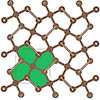
| This schematic illustrates the primary mechanisms causing negative thermal expansion in 2D materials. 1) Phonon Modes: Heating excites out-of-plane rippling vibrations (flexural ZA phonons), which pull the atoms closer together in-plane, causing net shrinkage. 2) Rigid Unit Modes (RUMs): In framework structures, the collective rotation of rigid polygonal units (e.g., squares or carbon rings) reduces the overall lattice dimensions. 3) Spin-Lattice Coupling: In magnetic 2D materials, the establishment of magnetic order upon cooling can pull atoms closer together, leading to contraction when heated through this transition point. (Image: Reproduced from DOI:10.26599/NR.2025.94908155, CC BY)
|
|
“Heat-induced expansion is a major problem in many technologies, causing stress, misalignment, and failure in devices from computer chips to space telescopes,” said Qilong Gao, a corresponding author of the review from Zhengzhou University. “Our work summarizes how 2D materials with negative thermal expansion can be the ultimate solution. We can use them as a ‘thermal compensation’ layer to counteract the expansion of other components, creating a composite that is dimensionally stable across a wide temperature range.”
|
|
The shrinking effect in these atomically thin materials arises from unique atomic vibrations. While in-plane bonds resist stretching, low-energy out-of-plane vibrations, or “ripples,” cause the material to contract laterally when heated. In magnetic 2D materials, the coupling between spin order and the lattice can also drive a dramatic contraction near their magnetic transition temperature.
|
|
The review details several methods to control NTE. Applying strain, chemical doping, or placing the material on a specific substrate can tune the thermal expansion coefficient from strongly negative to positive. Furthermore, by stacking 2D layers with opposite thermal behaviors—for instance, NTE graphene with a positive thermal expansion material—engineers can create van der Waals heterostructures with near-zero thermal expansion.
|
|
“Imagine a nanoelectronic circuit that doesn’t warp or a mirror in a space telescope that doesn’t distort with temperature changes,” Gao said. “By integrating these 2D NTE materials, that level of stability is within reach. We are moving from fundamental discovery towards a phase of active design and application.”
|
|
The potential applications extend beyond stabilization. The review points to uses in flexible electronics, where NTE materials could enhance durability under thermal cycling, and in thermoelectric devices, where their low thermal conductivity and tunable expansion can improve energy conversion efficiency.
|
|
Despite the progress, challenges remain, including the difficulty of measuring intrinsic NTE free from substrate effects and the scalable synthesis of high-quality, defect-free 2D crystals. The authors call for interdisciplinary collaboration to bridge the gap between laboratory insights and industrial deployment.
|
|
“The field is rapidly evolving,” Gao concluded. “With advanced computational models like machine learning helping us discover new 2D NTE materials and better fabrication techniques, we are on the cusp of a new era in thermal management for advanced technologies.”
|