| Apr 29, 2026 |
Polarizable nanodomains in lead-free BNT ceramics overcome the trade-off between energy storage density and efficiency at moderate electric fields.
(Nanowerk News) A team of materials scientists has engineered a lead-free bismuth sodium titanate (BNT)-based ceramic that achieves both high recoverable energy storage density and high efficiency at moderate electric fields.
|
|
Led by Pu Mao from Nanchang Hangkong University and Tianyu Li from the University of Science and Technology Beijing, the researchers constructed strongly polarizable nanodomains within the ceramic matrix to reach 6.11 J/cm³ and 86% efficiency at 330 kV/cm.
|
|
The results were published in the Journal of Advanced Ceramics (“Strongly polarizable nanodomains enable excellent energy storage performance at moderate electric fields in lead-free Bi0.5Na0.5TiO3-based ceramics”).
|
Key Findings
- The optimized BNT-based ceramic achieved a recoverable energy storage density of 6.11 J/cm³ with 86% efficiency at a moderate electric field of 330 kV/cm.
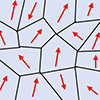
- Multi-ion substitution, including samarium doping, created strongly polarizable nanodomains that produce slim polarization-electric field loops with ultrahigh maximum polarization and very low remnant polarization.
- Refined grain size of approximately 0.28 μm and dense microstructure enhance breakdown strength while suppressing leakage current.
|
|
Dielectric ceramic capacitors are essential in pulse-power systems and modern electronics because they deliver ultrahigh power density and rapid charge-discharge rates. However, most reported ceramic compositions achieve either high recoverable energy storage density (Wrec) or high efficiency (η) at moderate electric fields, but not both simultaneously. That trade-off has limited the use of lead-free ceramics in automotive electronics, renewable energy systems, and pulsed power platforms.
|
|
“The key innovation lies in the formation of strongly polarizable nanodomains,” said Prof. Pu Mao, the corresponding author. “Through deliberate multi-ion substitution – including Sm3+ doping-and precise regulation of the rhombohedral (R) to tetragonal (T) phase ratio, we enhanced random fields and weakened interdomain interactions. This disrupts long-range ferroelectric order, reduces polarization anisotropy, and significantly lowers the energy barrier for polarization rotation near structural boundaries.”
|
|
In practical terms, the substitution strategy converts large ferroelectric domains into nanoscale polar regions. These nanodomains retain the matrix’s intrinsic high polarity but respond more freely to applied electric fields, producing slim polarization-electric field (P-E) loops. The optimized composition, designated 0.98(BNSB)0.985S0.01T-0.02CMN, reaches an ultrahigh maximum polarization (Pmax) of 65.8 μC/cm² while keeping remnant polarization (Pr) at just 5.34 μC/cm². The large gap between those two values is what drives the high recoverable energy density.
|
|
Microstructural factors also contribute. The optimized ceramic has a refined grain size of approximately 0.28 μm and a dense, uniform structure. Smaller grains distribute the applied voltage more evenly, raising the breakdown strength. The dense microstructure suppresses leakage current, which in turn supports the high efficiency.
|
|
“Notably, while many previously reported systems achieve either high Wrec or high η, they often compromise the other parameter. Our optimized composition uniquely achieves both high Wrec and high η, representing a significant advancement in comprehensive energy storage performance,” added Prof. Tianyu Li, co-corresponding author.
|
|
The performance figures surpass the vast majority of reported bulk dielectric ceramics tested under comparable electric fields. Achieving these results at 330 kV/cm rather than at extreme field strengths is significant because moderate operating fields reduce the risk of dielectric failure and are more compatible with real-world device architectures.
|
|
“Our work demonstrates that engineering strongly polarizable nanodomains is a viable pathway to break the traditional trade-off between polarization and breakdown strength in lead-free dielectrics,” said Prof. Pu Mao. “The achieved energy density and efficiency under moderate electric fields bring BNT-based ceramics a significant step closer to practical capacitor applications.”
|
|
By resolving the tension between energy density and efficiency without relying on extreme electric fields or lead-containing compositions, this nanodomain engineering approach offers a concrete design route for ceramic capacitors in automotive power electronics, renewable energy conversion, and pulsed-power systems.
|