| Mar 06, 2026 |
Researchers developed ceramic membranes with near-defect-free surfaces that filter dyes from wastewater at tap-water pressure, cutting energy use in water treatment.
(Nanowerk News) Researchers in South Korea have developed a ceramic membrane manufacturing process that eliminates surface defects and operates efficiently at pressures as low as tap water, addressing two persistent barriers in advanced water treatment technology.
|
|
Dr. Hong-Ju Lee and Dr. In-Hyuk Song of the Nano Materials Research Division at the Korea Institute of Materials Science (KIMS) created a dual innovation: a fabrication method that achieves nanoscale surface smoothing and a zirconia-based membrane material that performs precise contaminant separation without the high operating pressures conventional systems demand. The findings were published in Journal of Membrane Science (“Controlling substrate surface roughness via co-sintering of MF/UF-range sublayers ceramic membranes for high-integrity mesoporous top-layer coatings”).
|
Key Findings
- A mutual doping and co-sintering process reduced sintering temperatures from approximately 1,300°C to 1,000°C while cutting surface roughness by more than half, from 24.49 nm to 11.74 nm, producing a near-defect-free ceramic substrate.
- A zirconia-based loose nanofiltration membrane removed more than 99.8% of dyes from wastewater while allowing salt ions to pass through, operating at just 2 bar of pressure rather than the 10 bar typically required.
- The combined approach shifts water treatment capabilities from simple contaminant removal toward selective resource recovery, with applications ranging from textile wastewater to semiconductor-grade ultrapure water production.
|
|
Ceramic membranes offer superior chemical and thermal stability compared to polymer alternatives, making them essential for water treatment in harsh industrial environments. Their filtration precision depends on two factors: how accurately pore size can be controlled and how smooth the supporting substrate surface is.
|
|
Conventional fabrication requires repeated cycles of coating multiple membrane layers onto a substrate and firing each at high temperatures, a sequence that consumes substantial energy and introduces surface roughness. That roughness frequently causes microcracks in the thin upper separation layer, degrading filtration performance.
|
 |
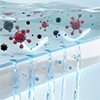
| Development of an ultra-flat, defect-free nanofiltration membrane fabrication technology that eliminates surface roughness and cracks. (Image: KIMS)
|
|
The KIMS team tackled this problem by developing what they call mutual doping, a technique that mixes particles from adjacent membrane layers to strengthen the bonds between them. They paired this with a co-sintering process that fires all layers in a single step rather than sequentially. The combined approach lowered the required sintering temperature by roughly 300°C while actually improving the density and structural integrity of the finished membrane. Surface roughness dropped from 24.49 nm to 11.74 nm, producing an ultra-flat substrate that fundamentally suppresses the crack formation that plagues conventional multi-step fabrication.
|
|
Building on this smooth foundation, the researchers applied an eco-friendly aqueous zirconia sol to create a loose nanofiltration membrane with dual separation mechanisms. Fine pores provide size-exclusion filtering, while the surface chemistry of the zirconia layer generates electrostatic repulsion that further blocks target contaminants. The result is a membrane that strips more than 99.8% of dyes from industrial wastewater at a pressure of just 2 bar, roughly equivalent to domestic tap water pressure, compared to the approximately 10 bar that conventional nanofiltration membranes require.
|
|
Critically, the membrane allows monovalent salt ions to pass through while rejecting larger dye molecules. This selective permeability addresses a limitation that has long constrained commercial membranes: the inability to efficiently separate ions from dyes. Rather than simply removing all dissolved substances, the technology enables recovery of valuable resources from waste streams, a capability with direct relevance to industries such as textile manufacturing where dye-laden wastewater represents both an environmental liability and a potential source of reusable materials.
|
|
The high water permeability of the membrane also translates to improved processing throughput, while the inherent chemical resistance of ceramic materials and strong flux recovery after cleaning extend operational lifetime and reduce long-term costs.
|
|
“The significance of this work lies in securing both low-pressure-operable material technology and a manufacturing process capable of implementing it without defects,” said Dr. Hong-Ju Lee, Senior Researcher and principal investigator at KIMS. He added, “We will continue our efforts not only to localize high-value ceramic membranes that have been entirely import-dependent, but also to advance this technology toward leading the global market in the future.”
|
|
The research received funding from the Nano and Materials Technology Development Program of the National Research Foundation of Korea under the Ministry of Science and ICT, and from the Materials and Components Technology Development Program of the Korea Institute for Advancement of Technology under the Ministry of Trade, Industry and Energy.
|
|
The team is now conducting scale-up studies for large-area membrane fabrication and mass production. Domestic and international patent filings for the core technologies have been completed, and the researchers plan to validate industrial applicability through pilot-scale demonstrations before pursuing technology transfer to manufacturers.
|
|
The developed technology targets applications that demand highly precise water purification, including treatment of dyeing wastewater in the textile sector and production of ultrapure water for semiconductor manufacturing. Its low-pressure operation could substantially reduce energy consumption and carbon emissions at large-scale treatment facilities. By establishing domestic capability in the high-value ceramic membrane market, an area historically dominated by a small number of international suppliers, the work also positions South Korea to reduce import dependence and respond to tightening global environmental regulations.
|