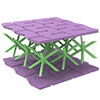
A 4D-printed structure pairs origami panels with a lattice core to fold flat for storage and bear heavy loads once deployed.
(Nanowerk Spotlight) When the James Webb Space Telescope launched in December 2021, its five-layer sunshield, roughly the size of a tennis court when deployed, had to fit inside a rocket fairing barely five meters wide. Engineers achieved this through a precise folding pattern that packed thin membrane layers tightly without tangling or damage.
Combining 3D printing with stimuli-responsive materials such as shape memory polymers has pushed the field further. This technique, known as 4D printing, produces origami structures that fold and unfold on their own in response to heat, light, or moisture. Self-folding robotic grippers, crawling robots, and deployable reflector antennas have all come out of this approach.
Yet a limitation remains. Materials compliant enough to fold along crease lines lack the stiffness to carry meaningful loads once deployed. Thick-panel origami, spring-assisted hinges, and multi-component modular assemblies add stiffness but also add fabrication complexity, part count, and weight. Existing approaches have struggled to combine high foldability and high load-bearing capacity in a single monolithically fabricated structure.
A study published in Advanced Functional Materials (“4D‐Printed “Ori‐Lattice” With Ultrahigh Foldability and Load‐Bearing Capacity”) addresses this gap with a design called the “Ori-lattice.” Rather than forcing one material to be both compliant and stiff, the design separates the two functions. Two origami-patterned face panels handle folding kinematics, while a cellular lattice core sandwiched between them provides structural support.
Schematic illustration of the Ori-lattice and its potential applications. The Ori-lattice consists of a central lattice core sandwiched between two origami-folded panels. The concept is tailored for deployable components within a CubeSat. While the launch vehicle ascends, the Ori-lattice remains tightly stowed, keeping the spacecraft at its minimum envelope. Upon orbital insertion, the Ori-lattice autonomously unfolds, expanding the CubeSat to its operational dimensions and transforming its panels into a stiff exoskeleton that supplies both load paths and geometric stability. (Image: Reproduced with permission from Wiley-VCH Verlag)
The researchers fabricated the entire assembly as a monolithic unit using 4D printing, eliminating hinges, fasteners, and post-fabrication assembly.
A shape memory polymer drives the transformation cycle. At room temperature, the material is rigid enough to bear loads. Heating it to 87 °C softens it, allowing the structure to fold into a compact state. Cooling locks in the folded shape. Reheating triggers autonomous recovery to the original geometry, with a shape recovery rate above 99%.
The design also required solving a geometric puzzle: preventing the origami panels and lattice core from colliding during folding. The researchers derived parametric relationships governing how strut dimensions, panel thickness, crease width, and folding angles interact. These relationships map out a valid design space where folding proceeds without self-intersection.
The team demonstrated four Ori-lattice configurations, each built from a different origami pattern: Miura-ori, water bomb, parallel crease, and a kirigami-inspired design. Each starts as a flat printed structure, folds into a compact state, and autonomously deploys when heated. The parallel-crease variant achieved a volumetric deployment ratio of 5:1. The Miura and water bomb configurations reached 4:1.
The lattice core does not obstruct folding. Its geometry channels it into the interstitial spaces that open as the panels fold, preventing buckling and preserving structural integrity throughout the shape change cycle. Finite element simulations of folding and recovery matched the physical prototypes across all configurations.
With the folding behavior validated, the next question was whether the deployed structures could actually bear loads. In compression tests, a Miura-pattern Ori-lattice weighing about 3 g supported loads up to 18 kg. The parallel-crease variant supported up to 50 kg with minimal deformation. Both matched the compressive stiffness of conventional, non-foldable sandwich panels of equivalent mass and material. The origami creases did not substantially weaken the structure.
Three-point bending tests revealed a failure mode unique to the origami architecture: a sudden force drop from localized fracture along predefined crease lines. Bending stiffness before this crease failure remained comparable to conventional panels, and the structure retained significant capacity afterward. Ultimate failure came from local buckling of the lattice core beneath the loading point, confirming that the lattice governs overall structural stability.
An Ashby-style analysis comparing specific elastic modulus against deployment ratio placed the Ori-lattice in a performance region no existing structural class occupies. Thin origami structures achieve high deployment ratios but low stiffness. Thick origami and modular assemblies offer better stiffness but limited deployability. The Ori-lattice combines both in a single manufacturable system.
The researchers envision applications in deployable satellite components such as CubeSat solar arrays, where structures must survive launch vibrations while compact and then autonomously expand into stiff, load-bearing configurations in orbit. Because the design framework is material-independent, it could extend to hydrogel composites for deep-sea monitoring actuated by water pressure or magneto-active elastomers for adaptive vibration isolation. The result is a printable architecture that, for deployable structures, no longer forces a choice between compactness and strength.
For authors and communications departmentsclick to open
Lay summary
Prefilled posts
ORCID information
Zeang Zhao (Beijing Institute of Technology)
, 0009-0008-7171-6942 corresponding author, first author
Nanowerk Newsletter
Get our Nanotechnology Spotlight updates to your inbox!
Thank you!
You have successfully joined our subscriber list.
Become a Spotlight guest author! Join our large and growing group of guest contributors. Have you just published a scientific paper or have other exciting developments to share with the nanotechnology community? Here is how to publish on nanowerk.com.