| Jun 06, 2026 |
Simulations show a compact orbital instrument could chart lunar elements in 1�2 years, offering new insight into the Moon’s evolution.
|
|
(Nanowerk News) Researchers from Tokyo Metropolitan University have used simulations to show that a newly developed, compact X-ray telescope could be used to map the chemical composition of the entire Moon surface, a vital breakthrough for understanding its geological evolution (Earth, Planets and Space, “Numerical simulation of light-element geochemistry of the lunar surface using a compact and lightweight XRF imaging spectrometer”).
|
|
Detailed modeling of the detector and a realistic satellite mission show that two years would be enough to map five key elements, while an array of five-by-five detectors could improve resolution and get results faster.
|
|
The geological evolution of the Moon remains a mystery to scientists. This reflects how challenging it is to get accurate information, for example, a complete map of the geochemistry of the lunar surface. Since we cannot readily go and collect samples from anywhere, scientists use a technology known as X-ray fluorescence imaging, where detectors directed at the Moon are used to pick up X-rays released by specific elements when they are hit by solar rays.
|
|
While observations during the Apollo and Chandrayaan missions have successfully yielded partial maps, we are nowhere near a comprehensive map which might illuminate lunar geology. This is due to significant technical challenges, including a lack of sufficient illumination by solar rays during the lifetime of a mission, and degradation of the detector. The illumination issue is particularly pronounced in polar regions, where solar X-rays are much weaker.
|
|
To overcome these challenges, a team led by Airi Toida and Prof. Yuichiro Ezoe at Tokyo Metropolitan University proposes the use of a compact X-ray telescope which could be mounted on a satellite mission around the Moon. A telescope would enable wide area observation of the lunar surface during powerful solar flares.
|
|
While conventional X-ray telescopes are prohibitively heavy and large, the teamâs newly designed compact unit, intended for observations of the Earthâs magnetosphere, weighs in at less than ten kilograms and might be easily deployed as part of long-term satellite observation.
|
 |
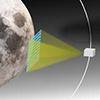
| X-ray Fluorescence Imaging of the Moon. The teamâs new compact and lightweight imaging unit can be installed on a long-term satellite mission. Their simulations show that a comprehensive map of the entire surface might be produced in a few years. (Image: Tokyo Metropolitan University)
|
|
The detector has also been tested under significantly more severe radiation environments than lunar orbit, realizing robust, wide-area, high resolution imaging of the lunar surface over extended mission durations.
|
|
Now, the team have incorporated the specifications of their X-ray telescope into a numerical simulation to see whether a satellite mission might successfully map the lunar surface. Assuming 300 solar flares per year and a single telescope on a satellite mission orbiting the Moon, they found that they could map the whole lunar surface for five elements (oxygen, iron, magnesium, aluminum, silicon) over two years with a grid size of 70 x 70 kilometers. Their telescope unit is so compact that it is feasible to have a five-by-five array of them on a single satellite.
|
|
The teamâs simulations also revealed that this 25-telescope system might reduce the mission time down to a year, with a map of sodium as well with two years, both with a grid size of 30 x 30 kilometers.
|
|
If either is realized, it would be the first complete map of elemental abundance over the whole surface of the Moon, a revolutionary step forward for understanding lunar geology.
|