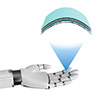
A flexible electronic skin inspired by shark electroreception lets robotic hands identify object shapes and materials through both non-contact electrostatic scanning and touch-based sensing.
(Nanowerk Spotlight) Sharks possess a sensory ability that most animals lack: they detect faint electric fields produced by the muscle contractions of nearby prey. Gel-filled pores clustered around the snout, called the ampullae of Lorenzini, register distortions in the surrounding electric field, allowing a shark to locate a flatfish buried under sand without seeing or touching it.
This biological electroreception has drawn attention from robotics researchers because most robotic systems still depend on direct physical contact to gather information about their surroundings. Tactile sensors measure pressure, texture, and temperature effectively, but they require the robot to touch an object first.
Alternative non-contact approaches, including ultrasonic ranging, geomagnetic detection, and humidity-gradient sensing, each carry practical drawbacks: vulnerability to acoustic noise, susceptibility to electromagnetic interference, or sensitivity to airflow and temperature fluctuations, respectively.
Electrostatic-field sensing avoids many of these problems because electric fields propagate stably through air and respond consistently regardless of an object’s optical, acoustic, or magnetic properties. The obstacle has been that the intrinsic electric fields generated by existing sensor designs attenuate rapidly with distance, confining reliable detection to just a few centimeters.
Mounted on a robotic hand and paired with a machine-learning classifier, the system identified object shapes with 100% accuracy and distinguished between seven everyday materials with 97.35% accuracy.
(a) Schematic illustration of electroreceptors in sharks, (b) Structure of e-skin equipped on the robotic hand. (c) A robotic hand equipped with an e-skin. (d) A multifunctional robotic hand exhibiting human-like visual and tactile capabilities. (e) Signals of non-contact sensing and contact sensing. (f) Preparation process of e-skin. (g) Stress–strain curve of e-skin under uniaxial tensile test. (h) Surficial potential variation of e-skin. (Image: Reproduced with permission from Wiley-VCH Verlag) (click on image to enlarge)
The e-skin has three functional layers. At its core sits a thin membrane of expanded polytetrafluoroethylene (ePTFE), a porous fluoropolymer loaded with negative surface charges through corona charging, a process in which a high-voltage electrode deposits ions onto the material’s surface. This charged membrane is embedded within Ecoflex, a highly stretchable silicone elastomer that serves as both structural matrix and protective shell. On the outer surface, a network of silver nanowires acts as the sensing electrode, with a sheet resistance of 12.34 Ω sq⁻¹, low enough to conduct signals efficiently while remaining mechanically flexible.
The full composite stretches to 450% strain without breaking. The Ecoflex encapsulation also shields the ePTFE’s stored charges from environmental degradation: after one month of storage, the surface potential held at approximately 0.6 of its initial value. Immersion tests showed the encapsulated electret retained stable charges through three water-exposure cycles, while an unprotected ePTFE film lost nearly all its charge after a single immersion.
Non-contact sensing works through electrostatic interaction between the charged ePTFE layer and the surface charges that everyday objects naturally acquire through friction, contact, or ambient exposure. When a charged object approaches, the combined electric fields shift the potential at the silver nanowire electrode. When the object retreats, the potential returns to baseline.
A theoretical model derived from Gauss’s theorem and Kirchhoff’s laws predicts that this potential shift is proportional to the sum of the charge densities on both the object and the ePTFE layer. This proportionality is the central design lever: by increasing the charge stored in the embedded electret, the research team amplified the sensing signal well beyond what passive or triboelectric-only sensors produce.
An e-skin without the charged ePTFE generated potential shifts below 10 V when a hand approached and withdrew. With an ePTFE layer polarized to −2000 V, shifts reached approximately 80 V under identical conditions.
The model also reveals a fundamental constraint. The proportional relationship holds only when sensor and object approximate infinite parallel plates with uniform fields between them. At distances comparable to the physical dimensions of the sensor, edge effects dominate and the field becomes non-uniform.
A modified expression accounting for finite-size effects shows that the potential shift scales inversely with the cube of the separation distance, explaining the steep sensitivity loss at range.
Two strategies proved effective at extending detection range. Increasing surface charge density by polarizing ePTFE to potentials as high as −8 kV amplified the signal directly. Scaling up the surface area of both sensor and target from 5 × 5 cm to 20 × 20 cm reduced the relative contribution of edge effects.
Applied together at maximum values, these enhancements yielded a measurable signal of approximately 1 V at 24 cm separation, with an initial signal near 400 V at 1 cm. Prior non-contact sensing technologies based on triboelectric, iontronic, or hybrid approaches have generally operated at lower intensities and shorter distances.
Contact sensing relies on a distinct phenomenon: the triboelectric effect, in which charge transfers between two surfaces when they touch and separate. The direction and magnitude of this transfer depend on where each material falls in the triboelectric series, a ranking of substances by their tendency to gain or lose electrons. The resulting voltage signals carry characteristic peak and valley profiles that vary by material.
The study tested seven substances: aluminum, copper, polyimide, nylon, acrylic, paper, and human skin. Because signal amplitude also depends on contact force, the robotic hand applied pressure within a controlled, narrow range to isolate material-specific patterns. The researchers treated environmental humidity as quasi-static given the short time windows involved in each recognition cycle.
Both sensing modes feed data into a long short-term memory (LSTM) neural network, an architecture designed to capture sequential dependencies in time-ordered data. For shape recognition, the robotic hand scanned five geometric forms, including a cube, triangular prism, and semicylinder, in non-contact mode. The raw waveforms were transformed into the frequency domain via Fourier analysis, and five spectral features served as classifier inputs. The LSTM classified all five shapes without error.
For material identification using triboelectric contact signals, the LSTM achieved 97.35% accuracy across seven materials. Convolutional neural networks and support vector machines applied to the same tasks scored somewhat lower, likely because they lack the LSTM’s built-in sensitivity to temporal sequence, where the order and timing of signal features carry information that other architectures may underweight.
In a combined demonstration, the robotic hand performed both tasks in sequence on composite test objects, including a semicylindrical acrylic sample, a cubic aluminum block, and trapezoidal copper and aluminum pieces. The system correctly identified both the shape and material of each object.
The dual-mode design replicates a perceptual sequence that humans perform routinely: assessing an object’s geometry from a distance before refining that picture through physical contact. Because the electret’s charge density is an adjustable parameter rather than a fixed property, detection range can be extended further as polarization techniques and electret materials improve.
The researchers point to automation, healthcare, and human-robot interaction as fields where robotic hands capable of both remote scanning and tactile identification could reduce reliance on vision systems and enable safer, more adaptive manipulation of unfamiliar objects.
For authors and communications departmentsclick to open
Lay summary
Prefilled posts
Nanowerk Newsletter
Get our Nanotechnology Spotlight updates to your inbox!
Thank you!
You have successfully joined our subscriber list.
Become a Spotlight guest author! Join our large and growing group of guest contributors. Have you just published a scientific paper or have other exciting developments to share with the nanotechnology community? Here is how to publish on nanowerk.com.