| Apr 15, 2026 |
Fluoride-doped perovskite nanocrystal glass achieves record blue quantum yield and powers single-laser multicolor holographic displays at 20,000 PPI resolution.
(Nanowerk News) Researchers have developed a fluoride-based strategy to embed perovskite nanocrystals in glass, producing a material that emits tunable full-spectrum light with high efficiency and enables multicolor holographic displays driven by a single laser wavelength.
|
|
The work, led by Professor Dezhi Tan at Zhejiang University in China, addresses persistent challenges in display technology by combining stable luminescent materials with advanced holographic techniques to reach pixel densities of approximately 20,000 pixels per inch (PPI) (Opto-Electronic Advances, “Perovskite nanocrystals in glass for high efficiency and ultra-high resolution dynamic holographic multicolor display”).
|
Key Findings
- Fluoride doping loosens the glass network structure, improving in-situ crystallization of perovskite nanocrystals and boosting photoluminescence quantum yield across the full visible spectrum.
- The blue-emitting glass composite achieved a quantum yield of 36%, the highest reported value for this class of material, addressing a critical gap in multicolor display systems.
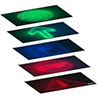
- A vertically stacked RGB glass architecture eliminates conventional color filter losses and raises full-color resolution to levels approaching monochrome displays.
|
|
Modern displays must balance two competing demands. High luminance ensures visibility in bright environments, while high efficiency keeps power consumption, heat output, and battery drain in check. Meeting both targets simultaneously, across the full color gamut, has remained a materials-level bottleneck.
|
|
Existing approaches each carry trade-offs. Liquid crystal displays depend on backlights that consume substantial power and limit contrast. Quantum dot LEDs face difficulties with manufacturing cost and high-resolution patterning. Dynamic holographic displays typically require multiple lasers at different wavelengths, or arrays of spatial light modulators, adding complexity and cost.
|
|
A simpler alternative is to use a single excitation beam to stimulate a luminescent material capable of emitting red, green, and blue light through photoluminescence. All-inorganic cesium lead halide perovskite nanocrystals (CsPbX3, where X is chlorine, bromine, or iodine) are strong candidates for this role. They offer high luminescence efficiency, broadly tunable emission wavelengths, and narrow spectral bandwidths.
|
|
Their major weakness is poor environmental stability. Encapsulating the nanocrystals within an inorganic glass matrix protects them from degradation, but achieving both high luminance and high quantum efficiency in such composites has been difficult because of strong self-absorption effects.
|
|
The team’s solution introduces sodium fluoride (NaF) into the glass composition. Fluorine atoms break apart the tightly cross-linked three-dimensional glass framework, loosening the network and lowering the glass transition temperature. This structural relaxation creates more favorable conditions for perovskite nanocrystals to nucleate and grow in situ within the glass. The result is a family of glass composites whose emission wavelength can be continuously tuned from approximately 459 nm in the blue to 663 nm in the red.
|
 |
| A fluoride-assisted strategy enhances CsPbX₃ perovskite nanocrystals embedded in glass, enabling stable, high-efficiency full-spectrum emission, including improved blue output. Integrated with spatial light modulation and holography, the system achieves single-wavelength-driven multicolor displays with ~20,000 PPI. A vertically stacked RGB architecture further boosts light utilization and resolution, offering a scalable pathway for next-generation, energy-efficient display technologies. (Image: Professor Dezhi Tan from Zhejiang University)
|
|
Quantum yield measurements confirmed strong performance across the primary colors needed for display applications. The red-emitting sample (648 nm) reached a photoluminescence quantum yield (PLQY) of 72.4%, and the green emitter (510 nm) achieved 78.3%. The blue emitter (479 nm) recorded 36.0%.
|
|
The blue figure is particularly significant because efficient pure-blue emission has been the most stubborn obstacle in perovskite-based multicolor systems. The 36% value represents the highest PLQY reported to date for blue-emitting perovskite nanocrystal glass.
|
|
To translate these material properties into a working display, the researchers paired the luminescent glass with a spatial light modulator and computer-generated holography. A single 405 nm laser served as the sole excitation source, and the system produced dynamic multicolor holographic images at a pixel density of approximately 20,000 PPI.
|
|
The team then extended the concept to a vertically stacked full-color architecture. In this design, red-, green-, and blue-emitting glass layers are arranged on top of one another rather than side by side. By adjusting the laser’s focal depth and phase pattern, individual color layers can be selectively excited.
|
|
This vertical arrangement eliminates the light losses that conventional color filters introduce, because the material itself performs the color conversion. It also removes the spatial penalty of arranging RGB sub-pixels in a planar mosaic, where each color occupies only one-third of the display area. With vertical stacking, each pixel position can produce any color, so full-color resolution approaches that of a single-color display.
|
|
By solving the blue-emission efficiency problem and demonstrating a scalable stacked architecture, the work establishes a practical materials platform for single-laser, full-color holographic displays that combine high luminance, high efficiency, and ultra-high resolution in a single system.
|