New nitride materials could let electricity control hidden magnetic spin patterns, pointing toward faster and more stable future electronics.
(Nanowerk Spotlight) A material used to store information must satisfy a demanding bargain. It has to keep its state when the power is off, resist noise from its surroundings, and still change when a device sends the right signal. Magnetism helps with the first two requirements. Electric fields are better suited for the third. The difficult part is finding one material in which magnetic stability and electrical control do not work against each other.
That problem sits near the center of spintronics, a field that uses electron spin as well as electric charge. Antiferromagnets offer one appealing path because neighboring atomic spins point in opposite directions, canceling the net magnetization. This makes them less sensitive to stray magnetic fields and potentially faster than conventional magnetic materials. It also creates a practical obstacle, since a magnetic state with no net magnetization can be hard to read and control.
A newer class called altermagnets has sharpened that opportunity. These materials remain antiferromagnetic overall, but their electronic bands can still split according to spin. That gives researchers a spin-dependent signal without the stray fields of ordinary magnets, a combination highlighted in Nanowerk’s coverage of how altermagnetism was experimentally demonstrated. The remaining challenge is whether such spin behavior can be switched cleanly by an electric field.
A study in Advanced Functional Materials (“Ferroelectricity in Antiferromagnetic Wurtzite Nitrides”) addresses that challenge in wurtzite-type nitrides, a family of compounds related to technologically important nitride semiconductors.
Wurtzite structures lack a center of symmetry, so their atoms naturally define a polar direction. In some cases, an electric field can reverse that direction, making the material ferroelectric. The paper’s authors ask whether that switchable polarity can coexist with antiferromagnetism and altermagnetic spin splitting.
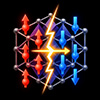
Switching the electric polarization in MnSiN₂ and MnGeN₂ reverses the calculated altermagnetic spin splitting, suggesting a route to electric control of hidden spin patterns in nitride magnets. (Image: Reproduced from DOI:10.1002/adfm.202525545, CC BY)
The calculations identify MnSiN₂ and MnGeN₂ as parent members of a new multiferroic nitride design space. Both materials place magnetic Mn²⁺ ions inside a polar tetrahedral nitride framework. Their spins form G-type antiferromagnetic order, meaning each manganese spin points opposite to its nearest neighbors. Their reported Néel temperatures, 453 K for MnSiN₂ and 448 K for MnGeN₂, place that magnetic order well above room temperature.
The same structures also carry electric polarization, but useful ferroelectricity requires more than polarity. The material must switch between opposite polarization states without leaking too much current or requiring an impractically large field. That introduces a trade-off. Wide-bandgap nitrides such as ZnSiN₂ and MgSiN₂ look attractive for ferroelectric switching, with experimental bandgaps near 4.0 and 4.8 eV, but they are nonmagnetic.
Manganese solves the magnetism problem while creating new constraints. MnSiN₂ has strong antiferromagnetic exchange, but its calculated polarization reversal barrier reaches 0.963 eV per formula unit, high enough to make switching less favorable. MnGeN₂ has a lower calculated barrier of 0.460 eV per formula unit, but its smaller bandgap weakens its role as an electrically switched insulator. The paper’s core task is to navigate this compromise.
The study does this with first-principles density-functional theory, using calculations to compare electronic structure, magnetic order, and polarization switching pathways. Rather than treating chemistry as a broad search over many unrelated materials, the work modifies the same nitride framework in controlled ways.
The models replace 25% of selected lattice sites with zinc, magnesium, cadmium, titanium, zirconium, or hafnium and then test how each change shifts the balance. The clearest improvement comes from partial replacement of manganese with zinc or magnesium in Si-based compounds. In the calculations, these A-site substitutions lower the ferroelectric reversal barrier relative to pristine MnSiN₂ while preserving G-type antiferromagnetic order in the modeled structures.
Ge-based substitutions offer smaller gains, which makes them less compelling as first experimental targets. The paper therefore points most strongly to Zn- and Mg-substituted MnSiN₂, with related MnGeN₂ compounds as secondary candidates. That recommendation carries an important qualification. The calculations use ordered model structures, while real materials may contain disorder, clustered dopants, defects, or local strain that changes the switching behavior.
The reason lies in how the crystal switches. Simple wurtzite materials are often discussed as if their polarization reverses through a uniform motion. These more complex nitrides behave differently. Their metal-nitrogen columns switch sequentially, one part of the structure after another. The hardest steps usually involve silicon or germanium, the more electronegative framework cations, while several later steps become nearly barrierless after the pathway begins.
This atom-by-atom view explains why chemical substitution helps but does not obey a simple rule. Replacing manganese with zinc or magnesium can introduce distortions that reduce the difficult parts of the switching pathway in Si-based materials. Replacing silicon or germanium with titanium, zirconium, or hafnium produces more mixed results. Defect interactions change the order of atomic motion, so lower electronegativity alone does not guarantee easier switching.
The magnetic calculations add a second design constraint. Strong antiferromagnetic exchange depends on the local Mn-N bonding network, and shorter polar Mn-N bonds generally strengthen that exchange. Replacing manganese with nonmagnetic ions can interrupt the network, but the modeled ordered compounds still keep G-type antiferromagnetic ground states. That result matters because it suggests limited chemical tuning can improve electric switching without erasing the magnetic foundation.
The most distinctive finding involves what happens to altermagnetic spin splitting when polarization switches. In pristine MnSiN₂ and MnGeN₂, the calculations show that reversing the ferroelectric polarization also reverses the sign of nonrelativistic spin splitting. In plain terms, the electric state of the crystal controls the spin-dependent electronic pattern, even though the material has no overall magnetization.
That effect is not the same as strong conventional magnetoelectric coupling. The paper finds limited linear coupling between polarization and magnetic order, and the manganese moments remain largely stable during polarization reversal. The useful connection instead comes from symmetry. In the pristine compounds, the two opposite ferroelectric states relate to opposite altermagnetic spin splittings, offering a direct electric handle on a spintronic property without requiring net magnetization.
Chemical substitution creates a trade-off at this point. Ordered substituted compounds can improve switching barriers or insulating behavior, but their chemical pattern can break the symmetry that lets the spin splitting reverse cleanly with polarization. The design choice therefore depends on the target device function. Pristine MnSiN₂ and MnGeN₂ provide the clearest switchable altermagnetic response, while substituted variants provide a route to more practical ferroelectric switching.
The work remains computational, and experiments will decide how much of this behavior survives in real samples. Thin-film growth, cation disorder, leakage currents, clustering of substituted ions, and actual switching fields could all alter the predicted performance. Still, the study gives a focused map for synthesis. It connects wurtzite nitride chemistry, room-temperature antiferromagnetism, ferroelectric switching, and electrically reversible altermagnetic spin splitting within one materials platform.
For authors and communications departmentsclick to open
Lay summary
Prefilled posts
Nanowerk Newsletter
Get our Nanotechnology Spotlight updates to your inbox!
Thank you!
You have successfully joined our subscriber list.
Become a Spotlight guest author! Join our large and growing group of guest contributors. Have you just published a scientific paper or have other exciting developments to share with the nanotechnology community? Here is how to publish on nanowerk.com.