| Apr 26, 2026 |
A neural-network-based controller adapts in real time to switching reference signals in piezoelectric nano-positioning stages, reducing tracking errors.
(Nanowerk News) Nano-positioning stages driven by piezoelectric actuators suffer from a persistent problem: the ceramic material’s inherent hysteresis distorts motion tracking, and the distortion worsens when the system must follow reference signals that abruptly change waveform or frequency.
|
|
A team from Huazhong University of Science and Technology and the University of Victoria has now developed a controller that uses a neural network to adapt in real time to these switching conditions, substantially reducing tracking errors compared with conventional approaches.
|
|
The work appears in Engineering (“Neural Network-Based Switching Output Regulation Control for High-Speed Nano-Positioning Stages”).
|
Key Findings
- The neural-network-based switching output regulation controller (NN-SORC) reduced tracking errors for both cosinusoidal and triangular reference signals across multiple operating frequencies, outperforming PID control and inverse hysteresis compensation.
- A custom FPGA–CPU dual-layer processing architecture achieves inner-loop computation rates up to 10 MHz, providing the speed needed for real-time adaptive control.
- Mathematical stability guarantees derived from Lyapunov theory were experimentally confirmed on a test bench with 10 μm stroke and 140 Hz bandwidth.
|
|
The core challenge is hysteresis, the tendency of piezoelectric ceramics to respond differently depending on their recent history of deformation. When a controller sends a voltage signal expecting a specific displacement, hysteresis causes the actual motion to lag or overshoot in ways that depend on past inputs. Standard proportional–integral–derivative (PID) controllers and model-based compensation schemes such as the Prandtl–Ishlinskii inverse method can partially correct for this, but they lose effectiveness when the reference signal switches between different waveforms or frequencies mid-operation, a common requirement in scanning, lithography, and precision inspection tasks.
|
|
The NN-SORC addresses this by first applying feedback linearization to convert the nonlinear hysteresis behavior into a structured tracking error model suited for switched-system analysis. A neural network then continuously adjusts the controller’s parameters based on observed tracking errors, effectively learning to compensate for the hysteresis distortion as operating conditions change. This creates a closed-loop system that does not rely on a fixed hysteresis model and can respond to abrupt reference switches without manual retuning.
|
|
To guarantee that this adaptive process remains stable rather than oscillating or diverging, the researchers turned to Lyapunov stability theory, a mathematical framework for proving that a system’s errors will shrink over time. Combined with a technique called average dwell-time analysis, which quantifies how long the system must remain on each reference signal before switching again, they derived formal conditions ensuring the controller converges reliably. They also extended these guarantees to reference signals with sharp corners or discontinuities in their derivatives, situations where standard smoothness assumptions break down.
|
|
“The work integrates a high-speed hardware platform, adaptive intelligent control, and switched-system stability analysis, offering a practical solution for precision motion control in nano-positioning systems,” the authors noted.
|
|
Running a neural network fast enough to control nano-scale motion required custom hardware. The team built a dual-layer processing architecture pairing a field-programmable gate array (FPGA) for high-speed signal conversion and algorithm execution with a central processing unit (CPU) for parameter tuning and monitoring. The FPGA layer handles inner-loop computations at up to 10 MHz, while the CPU manages the outer loop at 100 kHz.
|
|
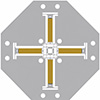
The nano-positioning stage itself uses multiple parallel-bonded thin piezoelectric ceramic layers in a symmetric drive configuration, paired with capacitive displacement sensors and voltage amplifiers. On this platform, with a 10 μm stroke and 140 Hz bandwidth, the researchers tested the NN-SORC against a finely tuned PID controller and the Prandtl–Ishlinskii inverse compensation scheme.
|
|
The NN-SORC consistently produced smaller tracking errors for both frequency-switching cosinusoidal and triangular references across the tested frequency range. Stable tracking was maintained during reference switching whenever the derived dwell-time constraints were satisfied, confirming the theoretical predictions in hardware.
|
|
The study was authored by Hongwei Sun, Ning Xing, Jiayu Zou, Yuqi Rong, Yang Shi, Han Ding, and Hai-Tao Zhang. Next steps include extending the approach to handle coupling effects between axes in multi-axis nano-positioning systems used for micro- and nano-fabrication.
|