| Jun 08, 2026 |
Researchers made nanoporous SiO2 coatings for ultraviolet laser optics, achieving uniform large area films and higher damage resistance.
(Nanowerk News) Researchers led by Jianda Shao and Meiping Zhu at the Shanghai Institute of Optics and Fine Mechanics, Chinese Academy of Sciences, have developed nanoporous SiO2 coatings for ultraviolet optics used in high power laser systems. Reported in Light: Advanced Manufacturing (“Advanced nanoporous SiO2 coatings for ultraviolet laser-resistant high-reflection and anti-reflection optics”), the work targets a manufacturing problem in large aperture laser optics for applications including inertial confinement fusion.
|
Key Findings
- The team made porous SiO2 by chemically removing Al2O3 from an Al2O3 SiO2 mixture coating.
- The method produced uniform porous SiO2 monolayers on fused silica substrates measuring 200 mm × 120 mm × 30 mm.
- An all SiO2 anti reflection coating reached a laser induced damage threshold of 46.9 J/cm2 at 355 nm, above the 41.1 J/cm2 measured for the fused silica substrate.
|
|
High power ultraviolet laser systems place severe demands on optical coatings. In inertial confinement fusion, optical components must withstand repeated exposure to intense laser pulses while maintaining low absorption and stable optical performance. The Chinese Academy of Sciences team focused on silicon dioxide, or SiO2, because its wide bandgap makes it suitable for coatings with high resistance to laser induced damage.
|
|
The material design uses dense SiO2 as the high refractive index layer and porous SiO2 as the low refractive index layer. This all silica approach avoids combining multiple oxide materials in the final optical stack and is intended to increase the laser induced damage threshold, the energy level at which laser exposure begins to damage a coating.
|
|
Conventional methods for making porous coatings have limited use in large ultraviolet optics. Sol gel processing and glancing angle deposition can produce porous structures, but the source report identifies two persistent problems: severe cracking in multilayer coatings and poor uniformity on large aperture substrates. Both issues are critical for large scale laser systems, where coating defects can reduce optical performance or trigger laser damage.
|
|
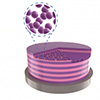
The new process starts with plasma assisted electron beam co evaporation, which deposits a mixed Al2O3 SiO2 coating. The coating is then exposed to an acid solution that selectively removes Al2O3. After this chemical etching step, the remaining material forms a porous SiO2 structure. The researchers improved the etching efficiency by adjusting both the Al2O3 SiO2 mixing ratio and the etching solution.
|
|
Using this selective etching method, the team fabricated porous SiO2 monolayer coatings on large fused silica substrates measuring 200 mm × 120 mm × 30 mm. The refractive index and thickness varied by less than ±1% across the coated optics. The source report presents these uniformity results as evidence that the method can be applied to large size optical components.
|
 |
| Schematic of the chemical etching process for porous SiO2 materials. (Image: Reproduced from DOI:10.37188/lam.2026.041, CC BY)
|
|
The researchers also designed and fabricated all SiO2 high reflection and anti reflection coatings based on the porous material. At a wavelength of 355 nm, both coating types showed absorption levels comparable to fused silica, at about 10 parts per million. The figure materials in the source describe the chemical etching process, uniformity results for large size optics, and high reflection and anti reflection coatings made with porous SiO2.
|
|
The anti reflection coating showed the strongest damage resistance result reported in the release. Its laser induced damage threshold reached 46.9 J/cm2, compared with 41.1 J/cm2 for the fused silica substrate. That comparison indicates that the coating did not reduce the substrate’s resistance to ultraviolet laser exposure and, under the reported test conditions, exceeded it.
|
|
The work presents a route for fabricating large scale multilayer ultraviolet laser coatings using dense and nanoporous SiO2. By combining plasma assisted electron beam co evaporation with selective chemical etching, the method addresses cracking and coating uniformity limits that have constrained other porous coating approaches for high power laser optics.
|