| Apr 29, 2026 |
Researchers developed a nano-tin interlayer that stabilizes solid-state battery interfaces, achieving 350 Wh/kg energy density and 81% capacity retention over 500 cycles.
(Nanowerk News) A research team at the Korea Electrotechnology Research Institute (KERI) has eliminated a key barrier to commercializing all-solid-state batteries by developing a nano-tin interlayer that stabilizes the troubled contact zone between lithium metal anodes and solid electrolytes.
|
|
The technology, published as the front cover article in Advanced Energy Materials (“Interface Stabilization via In Situ Lithiated Sn Interlayer in All‐Solid‐State Li‐Metal Batteries: Toward Pellet‐Type Cell to Pouch‐Type Cell”), produced cells exceeding 350 Wh/kg in energy density while maintaining long cycle life at low operating pressure.
|
Key Findings
- A nano-tin interlayer applied by transfer printing reduced interfacial resistance and suppressed lithium dendrite growth without requiring high external pressure.
- Pouch cells retained more than 81% of their capacity after 500 charge-discharge cycles at just 2 MPa of pressure.
- The cells achieved an energy density exceeding 350 Wh/kg, well above the 150–250 Wh/kg range typical of conventional lithium-ion batteries.
|
|
All-solid-state batteries replace the liquid electrolyte in conventional lithium-ion cells with a solid material, largely removing the risk of fire. Substituting the standard graphite anode with lithium metal further boosts energy density. But solid-to-solid contact between the lithium anode and the electrolyte creates interfacial resistance that blocks efficient ion movement. Repeated cycling also causes lithium to sprout branch-like structures called dendrites, which degrade performance and shorten battery life.
|
|
Until now, researchers have attacked these problems by applying external pressure in the tens of megapascals or by using elaborate coating processes. Both carry serious practical drawbacks. Pressurization equipment heavy enough to maintain tens of megapascals can outweigh the battery itself when installed in a vehicle, and complex coatings drive up manufacturing costs while reducing packaging efficiency.
|
|
The KERI team, led by Dr. Nam Ki-Hun at the Battery Materials and Process Research Center, took a different route. They fabricated a thin layer of nano-sized tin powder — a material with strong lithium affinity and high lithium storage capacity — and stamped it onto the lithium metal anode surface using transfer printing. Once in place, the tin layer cushions the lithium metal against physical damage from cycling and simultaneously opens an additional pathway for ion transport, lowering overall cell resistance.
|
 |
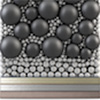
| KERI reduced the growth of lithium dendrites during the charge–discharge of all-solid-state batteries by adopting a nano-tin interlayer. (Image: KERI)
|
|
Tested in a large-area pouch cell, the interlayer performed well under conditions far milder than those typically required. At just 2 MPa of operating pressure, the cells kept more than 81% of their original capacity through 500 full cycles. Energy density exceeded 350 Wh/kg, compared with 150–250 Wh/kg for conventional lithium-ion cells. The results demonstrate that high-performance all-solid-state batteries can function without bulky pressurization hardware or expensive surface treatments.
|
|
A computational study conducted by Dr. Kim Youngoh at KERI’s Next-Generation Battery Research Center complemented the experimental work. Using first-principles simulations, the team traced how tin-based alloys regulate lithium transport and lower interfacial resistance at the atomic and electronic structure levels. The modeling provides design principles that could guide the engineering of future interlayer materials rather than leaving material selection to trial and error.
|
|
“The study is meaningful in that it secures both large-area scalability and interfacial stability, two essential factors for the commercialization of all-solid-state batteries, while also presenting a practical solution,” Dr. Nam Ki-Hun said. “Efforts will continue to further refine the technology for real manufacturing processes so that it can become a key enabler for future industries depending on high-performance batteries, including electric vehicles, humanoid robotics, and energy storage systems (ESS).”
|
|
Co-corresponding author and project leader Dr. Ha Yoon-Cheol framed the work in a broader competitive context. “All-solid-state batteries are central to the global race for battery leadership. This study result represents a meaningful progress toward technological independence and securing a competitive advantage. It will contribute significantly to strengthening the strategic technological capabilities of Korea going forward.”
|
|
Kim Garam, a master’s student at the University of Science and Technology (UST), and Im So-Jeong, enrolled in a joint KERI–Changwon National University program, are listed as co-first authors. A domestic patent application covering the technology has been filed. The paper appeared in Advanced Energy Materials (impact factor 26.0), a journal ranked in the top 2.7% of the energy and materials science field.
|