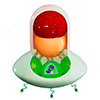
DNA base pairing snaps magnetic Janus nanoparticles and enzyme-loaded polymersomes into modular nanorobots that can be steered, tracked, and magnetically recovered for repeated catalytic cycles.
(Nanowerk Spotlight) Living cells coordinate thousands of molecular machines within a single micrometer-scale compartment. Separate systems handle transport, energy conversion, and catalysis, each optimized for its task. Synthetic nanorobots have not come close to this integration. Most perform a single function: they carry a drug, respond to a magnetic field, or catalyze a reaction.
Combining even two capabilities in one nanoscale construct forces incompatible components onto the same surface. Magnetic nanoparticles, for instance, adsorb DNA nonspecifically, blocking the programmable base pairing needed for controlled assembly. Enzymes lose activity when crowded against inorganic surfaces.
The individual building blocks exist and work well on their own: magnetic particles for wireless steering, polymersomes for enzyme protection, DNA for programmable self-assembly. Bringing them together without mutual interference, and then recovering the whole system for reuse, has been the unsolved problem.
A team from the University of Basel, the Max Planck Institute for Medical Research, Heidelberg University, and institutes in Seoul has now demonstrated a solution based on spatial separation. Published in Advanced Functional Materials (“Multiplex Modular Nanorobotic Systems with Catalytic Activity under Magnetic Navigation”), the study describes nanorobots built from two physically distinct modules joined by complementary DNA strands.
The first module is a magnetic Janus nanoparticle, a particle with two chemically different hemispheres. One hemisphere carries iron oxide for magnetic propulsion. The other displays single-stranded DNA. This two-faced geometry keeps the magnetic domain away from the biochemical interface, mitigating the adsorption and interference problems that have limited previous designs. The second module consists of enzyme-loaded polymersomes that snap onto the DNA-bearing hemisphere through complementary base pairing.
The team demonstrated three nanorobot configurations of increasing complexity, from magnetically guided optical tracking through targeted cancer cell killing to catalytic nanorobots that retained enzymatic function across multiple recovery cycles.
Generation of multiplex nanorobot with dual-module architecture. (a) The magnetic propulsion module (MPM) is based on Janus nanoparticles with one lobe exposing magnetic nanoparticles (red) and the second one (orange) functionalized with ssDNA. The extension module (ExtM) with biochemical function consists of several enzyme-loaded polymersomes exposing complementary ssDNA on their surface. A fraction of complementary ssDNA supports the self-organization of the nanorobot by ExtM attachment to MPM, while the rest provides docking capability. Encapsulating enzymes within polymersomes shields them from harsh environments and maintains their catalytic activity, while the magnetic properties of the propulsion module allow efficient recovery and repeated reuse of the modular nanorobots. (b) Schematic illustration of the MPM synthesis. Precursor Janus nanoparticles composed of a poly(tert-butyl acrylate) (PtBA) lobe (depicted in grey) and an azide lobe (orange) are obtained by seeded emulsion polymerization and phase separation. The tert-butyl groups on the PtBA lobe are hydrolyzed to form carboxylic acid groups and generate functionalized Janus nanoparticles. The lobe containing carboxylic acid groups is then amino-decorated by conjugation with NH2-Fe3O4 (red), while the lobe with azide groups is functionalized with DBCO-terminated single-stranded DNA. (c) SEM and high-resolution TEM micrographs of PtBA seed nanoparticles (left), precursor Janus nanoparticles (middle), and MPM (right). Scale bars SEM, 300 nm; scale bar TEM, 100 nm. (Image: Reproduced from DOI:10.1002/adfm.202600079, CC BY) (click on image to enlarge)
Before building complex variants, the team first needed to confirm that the modular construct could survive magnetic manipulation with its cargo intact. A basic nanorobot paired the magnetic module with dye-loaded polymersomes for simultaneous steering and optical tracking. Optimized self-assembly conditions yielded a 92% assembly rate, with each nanorobot typically carrying four polymersomes on its non-magnetic hemisphere.
Under a field gradient of 4.3 T m⁻¹, these nanorobots traveled at a mean velocity of 3.5 µm s⁻¹, faster than bare magnetic Janus particles despite their larger size. The team attributed this to transient clustering under the magnetic field: small groups of nanorobots carried more combined magnetic material, generating a collective pull that overcame increased drag. No fluorescence leaked during movement, confirming that the polymersomes remained sealed.
With structural integrity established, the team turned to therapeutic function. The extension module now carried L-asparaginase, an enzyme that depletes an amino acid certain cancer cells cannot produce. A Cy5 fluorescent dye on the magnetic lobe enabled real-time tracking. Melittin biopores perforated each polymersome membrane, allowing the amino acid substrate to diffuse in and reach the enzyme while keeping the enzyme itself protected inside.
Attaching the enzyme-loaded polymersomes to the magnetic module did not reduce enzymatic activity, confirming that the two modules operated independently. After five hours of incubation with HeLa cells, unhybridized DNA strands on the polymersomes anchored the nanorobots to scavenger receptors on cell membranes.
By 72 hours, cell viability dropped to 16%. Blocking the receptors with an inhibitor prevented both docking and cell death, and individual components tested alone could not match this result.
The most consequential test involved reusable catalysis. The extension module carried alkaline phosphatase instead of asparaginase, demonstrating that swapping enzyme cargo required no redesign of the propulsion module. A disc-shaped magnet pulled the nanorobots to its edge, where they concentrated into ring-shaped assemblies. Adding a fluorogenic substrate produced a radial fluorescence gradient: the strongest enzymatic signal appeared in regions of highest nanorobot density.
After each catalytic cycle, the researchers magnetically immobilized the nanorobots, removed the product, and redispersed them in fresh substrate. The nanorobots retained enzymatic activity across three consecutive cycles with only a minor decrease in reaction rate. The DNA linkage held, the polymersomes stayed sealed, and the enzyme kept working.
The ability to magnetically relocate catalytic activity and then recover the entire system introduces a practical capability absent from existing nanorobot platforms. A magnetically recoverable nanorobot that retains its cargo across multiple rounds changes the economics of nanoscale catalysis and could reduce long-term accumulation of synthetic materials in therapeutic settings.
The modular design also points toward greater functional complexity. The paper notes that different extension modules carrying different cargos could be attached to the same propulsion platform through DNA hybridization, enabling application-specific customization without redesigning the base system. Combined with the demonstrated structural robustness under repeated magnetic manipulation, this architecture establishes a framework for nanorobotic systems that are not only multifunctional but also adaptable and recoverable.
For authors and communications departmentsclick to open
Lay summary
Prefilled posts
Nanowerk Newsletter
Get our Nanotechnology Spotlight updates to your inbox!
Thank you!
You have successfully joined our subscriber list.
Become a Spotlight guest author! Join our large and growing group of guest contributors. Have you just published a scientific paper or have other exciting developments to share with the nanotechnology community? Here is how to publish on nanowerk.com.