| May 05, 2026 |
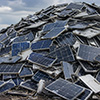
AI and supercomputers show early promise in speeding solar panel recycling by identifying solvents that separate silicon with less contamination.
|
|
(Nanowerk News) Research intended to advance the circular economy of renewable energy is being undertaken at the University of New England (UNE), where researchers have found early promise in using artificial intelligence (AI) to accelerate the recycling of solar panels.
|
|
While up to 95% of a panel’s mass can already be recovered using standard mechanical methods, the most valuable component cannot currently be recycled. These include the silicon wafers that absorb photons from sunlight, releasing electrons and producing electric current.
|
|
To survive at least a quarter of a century in sunlight and weather, the wafers are bonded to their substrate using special compounds that can’t be effectively degraded in a way that allows clean separation of the silicon. Silicon is valued according to its purity.
|
|
The UNE team, part of the University’s Institute for Strategic Artificial Intelligence (ISA), is using AI and powerful supercomputers to assess potential solvents that enable the silicon to be separated from its substrate with minimal contamination.
|
|
The approach represents a fundamental shift in how chemical formulations are discovered.
|
|
Rather than laboriously developing and testing potential compounds in a laboratory – a process that might take years without success – AI-driven quantum chemical simulations can propose potentially useful molecular formulations, evaluate their chemical efficacy, flag new pathways, and then move onto the next computation.
|
|
Only recently, this work would have required traditional trial-and-error laboratory testing. “Now we can use advanced quantum chemical simulations and AI models to predict how these panels can be disassembled at the molecular level,” says UNE computational chemist, Dr Kasimir Gregory. “These technologies are giving an exponential boost to the process of scientific discovery.”
|
|
Another team member, Professor Amir Karton, says the discovery process is being driven through a pairing of an AI platform based at UNE, and a $2.7 million ARC-funded automated robotic laboratory shared by several institutions.
|
|
With this system, Professor Karton reports, “we can efficiently create an effective feedback loop between AI-driven predictions and experimental observations. This allows us to actively steer the experimental discovery of optimal recycling pathways at unprecedented speeds.”
|
|
The research comes at a critical time and aligns closely with recent NSW Government capability commitments to address renewable energy waste. Global photovoltaic energy production is rising steeply. At the start of 2025, the world had installed more than two terawatts of total solar energy generation capacity. By 2030, projections suggest that one terawatt of solar generation capacity will be built per year.
|
|
In Australia alone, the cumulative volume of end-of-life solar panels is expected to reach one million tonnes by 2035. The material value within these panels is projected to exceed $1 billion. Most of the materials can be already recycled, but recovering high-purity silicon will further enhance the value from decommissioned panels.
|
|
The research has attracted attention from major players in the solar energy sector, who recognise that maximizing material recovery is an important element in the long-term sustainability of solar power.
|
|
Renewables developer ACEN Australia is supporting the research by providing panels from its New England Solar project, near Uralla in the NSW Northern Tablelands.
|
|
Managing Director David Pollington said ACEN Australia has a demonstrated commitment to panel recycling – its recently-opened Stubbo Solar project is the first large-scale project to achieve Circular PV Alliance certification – and the UNE research is an important step in further improving the effectiveness and efficiencies of recycling processes.
|
|
“We are also committed to supporting the regions in which we operate, so we’re extra excited that this industry-leading research is happening right here in the New England,” he said.
|
|
For UNE too, a key reason for getting panel recycling right is to support the local economies that host renewables infrastructure.
|
|
“UNE is in the heart of NSW’s largest renewable energy zone (REZ),” Prof. Karton says.
|
|
“It is not practical to ship thousands of tonnes of solar waste across the country for processing. The University has a strategic focus on ensuring the renewables rollout here provides maximum benefit to the region while it benefits the nation.”
|
|
“New technologies are making it possible for us to apply world-class methods to these challenges, not as some distant abstract issue, but in support of an energy revolution that is almost literally taking place in our backyards.”
|