| Apr 17, 2026 |
A 3D cage-like flexible capacitive pressure sensor increases its sensitivity as pressure rises, offering tunable performance for wearable, structural, and environmental monitoring.
(Nanowerk News) Researchers at Zhejiang University have developed a flexible capacitive pressure sensor whose sensitivity increases rather than decreases as pressure builds.
|
|
Published in Microsystems & Nanoengineering (“Tunable flexible capacitive sensor for dynamic pressure monitoring”), the study describes a cage-like three-dimensional architecture fabricated through buckling-guided assembly and laser cutting. The device overcomes a persistent limitation of conventional flexible sensors, which typically perform well only at low pressures and lose responsiveness under heavier loads.
|
Key Findings
- The sensor’s nonlinear electrode geometry produces rising sensitivity under increasing pressure, reaching 3.079 kPa⁻¹ at 0.7 kPa compared to 0.549 kPa⁻¹ at low loads.
- The device maintained stable performance over 6,000 loading cycles with approximately 4% hysteresis and response and recovery times of 131 and 140 ms.
- Wind tunnel tests confirmed reliable wind-speed sensing across different surface curvatures, demonstrating practical readiness for environmental and structural monitoring.
|
|
Most flexible capacitive pressure sensors rely on flat or micropatterned dielectric layers that compress easily under light touch but quickly saturate as pressure increases. That trade-off limits their usefulness in applications such as gait analysis, robotic grasping, wind-load evaluation, and infrastructure diagnostics, where pressure levels fluctuate widely and reliable output across the full range is essential.
|
 |
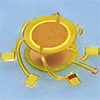
| Schematic of the buckling-guided assembly process. The main panel illustrates the design and sequential assembly steps, while the top right inset shows an optical image of the fabricated device, featuring a cage-like upper electrode and a circular lower electrode on an elastic substrate. Upon release of a 42% biaxial prestrain, the 2D precursor transforms into a 3D configuration. (Image: Adapted from DOI:10.1038/s41378-026-01252-x, CC BY) (click on image to enlarge)
|
|
The team from Zhejiang University’s Institute of Hypergravity Science and Technology and Department of Civil Engineering addressed this problem by converting a flat two-dimensional precursor into a three-dimensional cage-like structure. Buckling-guided assembly shaped the device, while laser cutting defined its geometry. The resulting architecture changes shape in a controlled, nonlinear manner as compression increases, progressively narrowing the gap between internal electrodes rather than simply flattening.
|
|
That internal geometry drives the sensor’s unusual behavior. Finite element analysis and experiments showed capacitance rising from 113.8 fF to 558.9 fF as compressive strain reached 80%. At low loads, sensitivity measured 0.549 kPa⁻¹. As pressure increased to 0.7 kPa, sensitivity climbed to 3.079 kPa⁻¹. The device also registered pressures as low as approximately 2 Pa, giving it a detection floor suitable for subtle mechanical signals.
|
|
Durability testing confirmed stable output over 6,000 loading and unloading cycles, with about 4% hysteresis and response and recovery times of 131 and 140 ms. The researchers also showed that applying lateral strain after fabrication could reversibly shift the sensor’s operating characteristics. Redesigning electrode shapes so that compression-induced rotation increased electrode overlap further boosted signal response, adding another adjustment method without requiring a new fabrication run.
|
|
As the researchers wrote in the study, “Instead of losing precision as pressure builds, this sensor appears to become more informative at the point where many conventional flexible devices begin to struggle. That shift could make it especially valuable for monitoring tasks involving strong, variable, or uncertain loads, where a sensor needs to remain adaptable rather than be optimized for only one narrow operating window.”
|
|
Liquid encapsulation protected the device from environmental disturbance, while its flexible form factor allowed it to conform to curved surfaces. In wind tunnel experiments, the tunable pressure sensor responded strongly when airflow struck from the most relevant direction and maintained stable signals even on surfaces with different curvatures.
|
|
These results point toward applications in intelligent wind monitoring, structural wind-load evaluation, smart infrastructure, environmental sensing, and other flexible electronic systems that must operate reliably under changing or harsh conditions.
|