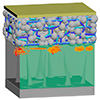
An ultrathin composite solid electrolyte uses MOF-encapsulated flame retardant that releases only during thermal abuse, enabling safe, high-energy lithium metal batteries.
(Nanowerk Spotlight) Packaging a reactive substance inside a protective shell and releasing it only at the right moment is a powerful design strategy across many fields of engineering. Pharmaceutical capsules dissolve in the gut, not the mouth. Fire suppression systems hold their extinguishing agents until heat breaks a seal. The principle in each case is the same: keep something potent contained until the environment signals that it is needed.
The same logic now applies inside batteries. Lithium metal batteries promise greater energy storage than today’s lithium-ion cells, but the polymer electrolytes that make them practical are flammable. Adding flame-retardant chemicals to the electrolyte seems like an obvious fix. The problem is that the most effective retardants, phosphorus-based compounds, react with the lithium metal anode and steadily degrade the battery from within.
Prior approaches struggled to keep phosphorus retardants present in the electrolyte yet isolated from the anode. A team of researchers has now addressed this impasse with a composite electrolyte design that locks a flame-retardant molecule inside a porous cage until dangerous heat forces its release.
(a) Schematic representation of the hierarchical design and multifunctional features of the PEO/HKUST-1@TMP/PET electrolyte. (b) Schematic of battery configurations with thick PEO electrolyte, highlighting associated safety concerns. (c) Schematic of battery configurations with ultrathin PEO/HKUST-1@TMP/PET electrolyte, illustrating enhanced safety and cycling stability. (Image: Reproduced with permission from Wiley-VCH Verlag) (click on image to enlarge)
The core innovation is a filler particle called HKUST-1@TMP. HKUST-1 is a copper-based metal-organic framework, a crystalline material built from metal ions and organic linkers arranged into a cage-like structure with uniform nanoscale pores. The researchers loaded these pores with trimethyl phosphate (TMP), a phosphorus compound that scavenges the reactive radicals driving combustion.
The central question was whether the framework could hold TMP tightly enough to prevent premature release. Thermal analysis provided the answer: free TMP begins evaporating at around 35 °C, but encapsulated TMP shows no loss until approximately 120 °C and reaches its peak release rate near 180 °C. Gas adsorption data reinforced this picture, showing that encapsulation fills the pores almost completely and reduces the framework’s accessible surface area by more than 90%.
This confinement translates into better anode stability. Lithium symmetric cells built with a simple physical mixture of HKUST-1 and free TMP short-circuited after only 87 hours of cycling. Cells using the encapsulated version ran for over 350 hours without failure. The mixture-based cell’s interfacial resistance quadrupled after cycling, while the encapsulated cell’s rose only modestly.
Surface analysis of the cycled lithium foils explained why. The mixture cell left phosphorus decomposition products on the anode, evidence of continuous parasitic reactions between TMP and lithium metal. The encapsulated cell’s anode showed no phosphorus at all, confirming that the framework keeps TMP away from the reactive surface.
Beyond fire safety, the HKUST-1@TMP filler also improves lithium-ion transport. The framework disrupts the crystalline structure of the poly(ethylene oxide) (PEO) matrix, expanding the amorphous regions where ions move most freely. Computational modeling showed that the framework’s copper sites bind the lithium salt’s bulky anions more strongly than PEO does. This anchoring effect restricts anion movement and promotes selective lithium-ion migration, raising the transference number to nearly three times that of pure PEO.
To achieve practical thinness, the researchers used a porous polyethylene terephthalate (PET) membrane as a mechanical scaffold. Infiltrating the PEO/HKUST-1@TMP slurry into this scaffold and hot-pressing it produced a final electrolyte just 20 µm thick, one-fifth the thickness of conventional solid polymer electrolytes. The PET scaffold also boosted tensile strength to more than 50 times that of bare PEO.
This thinness shortens the path ions must travel. The resulting ionic conductance reached roughly 880 times that of a standard PEO membrane of conventional thickness. Combined with the high transference number, the electrolyte moves lithium ions faster and more selectively than the polymer electrolytes tested for comparison.
The mechanical reinforcement also helps suppress dendrite growth, the needle-like lithium deposits that can pierce an electrolyte and short-circuit a cell. The composite electrolyte withstood current densities more than three times the limit of pure PEO. In long-term cycling, lithium symmetric cells using the composite electrolyte operated for over 2200 hours, while pure PEO cells lasted only 258 hours.
With electrochemical performance established, the researchers turned to fire safety validation. The composite electrolyte crossed the oxygen-index threshold that classifies a material as flame-retardant. It resisted ignition from a direct flame for three seconds, while pure PEO and PEO/PET electrolytes burned immediately.
The PET component contributed a second layer of protection. Its high melting point maintained the electrolyte’s dimensions up to 150 °C, preventing the physical shrinkage that can bring cathode and anode into contact and trigger the internal short circuits that cause solid-state batteries to fail.
These material-level results carried through to working devices. Pouch cells pairing the composite electrolyte with a nickel-rich cathode and thin lithium foil delivered energy densities of 368.2 Wh kg⁻¹ and 693.9 Wh L⁻¹. The cells retained 91.5% of capacity after 100 cycles.
Under the Chinese national thermal abuse protocol, a fully charged cell heated to 130 °C and held for 30 minutes showed no self-accelerating temperature rise. In extreme thermal runaway testing, the composite electrolyte cell reduced total heat release by more than 40% compared to a standard PEO cell and delayed the onset of catastrophic temperature spikes.
The work demonstrates that the trade-off between fire safety and electrochemical performance in polymer-based lithium metal batteries is not inevitable. By applying the principle of stimulus-responsive containment and pairing it with an ultrathin architecture, the researchers created an electrolyte where the flame retardant stays dormant during normal use but activates when thermal danger arises. The design offers a practical template for solid-state batteries that do not sacrifice safety for performance.
For authors and communications departmentsclick to open
Lay summary
Prefilled posts
ORCID information
Yue Ma (Northwestern Polytechnical University, Xi’an)
, 0000-0002-1005-9386 corresponding author
Nanowerk Newsletter
Get our Nanotechnology Spotlight updates to your inbox!
Thank you!
You have successfully joined our subscriber list.
Become a Spotlight guest author! Join our large and growing group of guest contributors. Have you just published a scientific paper or have other exciting developments to share with the nanotechnology community? Here is how to publish on nanowerk.com.