| May 21, 2027 |
Scientists have found a formula describing a strange phenomenon: space and time can form a kind of ‘crystal’ that may turn into a black hole.
|
|
(Nanowerk News) Alongside the famous gigantic black holes, physics also allows for microscopic versions. They emerge from so-called critical states, when spacetime organizes itself into a regular, crystal-like structure during a process known as critical collapse. A team from Goethe University Frankfurt and TU Wien has now succeeded, for the first time, in describing this phenomenon with an exact mathematical formula using an unusual mathematical trick.
|
|
Black holes usually form in spectacular events, such as the death of a massive star. But in theory, arbitrarily small black holes are also possible: tiny microscopic objects that can emerge from special critical states after the slightest addition of energy. Such states may have existed shortly after the Big Bang, when the universe was still a chaotic mixture of particles, potentially giving rise to so-called primordial black holes.
|
|
The theoretical possibility of such critical structures had already been demonstrated in computer simulations. Now, researchers from Goethe University Frankfurt and TU Wien have managed to confirm these results with a mathematical formula — using nothing more than paper and pencil (Physical Review Letters, “Analytic Discrete Self-Similar Solutions of Einstein-Klein-Gordon at Large D”).
|
 |
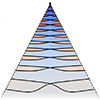
| Left: visualization of a spacetime-crystel. Right: a cubic crystal structure. (Image: TU Wien)
|
Critical Collapse
|
|
“Sometimes a tiny, seemingly insignificant cause is enough to trigger a huge and dramatic change,” says Prof. Daniel Grumiller from TU Wien. “Take liquid water at zero degrees Celsius, for example. A very small change is enough to make the water freeze. The water molecules then spontaneously arrange themselves into a regular pattern and form an ice crystal.”
|
|
According to Albert Einstein’s theory of relativity, something very similar can happen in space and time. Whenever particles move from one place to another, they affect spacetime itself. “We say that spacetime is curved by mass,” explains Christian Ecker from the Institute for Theoretical Physics at Goethe University Frankfurt. “Large objects such as stars curve spacetime strongly — for example, we can observe this when light rays are deflected by massive stars. But smaller masses also produce spacetime curvature, just to a lesser extent.”
|
|
Just as physics allows water molecules to form a regular crystal out of disordered liquid water, relativity allows spacetime curvature to organize itself into a regular structure — a repeating pattern in space and time. A kind of “spacetime crystal” emerges. Physicists refer to the process leading to this state as critical collapse.
|
|
“This spacetime crystal is a very peculiar and fascinating object,” says Grumiller. “It is a kind of intermediate state, an unstable point that can evolve in two different directions. It may simply dissolve again, leaving behind ordinary spacetime filled with freely moving particles. But if a tiny amount of energy is added, the evolution takes a completely different path: the inconspicuous spacetime crystal turns into a black hole.”
|
Confirming an Old Hypothesis
|
|
Computer simulations had already suggested back in 1993 that black holes might form spontaneously in this way. Since then, researchers have tried to describe the process mathematically and derive the correct formulas — but this turned out to be extremely difficult. The team from Vienna and Frankfurt has now solved the problem using a remarkable trick.
|
|
“Our universe has four dimensions — three dimensions of space and one dimension of time,” explains Christian Ecker. “But in principle, nothing prevents us from writing down physical equations for a larger number of dimensions — five dimensions, forty-two dimensions, or even infinitely many.”
|
|
One might expect the theory to become vastly more complicated that way, but that is not necessarily the case. The team showed that, in the limit of infinitely many dimensions, some highly complex questions become surprisingly simple. The next step is to check whether the solution can be translated back to a smaller number of dimensions. In this way, the researchers were able to gain insights into our four-dimensional universe by taking a detour through a hypothetical universe with infinitely many dimensions.
|
|
“Our technique turns out to be remarkably stable. Depending on the desired precision, we can systematically improve our formulas using additional approximation methods,” says Florian Ecker from TU Wien. “This gives us a new method for studying black-hole-related phenomena that could previously not be analyzed analytically.”
|