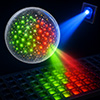
Glass microspheres help perovskite quantum dots resist blue-light degradation, heat, and moisture in patterned micro-LED color-conversion pixels.
(Nanowerk Spotlight) A material that changes light has to survive the light it changes. In a display, that means the color-changing layer must keep working inside the pixel, not just glow in a laboratory test. Heat, moisture, and intense illumination can turn small chemical weaknesses into visible flaws: dimmer pixels, drifting colors, or unwanted light leaking through.
Micro-LED displays expose this problem because blue micro-LEDs offer a practical starting point for full color. Blue devices can be bright and efficient, while red and green microscopic LEDs remain harder to integrate at scale. A simpler route is to use blue pixels as the light source, then place materials above selected pixels that convert blue light into red or green. That shortcut only works if the converter can absorb blue light cleanly and withstand the stress of doing so.
Perovskitequantum dots are strong candidates for that role because they emit narrow, vivid colors with high efficiency. They are also fragile. Water, heat, and blue light can create defects in the crystals, and those defects waste energy that should become red or green light. The material can start bright and still fail the practical test of operating inside a display.
The researchers grew perovskite quantum dots inside submicron glass microspheres and added silver bromide as an internal bromide source. The glass protects the dots from outside stress, while the silver bromide supplies bromide ions that help neutralize defects from within.
The approach matters because it addresses more than one weakness at the same time. Bare perovskite quantum dots can emit efficiently, but they degrade too easily. Perovskite quantum dot glass can improve stability, but bulk glass particles are difficult to arrange into the tiny patterns needed for display pixels. The new microspheres are designed to keep the optical advantages of perovskites while making the material stable and processable.
(a) Schematic illustration of submicron perovskite quantum dot glass microspheres (PQDGMS) preparation by the ball milling method and self-healing mechanism of PQDGMS. (b) Image of mass production of PQDGMS. (c) Variation of D50 particle size of PQDGMS with high-energy ball milling time. (d) TEM image of PQDGMS after milling for 60 min. (e) Images of perovskite quantum dots (PQDs), PQD-SiO2, and PQDGMS in harsh conditions. (f) Schematic diagram and patterned PQDGMS arrays by inkjet printing, photolithography, and through-hole glass-based filling. (g) Comparison of the PLQY, patternability, and stability of PQDGMS, PQD-SiO2, and PQDs. (Image: Reproduced with permission from Wiley-VCH Verlag) (click on image to enlarge)
The team made the particles through a top-down process. They melted and quenched a precursor glass containing the ingredients needed for the perovskite and silver bromide phases. A heat treatment then grew the quantum dots inside the glass matrix. High-energy milling reduced the material into microspheres smaller than 1 µm. The process reached 2 kg batches, which does not prove commercial manufacturing but moves the material beyond small laboratory quantities.
The glass matrix provides the first layer of protection. It surrounds the perovskite quantum dots with an inorganic barrier that limits contact with water and other external stressors. That barrier alone would not fully solve the problem, because blue light and heat can still create defects inside the emitter. The silver bromide gives the particles a second line of defense.
That second defense targets a common failure pathway in perovskites. Missing halide sites, known as vacancies, can act as traps where energy disappears instead of being emitted as light. Under heat or illumination, silver bromide can provide bromide ions that help fill or neutralize those sites. The paper supports this mechanism with chemical and structural evidence, while treating possible silver nanoparticle effects as less directly established.
The optimized green-emitting material kept the brightness that makes perovskite quantum dots attractive. It reached a photoluminescence quantum yield of 96.7 %, meaning it converted absorbed light into emitted light with high efficiency. It also produced narrow green emission, which matters because narrow emission gives displays cleaner colors.
The stability results addressed the main reasons perovskite emitters struggle in devices. After 10 000 hours in water, the microspheres retained more than 95 % of their initial emission. They also retained more than 82 % after heating at 100 °C and at least 86 % under continuous blue-light irradiation at 800 W m⁻² for 240 hours. Bare perovskite quantum dots degraded much faster under comparable conditions.
The comparison with silica-coated quantum dots clarifies why the design is more than simple encapsulation. A coating can slow water from reaching the emitter, but it does not necessarily stop light-driven defects inside the perovskite. The glass microspheres combine a physical barrier with a bromide source. That pairing matches the two-part stress faced by color-conversion layers: outside exposure and internal degradation under blue light.
The next question was whether the particles could work in display-like patterns. The researchers dispersed the microspheres into a photocurable ink and filled microscopic holes in glass substrates. Capillary action pulled the ink into the holes, and ultraviolet curing fixed it in place. The method produced patterned red and green conversion arrays with 20 µm pixels, showing why submicron particle size matters.
The device tests connected the material chemistry to micro-LED performance. Green color-converted chips reached an external quantum efficiency of 24.8 %, while red chips reached 16.7 %. Under the reported operating conditions, the conversion layers absorbed nearly all of the blue source light: 99.5 % in the green device and 99.9 % in the red device. Low blue leakage is essential for accurate color.
Glass confinement has also appeared in other perovskite optical devices, including perovskite nanocrystal glass for multicolor holographic displays. In the present work, that protective strategy is combined with submicron particle processing and bromide-based defect control, bringing it closer to the specific demands of micro-LED color conversion.
The work does not yet prove that the material is ready for commercial displays. Real products would require longer testing under packaged device conditions, electrical driving, repeated thermal cycling, and large-area uniformity checks. Uniform behavior across many pixels will matter as much as peak efficiency. The paper provides strong evidence for the material concept, but display manufacturing imposes stricter tests than laboratory demonstrations.
For demanding display applications, perovskite quantum dots may need more than improved nanocrystal chemistry. They may need to be built into larger, engineered particles that can protect them, control defects, and fit into pixel-scale manufacturing. In this study, that useful object is the whole microsphere: bright emitters, a glass barrier, bromide-based defect control, and a size compatible with patterned color-conversion layers. That combination is what makes the result relevant for micro-LED displays.
For authors and communications departmentsclick to open
Lay summary
Prefilled posts
Nanowerk Newsletter
Get our Nanotechnology Spotlight updates to your inbox!
Thank you!
You have successfully joined our subscriber list.
Become a Spotlight guest author! Join our large and growing group of guest contributors. Have you just published a scientific paper or have other exciting developments to share with the nanotechnology community? Here is how to publish on nanowerk.com.