| Apr 30, 2026 |
New method using ultrashort electron pulses enables detailed structural insights beyond conventional limits.
(Nanowerk News) At DESY´s electron accelerator REGAE researchers have developed a new method to determine the detailed atomic structure of materials using high-energy electrons which are diffracted by the sample. The technique which the team describes in the journal IUCrJ (“3D atomic structure determination with ultrashort-pulse MeV electron diffraction”) from the International Union of Crystallography makes it possible for the first time to apply the high sensitivity of electron diffraction to thicker samples, which have been out of reach so far with conventional electron diffraction.
|
|
“The method of high-energy electron diffraction makes it possible to combine the advantages of electron diffraction – such as significantly reduced radiation damage effects and improved visibility of light atoms – with much thicker samples”, says DESY researcher Alke Meents, who lead the experiments. “This opens up the way to investigate processes – such as those occurring in chemical catalysis and the charging and discharging of batteries – under real, so-called “operando” conditions, and thereby gain a much better understanding of the specific role of light atoms, such as hydrogen and lithium in these processes.”
|
|
Electron diffraction is a very promising and rapidly growing method for high-resolution structure determination in particular for radiation-sensitive materials, nanometer-sized samples, or samples of which only extremely small quantities are available. However, due to the strong interaction of electrons with the sample, conventional electron diffraction is limited to the examination of very thin samples with thicknesses of typically below 200 nanometers, currently preventing a wider adaption of the method.
|
|
The team at the accelerator REGAE (Relativistic Electron Gun for Atomic Exploration) has now overcome this limitation and was able to obtain structural data from much thicker samples with very high quality that is otherwise only achievable using X-ray synchrotron sources. They used the accelerator to generate ultrashort electron pulses with energies in the mega electron volt (MeV) range. In combination with further innovations, such as a specially developed measurement setup and a highly sensitive detector, the scientists were able to determine the 3-dimensional structures of the quantum material 1T-TaS₂ and the layer silicate.
|
 |
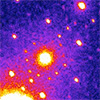
| This diffraction pattern of the quantum material 1T-TaS₂ was recorded at the REGAE accelerator using MeV electrons. (Image: DESY, REGAE group)
|
|
“This is the first time that high-energy electron diffraction has been used to determine full 3D atomic structures at this level of detail,” says Vincent Hennicke, lead-author from DESY.
|
|
The results show that even subtle structural features, such as the highly complex structure of the quantum material 1T-TaS₂, can be resolved with high accuracy. Particularly noteworthy is also the extremely good visibility of the hydrogen atom in the muscovite structure, which can otherwise only be determined in such detail using the significantly more complex method of neutron diffraction.
|
|
“Understanding atomic structure is essential for developing new materials,” says Paul Klar (Bremen University), one of the lead authors. “Our method allows us to analyse samples that were previously difficult or impossible to study with electron diffraction.”
|
|
A key to the success is the exceptional quality of the electron beam produced at REGAE. The accelerator delivers ultrashort pulses with very low emittance, resulting in highly coherent beams.
|
|
“The low emittance of the beam is crucial for achieving the necessary coherence required for achieving the high resolution,” explains Klaus Flöttmann, DESY accelerator physicist and co-author of the study. “This beam quality enables us to record diffraction data with the precision required for reliable structure determination.”
|
|
The new technique complements existing large-scale research infrastructures such as synchrotron radiation sources and X-ray lasers. “Accelerator-based electron diffraction is becoming an important addition to our portfolio,” says Wim Leemans, Director of DESY’s Accelerator Division. “It offers new experimental possibilities with comparatively efficient use of resources.”
|
|
Following these initial, very promising results, the participating scientists are now working to further expand REGAE’s experimental capabilities. With a new laser system, scheduled for installation this summer, it will be possible to observe dynamic processes – such as switching events in quantum materials – at the atomic level with a time resolution in the femtosecond range. “In the future, we want to combine this with time-resolved measurements to observe structural changes in real time,” says Meents.
|
|
A new experimental setup for operando experiments and catalysis research, which is currently being developed by the REGAE team, is intended to provide a better understanding of the role of hydrogen and other light atoms in biological and chemical processes – a role that is highly relevant to many biological and chemical processes and not fully
|