| Apr 28, 2026 |
A new DNA-based transistor overcomes the single-use limitation of molecular circuits, enabling both computation and memory storage at the molecular scale.
(Nanowerk News) A research team at KAIST has built a DNA-based molecular circuit that can compute, store results, and accept new inputs without ever needing to be reset (Science Advances, “Reset-free DNA logic circuits for real-time input processing and memory”). The system operates at a scale where the distance between functional units is just 0.34 nanometers — roughly six times smaller than the 2nm transistors that represent the current edge of silicon chip fabrication.
|
Key Findings
- The team created a DNA-based bio-transistor that mimics the switching function of semiconductor transistors at the molecular level.
- The new circuit operates without a reset step, enabling continuous real-time information processing while retaining previously computed data as stored memory.
- DNA’s 0.34nm base-pair spacing allows circuit density far beyond what silicon fabrication can currently achieve.
|
|
Until now, DNA-based circuits have been essentially disposable. A molecular circuit would detect a target — a cancer-related biomarker, for instance — trigger a reaction, and then be spent. The molecules were consumed in the process, making any follow-up computation impossible without assembling an entirely new circuit.
|
|
This single-use constraint kept DNA computing confined to basic sensing tasks, far from the sequential logic operations that define real computation.
|
 |
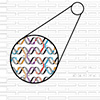
| Illustration of a DNA-based nanoscale bio-memory circuit capable of low-power operation. (Image: KAIST) (click on image to enlarge)
|
|
Professor Yeongjae Choi’s team at the KAIST Graduate School of Engineering Biology tackled this limitation directly. They engineered DNA molecules that reconfigure their binding arrangements when they receive an input signal, then hold that new configuration stable over time. The reconfigured state itself becomes the stored output — a molecular memory that persists and shapes how the circuit responds to the next input. No external flush or reinitialization is needed between operations.
|
|
This design effectively replicates, at the molecular level, what a transistor does inside a semiconductor chip: it receives a signal, switches state, and passes that state forward. The difference is scale. A cutting-edge silicon transistor gate sits at around 2 nanometers. The functional spacing in these DNA circuits is 0.34 nanometers — the fixed distance between adjacent nucleotide bases in a DNA strand.
|
|
Professor Yeongjae Choi stated, “This research advances the feasibility of implementing molecular computers using DNA. It has the potential to open new directions in both bio-computing and medical technologies.”
|
|
The ability to combine logic and memory in a single molecular system moves DNA computing beyond passive chemical detection. A programmable molecular circuit that processes inputs sequentially, without consuming itself, opens a design space for bio-compatible computing elements that could eventually operate inside living systems for applications such as disease diagnosis — processing multiple biological signals in real time rather than returning a single yes-or-no result.
|