| May 06, 2026 |
Dynamic catalyst interfaces offer a smarter route for converting CO2 into formic acid.
|
|
(Nanowerk News) Electroreduction offers a promising route for converting CO2 into value-added chemicals using renewable electricity. Among the possible products, formic acid is particularly attractive because it is an important chemical feedstock and a potential liquid hydrogen carrier.
However, developing catalysts that convert CO2 into formic acid with both high efficiency and selectivity remains a major challenge.
|
|
In a study, published in ACS Catalysis (“Metal−Support Interactions at the Pd/In2O3Interface Enhance CO2Electroreduction”), researchers from the teams of Prof. Chih-Jung Chen at National Taiwan University and Prof. Weixin Huang at the University of North Dakota report that palladium nanoparticles supported on indium oxide can significantly enhance CO2 electroreduction into formic acid. The catalyst, Pd/In2O3, shows higher Faradaic efficiency and partial current density for formic acid production than bare In2O3.
|
 |
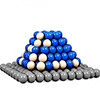
| Schematic illustration of metal support interaction (MSI) driven restructuring of Pd/In2O3 catalysts into Pd–In alloy sites during CO2 electroreduction to promote formic acid production.
|
|
At −1.1 V versus RHE, the introduction of palladium increased the Faradaic efficiency for formic acid from approximately 30% to 48%, while the formic acid partial current density nearly doubled. Importantly, a Pd/C control catalyst showed only about 2% Faradaic efficiency under the same conditions, indicating that palladium alone is not responsible for the enhanced activity. Instead, the improvement arises from the specific interaction between palladium and the indium oxide support.
|
|
To understand how this interaction influences the reaction, the researchers applied operando infrared spectroscopy to monitor surface species during CO2 electroreduction. They found that Pd/In2O3 formed key reaction intermediates more rapidly than bare In2O3. In simple terms, the catalyst provides CO2 with a more favorable “landing site,” helping guide the reaction toward formic acid rather than competing pathways.
|
|
Structural analysis using X-ray absorption spectroscopy and X-ray photoelectron spectroscopy suggested that Pd/In2O3 can generate Pd–In alloy sites during CO2 electroreduction. To clarify why these newly formed sites improve performance, the team further carried out density functional theory calculations. The calculations showed that Pd–In alloy sites make the formation of formate, a key intermediate in the pathway toward formic acid, energetically more favorable than on In2O3 salone.
|
|
“Our study shows that the active structure of a catalyst may not be fully established before the reaction begins,” said co-corresponding author Prof. Chih-Jung Chen. “The catalyst can evolve during operation, and this dynamic change can create more active sites for CO2 conversion.”
|
|
The finding highlights an important design principle for future CO2 conversion catalysts: researchers should consider not only the initial structure of a catalyst, but also how it changes under working conditions. This is especially important in electrocatalysis, where the reaction environment can reshape catalyst surfaces and generate new active sites.
|