| Apr 20, 2026 |
Researchers develop a new computational model that helps identify origin of complex magnetization reversal in soft magnets.
(Nanowerk News) The rapid increase in electric vehicle adoption in recent years has highlighted a crucial issue: the energy conversion efficiency of electric motors. In electric motors, iron loss or magnetic hysteresis loss is a primary source of energy dissipation, arising from the repeated reversal of magnetic fields within the motor core, made of soft magnetic materials.
|
|
Moreover, electric motors typically operate in high-temperature environments, where thermal effects can lead to partial demagnetization, further complicating energy-loss mechanisms. The structure of magnetic domains (tiny magnetic regions) of soft magnetic materials strongly influences their magnetic properties, including response to high temperatures and hysteresis loss.
|
|
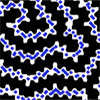
Magnetic domains exhibit a variety of fine structures. In some soft magnetic materials, they form intricate zig-zag patterns known as maze domains. These maze domains show complex and abrupt temperature-dependent behavior that can significantly affect energy loss. However, analyzing such structures remains challenging using current models due to a complex interplay of various factors such as metallographic structure, thermal effect, and energy stability.
|
|
To address these limitations, a research team led by Professor Masato Kotsugi and Dr. Ken Masuzawa from the Department of Material Science and Technology at Tokyo University of Science (TUS), Japan, in collaboration with researchers from the University of Tsukuba, Okayama University, and Kyoto University, introduced a novel entropy-feature-eXtended Ginzburg-Landau (eX-GL) model and applied it to uncover the energy landscape of complex maze domains in a rare-earth iron garnet (RIG).
|
 |
| The explainable entropy-feature-eXtended Ginzburg-Landau (eX-GL) model maps complex maze-like magnetic domain structures into a free energy landscape, enabling identification of key energy barriers and mechanisms driving temperature-dependent magnetization reversal. (Image: Prof. Masato Kotsugi, Tokyo University of Science)
|
|
“Conventional simulations oversimplify real materials, while experiments reveal complexity without a clear way to quantify cause and effect,” explains Prof. Kotsugi. “Our physics-based explainable artificial intelligence framework addresses these limitations and is designed to mechanistically explain temperature-dependent magnetization reversal process.”
|
|
Their study was published in Scientific Reports (“Explainable analysis of the complex maze magnetic domain structure through extension of the Landau free energy model by adding an entropy feature”).
|
|
To investigate the temperature dependence of magnetization removal in maze domains, the researchers obtained microscopic magnetic domain images of the RIG sample at different temperatures and used them as input for the eX-GL model. In the first step, this model utilizes persistent homology (PH), an advanced tool that analyzes topological features in data, to extract inhomogeneous structural features from the domain images.
|
|
Subsequently, machine learning-based pattern recognition is applied to identify the essential features from the PH data, creating a digital free-energy landscape, mapping the changes in magnetic domain microstructures with energy evolution. Finally, the obtained energy landscape is analyzed using mathematical techniques to link microscopic magnetic domain structures to the macroscopic magnetization reversal process.
|
|
Using this approach, the team identified a dominant feature, termed PC1, which effectively captures the magnetization reversal process. By correlating PC1 with physical parameters, they visualized four key energy barriers that play critical roles in the magnetization reversal dynamics.
|
|
Through detailed causal analysis of these barriers and their associated microstructures, the researchers were able to trace how different energy contributions influence reversal magnetization. In particular, they quantified energy transfer among exchange interactions, demagnetizing effects, and entropy. Furthermore, they found that as the length of domain walls increases, maze domains become more complex, a process driven by the coupling of entropy and exchange interactions. These findings clarify the underlying mechanics of maze-domain reversal.
|
|
“Our eX-GL approach effectively automates the interpretation of complex magnetization reversal process and enables identification of hidden mechanisms, difficult to discern using conventional methods,” remarks Prof. Kotsugi. “In addition, since free energy is a universal thermodynamic metric, our model can be extended to other systems with similar characteristics.”
|
|
Overall, this study not only clarifies maze-domain mechanics, but also offers a general strategy for examining complex energy landscapes in magnetic and related physical systems.
|