| Apr 15, 2026 |
Scientists have pioneered a way to make integrated circuits for light by depositing complex patterns of specialized materials onto silicon wafers.
(Nanowerk News) Computer chips that cram billions of electronic devices into a few square inches have powered the digital economy and transformed the world. Scientists may be on the cusp of launching a similar technological revolution — this time using light.
|
|
In a significant advance toward that goal, National Institute of Standards and Technology (NIST) scientists and collaborators have pioneered a way to make integrated circuits for light by depositing complex patterns of specialized materials onto silicon wafers. These so-called photonics chips use optical devices such as lasers, waveguides, filters and switches to shuttle light around and process information. The new advance could provide a big boost for emerging technologies such as artificial intelligence, quantum computers and optical atomic clocks.
|
Key Findings
- By stacking specialized materials onto silicon wafers, NIST researchers have developed a new method for creating chips that process photons similarly to how traditional chips process electrons.
- These fingernail-sized “integrated photonics” chips can generate a rainbow of colors — a big step toward miniaturizing today’s bulky, expensive laser systems.
- NIST’s chips could help emerging technologies such as quantum computers and optical atomic clocks escape the lab and start to impact biomedicine, navigation, communications and other areas.
|
|
Making circuitry for light as powerful and ubiquitous as circuitry for electrons is one of today’s technological frontiers, says Scott Papp, a NIST physicist whose group led the research, published in Nature (“Monolithic 3D integration of tantalum pentoxide nonlinear photonics”). “We’re learning to make complex circuits with many functions, cutting across many application areas.”
|
 |
| This small rectangular chip has been fabricated with numerous circuits designed to change the color of laser light. In the photo, one of these circuits is shown converting invisible infrared light into visible blue light. (A dime provides a size comparison.) (Image: R. Jacobson, NIST)
|
Light Speed
|
|
When it comes to information transfer and processing, light can do things that electricity can’t. Photons — particles of light — are far zippier than electrons at working their way through circuits.
|
|
Laser light is also essential for controlling powerful, emerging quantum technologies such as optical atomic clocks and quantum computers.
|
|
But several hurdles remain before integrated photonics can truly hit its stride. One involves lasers. High-quality, compact and efficient lasers exist in only a few wavelengths, or colors, of light. For example, semiconductor lasers are very good at generating infrared light with a wavelength of 980 nanometers — a color just outside the range of human vision.
|
|
Emerging technologies such as optical atomic clocks and quantum computers need laser light in many other colors as well. The lasers that produce those colors are big, costly and power-hungry, effectively confining these quantum technologies to a handful of special-purpose labs.
|
|
By integrating lasers into circuits on chips, scientists hope to help quantum technologies become cheaper and more portable, so they can start to fulfill their vast promise.
|
 |
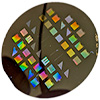
| A chip based on nonlinear optics contains lasers in several dozen colors. (A dime provides a size comparison.) (Image: R. Jacobson, NIST)
|
A Multilayered Approach
|
|
The new NIST photonics chip is a bit like a layer cake. NIST physicists Papp and Grant Brodnik, along with colleagues, started with a standard wafer of silicon coated with silicon dioxide (glass) and lithium niobate, a so-called nonlinear material that can change the color of light coming into it.
|
|
The researchers then added pieces of metal to electrically control how the circuits convert one color of light to others. The scientists also created other metal-lithium niobate interfaces that allowed them to rapidly turn light on and off within the circuits — a crucial ability for data processing and high-speed routing.
|
|
The icing on the cake, so to speak, was a second nonlinear material called tantalum pentoxide, or tantala. Tantala can transform light in ways that feel like magic, taking in a single laser color and putting out the full rainbow of visible light colors plus a wide range of infrared wavelengths. Papp and colleagues have spent years developing techniques to fabricate circuits out of tantala without heating it up, allowing the material to be deposited onto other materials without damaging them.
|
|
By patterning the different materials on top of each other in a three-dimensional stack, the researchers produced a single chip that efficiently routes light between layers. That allowed them to merge the light-manipulating wizardry of tantala with the controllability of lithium niobate. The new technique “allows seamless integration,” says Brodnik. “The real power is that tantala can be added to existing circuitry.”
|
|
Ultimately, the researchers were able to fit roughly 50 fingernail-sized chips containing 10,000 photonic circuits, each outputting a unique color, onto a wafer roughly the size of a beer coaster. “We can create all these different colors, just by designing circuits,” says Papp.
|
One Chip, Many Potential Uses
|
|
Quantum technologies such as clocks and computers could be among the biggest beneficiaries of integrated photonics. These devices often use arrays of atoms to store and process information. For each type of atom, physicists need lasers tailored to the atom’s internal quantum energy levels. For example, rubidium atoms, commonly used in quantum computers and clocks, respond to red light with a wavelength of 780 nanometers. Strontium atoms, another popular choice, “see” blue light at 461 nanometers. Shine other colors on the atoms and nothing happens.
|
|
The bulky, costly and complicated lasers needed to produce these bespoke colors have been a major hindrance to getting quantum computers and optical clocks out of the lab and into the field, where they could have big impacts. Cheap, low-power, portable optical clocks, for example, could help predict volcanic eruptions and earthquakes, offer an alternative to GPS for positioning and navigation, and help scientists investigate scientific mysteries such as the nature of dark matter. Quantum computers could offer new ways to study the physics and chemistry of drugs and materials.
|
|
Integrated photonic circuits aren’t just for quantum. Papp believes NIST’s photonics chips could help efficiently shuttle signals between the specialized chips used by tech firms, potentially making AI-based tools more powerful and efficient. Tech companies are also interested in using photonics to improve virtual reality displays.
|
|
While NIST’s chips aren’t yet ready for mass production, the technique used to create them provides a path forward, Papp and Brodnik say. The NIST scientists collaborated with experts at Octave Photonics, a Louisville, Colorado-based startup company founded by former NIST researchers that’s now working to scale up the technology.
|
|
“When you see the chip glowing in the lab, taking in invisible light and making all this visible light in one integrated chip — it’s obvious how many potential applications there could be,” says Papp.
|