| Jan 23, 2026 |
A new quantum framework now accurately models nanocapacitors where standard physics fails, enabling precise design and characterization of future electronics.
(Nanowerk News) The State University of New York at Stony Brook (Stony Brook University) researchers led a new study published in Physical Review Letters (“First-Principles Nanocapacitor Simulations of the Optical Dielectric Constant in Water Ice”) that overturns long-standing assumptions about how capacitors operate when engineered at the nanoscale, offering a clearer scientific foundation for future nanoscale electronic devices.
|
|
Capacitors—core components of modern electronics—store electrical charge between metallic electrodes separated by a dielectric material. While their performance is well understood at macroscopic scales, conventional models break down at the nanoscale, where the material properties assumed in standard equations are no longer well defined. These discrepancies pose significant challenges for interpreting the dielectric response of ultrathin materials and for designing reliable nanocapacitors.
|
|
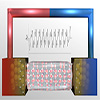
To address this problem, the Stony Brook University team developed a quantum-mechanical framework that unambiguously separates the contributions of the electrodes and the dielectric. The new protocol establishes fundamental limits on how small a capacitor can be made and provides a reliable approach for evaluating the intrinsic behavior of nanoscale insulating materials.
|
|
Demonstrating the method on ultrathin ice, the researchers found that its electronic response to electric fields is essentially indistinguishable from that of bulk ice, despite extreme confinement. The result resolves discrepancies between theoretical predictions and experimental measurements of ice films only a few molecules thick.
|
|
“This work offers a pathway to accurately characterize ultrathin dielectric materials using first-principles calculations,” said Ph.D. candidate Anthony Mannino, the study’s lead author. “With a clearer understanding of nanoscale dielectric behavior, we can improve device design and better interpret experimental data.”
|
|
“This work is the culmination of a long-term research effort in my group to understand the fundamental electronic properties of water using quantum-mechanical methods,” said Marivi Fernández-Serra, PhD, Professor of Physics and Astronomy and Core Faculty of the Institute for Advanced Computational Science (IACS). “Water and ice continue to surprise us with experimental results that challenge conventional theory. By developing new first-principles simulation tools, we can now clarify these discrepancies and provide a unified framework that connects theory and experiment at the nanoscale.”
|