| May 02, 2026 |
Scientists develop sophisticated blood test that is 97% effective in revealing pancreatic cancer.
(Nanowerk News) Scientists at Oregon Health & Science University have developed a new technique using an electronic jolt and nanoparticles to reveal the telltale signal of an insidious form of cancer.
|
|
The technique, described in a study published in the journal Small (“Liquid Biopsy Differentiation of Pancreatic Cancer From Non‐Cancerous Pancreatic Disease Using Dielectrophoresis‐Recovered Nanoparticles Carrying Cell‐Free DNA and Protein Biomarkers”), offers a new way to detect early signs of pancreatic cancer — a particularly deadly type of cancer because it isn’t detected until it’s progressed to later stages that are difficult to treat effectively. The new method would involve a simple blood draw among people who are considered higher risk due to family history or other factors.
|
|
“The pancreas is deep inside the body. It’s not like skin cancer you can see or a lump that you can feel,” said senior author Stuart Ibsen, Ph.D., associate professor of biomedical engineering in the OHSU School of Medicine and the OHSU Knight Cancer Institute. “By the time people experience jaundice or abdominal pain, it’s usually already progressed to an advanced stage.”
|
|
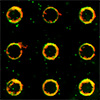
The sophisticated technique uses a small electronic jolt on a microchip to collect nanoparticles shed by tumors into blood. The next step involves fluorescent staining to reveal biomarkers associated with pancreatic cancer.
|
|
In the new collaborative study with OHSU’s Brenden-Colson Center for Pancreatic Care, researchers compared blood drawn from 36 people, including those known to have pancreatic cancer and a control group of people with other noncancerous forms of pancreatic disorders such as pancreatitis.
|
|
The study was blinded so the researchers did not know which samples came from the cancer patients.
|
|
The results were strikingly effective, with a 97% likelihood of correctly distinguishing people with cancer from those with benign pancreatic disease. That’s far higher even than direct biopsies of the pancreas itself. Typically, the invasive technique — involving tissue retrieval using ultrasound-guided fine needles — reveals 79% of pancreatic cancers.
|
|
“The more cancer biomarkers, the brighter the electrodes on the chip become,” Ibsen said.
|
|
The new technique benefits from the fact that cancerous tumors secrete an abundance of a particular type of nanoparticle — easily sampled with a simple blood draw.
|
|
“Whatever biomarkers the tumor has are carried on these little particles,” Ibsen said. “Our technology allows us to detect those particles.”
|
|
Even better, the study demonstrates that scientists can distinguish cancerous pancreatic tumors from benign precancerous lesions, which can’t typically be accomplished through imaging alone. Discerning the difference could mean sparing patients an invasive surgery to remove a mass that turns out to be benign.
|
|
“The information from our blood test could help the surgeon know whether this is something that really needs to come out,” Ibsen said.
|
|
Ibsen estimates the technique is probably five years away from clinical use.
|