| May 02, 2026 |
A light-driven catalyst built from palladium single atoms and plasmonic gold nanoparticles converts phenylacetylene to styrene at room temperature with 90% selectivity.
(Nanowerk News) Researchers have built a photocatalyst that addresses a long-standing trade-off in selective alkyne semihydrogenation by assigning hydrogen activation and selective hydrogenation to two different metals working side by side.
|
|
The light-driven antenna and reactor system, which combines palladium single atoms with plasmonic gold nanoparticles, converts phenylacetylene to styrene at room temperature and atmospheric pressure, according to a study published in eScience (“Nonequilibrium carriers trigger hydrogen spillover for the highly efficient semihydrogenation of alkynes under ambient conditions”).
|
Key Findings
- A photocatalyst pairing palladium single atoms on carbon nitride with plasmonic gold nanoparticles converts phenylacetylene to styrene at 298 K and atmospheric pressure with about 90% selectivity.
- Visible light generates nonequilibrium charge carriers in the gold nanoparticles, which drive hydrogen dissociation at palladium sites and spillover onto neighboring gold surfaces.
- Density functional theory calculations show the selective hydrogenation step has a lower energy barrier on gold than on palladium, supporting the case for splitting the two reaction stages between distinct sites.
|
|
Selective semihydrogenation of alkynes produces alkenes used in polymers, pharmaceuticals, and fine chemicals. The reaction is hard to control because catalyst sites that activate hydrogen molecules well also tend to bind reaction intermediates strongly. That tight binding raises the chance of over-hydrogenation, where the desired alkene is reduced further to an alkane and lost as a byproduct. Existing fixes rely on intricate catalyst tuning or tightly controlled reaction conditions, both of which are difficult to scale.
|
 |
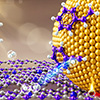
| Nonequilibrium carrier–driven hydrogen spillover enables selective alkyne semihydrogenation. Schematic illustration of the antenna–reactor photocatalytic mechanism. Under visible light irradiation, plasmonic Au nanoparticles generate nonequilibrium charge carriers that promote H₂ dissociation at adjacent Pd single-atom sites supported on carbon nitride. The resulting active hydrogen species spill over onto the Au surface, where phenylacetylene (PA) is selectively converted to styrene (Sty). Spatial decoupling of hydrogen activation and hydrogenation suppresses over-hydrogenation and enables high activity and selectivity under ambient conditions. (Image: Reproduced from DOI:10.1016/j.esci.2025.100481, CC BY)
|
|
Plasmonic photocatalysis, which uses light absorption by metal nanoparticles to drive chemistry under mild conditions, has gained attention as an alternative route. Its application to the underlying activity and selectivity conflict in catalysis, however, remains underexplored. The new work, carried out by researchers at Nankai University, Dalian Maritime University, and partner institutions, uses plasmonic effects specifically to break that trade-off rather than to lower reaction temperature alone.
|
|
The catalyst architecture places palladium single atoms anchored on carbon nitride next to plasmonic gold nanoparticles. The two components are spatially separated but operate in tandem under visible light. The gold nanoparticles act as optical antennas, absorbing light and generating energetic, nonequilibrium charge carriers as the plasmon decays. Those carriers boost hydrogen dissociation at the isolated palladium atoms, allowing the activation step to proceed efficiently without the elevated temperatures or pressures normally required.
|
|
To track what happens after hydrogen splits, the team used in situ surface-enhanced Raman spectroscopy. The measurements showed active hydrogen species moving from palladium sites onto adjacent gold surfaces, a process called hydrogen spillover. That migration controls the system’s selectivity. Palladium handles the demanding job of breaking the hydrogen molecule, while gold provides a surface that binds alkynes more weakly, lets the alkene product desorb quickly, and avoids the further reduction that produces unwanted alkanes.
|