A slippery droplet microarray enables parallel 3D bioprinting of separated, immersed hydrogel models, cutting array fabrication time from hours to minutes.
(Nanowerk Spotlight) Testing many biological samples at once requires separation. Standard well plates solve that problem with walls: each well keeps its own cells, liquid, and chemical conditions apart from its neighbors. Those walls also create an access problem. A printer or handling system must address one compartment after another, so the same feature that keeps samples separate can force the work to proceed serially.
Flat cell layers tolerate that compromise because they are easy to seed, dose, and read in dense plates. Tissue-like models ask more of the system. They need three-dimensional structure, controlled shape, and surrounding liquid to carry nutrients, waste, and test compounds. The challenge is therefore not only to print 3D structures, but to print many separate, immersed structures without making the printer visit each compartment in sequence.
A study published in Advanced Functional Materials (“Parallel 3D Bioprinting on SLIPS‐Microarrays”) tackles that conflict by keeping the liquid boundaries and removing the physical barriers. The researchers combined digital light processing, a light-based 3D printing method, with a droplet microarray that holds liquids on defined surface spots. The result is an open build surface where separate hydrogel environments can form without placing walls in the printer’s path.
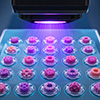
Concept of parallel 3D biofabrication on the slippery liquid-infused porous surface (SLIPS)–DMA platform. (A) Schematic of the Droplet Microarray (DMA) platform consisting of hydrophilic spots on a superhydrophobic background, enabling wall-less liquid compartmentalization through high local wettability contrast. (B) Comparison of serial versus parallel 3D bioprinting workflows. In serial systems, print time (Y) scales linearly with the number of compartments (x) due to intercompartment traversal (t), whereas in parallel fabrication, all structures are printed simultaneously, maintaining constant fabrication time independent of array size. (C) Conventional compartmentalization using physical walls, which restricts print-head motion dictating the use of serial 3D printing technology following the platform’s layout. (D) Schematic of the developed SLIPS–DMA platform enabling parallel DLP-based 3D bioprinting of hydrogel structures directly onto hydrophilic spots. The SLIPS treatment maintains droplet-based compartmentalization during printing (left) and allows subsequent full immersion of the printed structures in defined liquid environments (right). (Image: Reproduced from DOI:, CC BY) (click on image to enlarge)
The work extends the logic behind droplet microarrays for high-throughput control of living systems: replace bulky wells with patterned surfaces that confine tiny liquid volumes by wetting contrast. A droplet microarray uses hydrophilic spots that attract water, surrounded by a background that repels it. Liquid contracts onto the spots, so each location can hold its own condition while the full slide remains exposed.
That open exposure is what makes parallel printing possible. In digital light processing, the printer does not have to trace each structure or move from spot to spot. It projects a patterned image into a light-sensitive hydrogel precursor, curing every illuminated region in the field at the same time. Changing the image layer by layer builds the 3D objects. The same projection can therefore address many droplets at once, provided they fit within the light field.
The open droplet platform could not simply become a build plate. The study used gelatin methacryloyl, or GelMA, a modified gelatin that forms cell-compatible hydrogels when exposed to light. GelMA brought the array’s key weakness into view. On an untreated droplet microarray, the ink altered the water-repelling background, and later washing did not restore clean compartmentalization.
That failure mattered because the device depends on sharp boundaries. Once GelMA fouled the background, water spread between neighboring spots and formed liquid bridges. Separate droplets collapsed into connected liquid regions. A printed hydrogel could no longer sit inside its own defined environment, which defeated the purpose of building a screening array.
The researchers addressed this by turning the background into a slippery liquid-infused porous surface. The coating holds a fluorinated oil inside nanoscale pores, creating a low-adhesion liquid interface above the solid texture. GelMA can contact this surface during printing, but it does not bind strongly enough to erase the droplet boundaries that the array needs afterward.
The critical test was whether the surface still behaved like a compartmentalizing platform after bioink exposure. A conventional water-repelling coating lost droplet mobility after GelMA contact, and extended washing did not bring it back. The slippery surface kept nearly unchanged wetting behavior after the same treatment. It preserved the functional boundary between each hydrophilic spot and the surrounding background.
The printing workflow then treated the surface, the printer, and the droplet pattern as one system. A custom fixture holds the patterned slide inside a commercial digital light processing bioprinter and aligns it with the projection plane. A digital layout places each hydrogel structure over a hydrophilic spot. After printing, washing removes uncured ink while the cross-linked structures remain attached to their intended locations.
Geometry had to follow the surface design. The printed hydrogel could not cover the entire hydrophilic spot, because exposed hydrophilic area must remain to anchor the droplet. This detail makes the platform more than a faster printer on a patterned slide. The printed structure and wetting pattern have to work together so liquid can later surround and immerse each gel.
With optimized parameters, the system printed 70 GelMA structures with five different geometries in 6.5 min. The paper estimates that a comparable serial process would take more than 7 h. In separate tests, the platform produced arrays containing up to 588 smaller structures in under 3.5 min, compared with more than 34 h for sequential fabrication.
Unlike other approaches to faster tissue bioprinting, the speed increase here does not come mainly from accelerating a single print path. It comes from changing what controls fabrication time. Serial printing scales with the number of compartments because every added location adds fabrication and movement. Parallel projection removes that traversal cost.
Once the array fits within the light field, the tallest structure largely determines the print duration, not the number of droplets on the slide. The platform also turns shape into a screening variable. The study printed cubes, cylinders, pyramids, prisms, and more complex geometries on the same type of array. Shape affects how much hydrogel contacts the surrounding liquid, how far molecules must diffuse, and how cells experience the material.
The biological tests kept the claims appropriately narrow. The researchers printed GelMA structures containing dispersed HEK-293 cells, a widely used human cell line. Viability staining showed that many cells remained alive after printing and incubation. The dyes moved through the gel, indicating that soluble molecules could diffuse between the printed hydrogel and the surrounding droplet.
The team also trapped preformed HEK-293 spheroids inside printed hydrogel scaffolds. Spheroids contain cell-cell contacts before printing, so they offer a different starting point from dispersed cells embedded in gel. Supporting both formats suggests that the platform could compare hydrogel composition, printed geometry, liquid environment, and cellular organization in one miniaturized format.
The study does not yet amount to a full drug screening workflow. It demonstrates parallel fabrication, postprinting immersion, compartment stability, and cell compatibility. Longer culture periods, more cell types, evaporation control, readout methods, and automated analysis remain practical next steps. The current hardware also limited projection area, pixel resolution, spot size, and the smallest structures that could be reliably printed and immersed.
Its contribution is nevertheless specific and important. Walled formats keep samples separate by forcing physical separation; that same separation makes many 3D printing workflows serial. The slippery droplet microarray separates the liquids without separating the printer’s access to them. It gives 3D bioprinting a route to build many distinct, immersed cell environments as one parallel fabrication job.
For authors and communications departmentsclick to open
Lay summary
Prefilled posts
Nanowerk Newsletter
Get our Nanotechnology Spotlight updates to your inbox!
Thank you!
You have successfully joined our subscriber list.
Become a Spotlight guest author! Join our large and growing group of guest contributors. Have you just published a scientific paper or have other exciting developments to share with the nanotechnology community? Here is how to publish on nanowerk.com.