| Jun 01, 2026 |
Researchers have developed a type of peptides that can enter cells and block protein interactions considered difficult to target with drugs.
|
|
(Nanowerk News) Many diseases are driven by proteins interacting with each other inside cells. But blocking these interactions with drugs is difficult because our typic “small-molecule” drugs often prove to be too small to grip the broad, flat surfaces involved in protein-protein interactions.
|
|
On the other hand, peptides — short chains of amino acids — can cover larger surfaces. Cyclic peptides in particular, have ends that are chemically linked into a ring and are especially promising because their compact structure helps them bind tightly to difficult targets.
|
|
The problem is that most of these peptides cannot cross the cell’s membrane, which limits their use. As a result many peptide-based drugs must be injected because they struggle to cross biological barriers.
|
A major challenge in drug development
|
|
A team led by Christian Heinis at EPFL’s Laboratory of Therapeutic Proteins and Peptides has now developed a way to discover membrane-permeable cyclic peptides entirely from scratch. The researchers found that they can generate and screen large libraries of synthetic cyclic peptides to identify compounds that both enter cells and block a disease-related protein interaction.
|
|
The study is published in Nature Chemical Biology (“Generation of membrane-permeable cyclic peptides inhibiting protein–protein interaction”).
|
|
“We focused on small, less than 1000-Dalton, non-polar cyclic peptides that can enter cells by rapidly crossing the hydrophobic inner region of cell membranes,” says Heinis. “The challenge was then to develop cyclic peptides with suitable shapes so that they can bind to targets of interest.”
|
 |
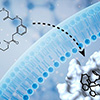
| Membrane-permeable cyclic peptide that inhibits the intracellular Keap1-Nrf2 protein-protein interaction. (Image: Christian Heinis, EPFL)
|
|
As a model, lead researcher Xinjian Ji focused on an interaction between the proteins Keap1 and Nrf2, which is linked to inflammation, oxidative stress, neurodegeneration, and cancer.
|
|
“My lab had developed high-throughput peptide synthesis methods for producing and testing in parallel ten-thousands of different small cyclic peptide structures at a nanomole-scale,” says Heinis. “This work is a bit like searching the needle in a haystack,” he adds.
|
|
Using these methods, the researchers synthesized and screened a library of 15,360 fully random cyclic peptides, all designed to be small, compact, and relatively nonpolar, properties associated with membrane permeability. The screen identified several compounds capable of disrupting the Keap1–Nrf2 interaction.
|
|
The researchers then refined the most promising candidates through repeated design, synthesis, and testing cycles. They also solved X-ray crystal structures showing that the synthetic peptides bound to Keap1 differently from the natural Nrf2 protein.
|
From test tube to living cells
|
|
After several optimization rounds, the researchers produced a cyclic peptide called peptide 30. The compound combined strong target binding with membrane permeability.
|
|
The peptide inhibited the Keap1–Nrf2 interaction inside living cells in a dose-dependent assay. Compared with the natural Nrf2 sequence, peptide 30 had no electrical charge, far fewer hydrogen bond donors, and a much lower polar surface area. These features helped it cross cell membranes while maintaining strong target binding.
|
|
The final peptide had a molecular weight of 890.6 daltons, small enough for membrane permeability and large enough to bind and inhibit the challenging protein-protein interaction.
|
Opening access to difficult targets
|
|
The study shows that membrane-permeable cyclic peptides can be developed without starting from known ligands, natural products, or known binding motifs. According to the researchers, this could broaden access to intracellular targets previously considered difficult to drug.
|
|
The approach could also support the development of orally available peptide drugs. Molecules taken by mouth must cross the membranes of intestinal cells before entering the bloodstream, something most peptide drugs cannot do efficiently.
|
|
“Our lab is now further advancing the technology to synthesize and screen even larger libraries of small, membrane-permeable cyclic peptides,” says Heinis. “And we are applying the technology to some of the most challenging protein–protein interaction targets, including big cancer targets like KRAS, b-catenin and c-Myc.”
|
|
Heinis’s group has patented the method and founded the spin-off company Orbis Medicines, which recently raised more than €90 million in Series A funding to further develop and apply the technology for drug discovery and development.
|