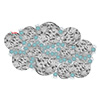
A soft polymeric microgel glues onto nanoscale plastic particles in water, aggregating them for removal at sizes that defeat conventional treatment methods.
(Nanowerk Spotlight) Removing a contaminant from water is straightforward when the particles are large enough to settle on their own or get caught in a filter. But as particles shrink below a micrometer, they enter a regime where thermal jostling keeps them permanently suspended and thin layers of water molecules cling to their surfaces, preventing them from clumping together. At that scale, conventional separation methods fail.
The challenge is acute for microplastics and even more so for nanoplastics. Plastic debris fragments into ever-smaller pieces in the environment, and particles below 1 µm now represent one of the most difficult fractions to capture. Standard water treatment steps such as adding chemicals to clump particles together, letting them settle, and passing water through sand filters all struggle in this size range.
In a study published in Advanced Science (“Adhesion‐Driven Removal of Microplastics From Aquatic Systems by Using Microgel Glues”), a team at Xiamen University takes a different approach. They designed a soft polymeric microgel that acts as a nanoscopic glue, latching onto dispersed plastic particles through multiple weak molecular forces and aggregating them into clusters that settle out of suspension or can be magnetically extracted.
(a) Overview of microplastic size removal capabilities of conventional water treatment methods, and the adhesive-driven co-precipitation strategy developed in this work. (b) Synthesis of pVIM microgel glues for demonstrating the adhesion-driven co-precipitation strategy. (c, d) Scanning electron microscopy (SEM) and transmission electron microscopy (TEM) images of pVIM microgel glues. (Image: Reproduced from DOI:10.1002/advs.75293, CC BY)
The microgel, designated pVIM, combines two monomers. One contributes a flexible, highly hydrated polymer chain that conforms easily to surfaces in water. The other introduces imidazole groups, ring-shaped nitrogen-containing units that can gain or lose a proton depending on pH. This tunability gives the microgel adaptive electrostatic behavior, while the imidazole’s hydrogen-bonding capacity strengthens its grip on diverse polymer surfaces.
The resulting particles measure roughly 180 nm across. Their mechanical compliance is central to the design. The polymer chains’ glass transition temperature sits at roughly −1 °C, well below the operating temperature of 25 °C. That gap ensures the chains remain mobile, able to deform and spread across the surface of a plastic particle to maximize contact area.
The team tested the concept using fluorescently labeled polystyrene microspheres as model microplastics. Without microgel, the particles stayed uniformly dispersed. After adding a small dose of pVIM, the particles migrated toward container walls within 30 minutes and formed dense sediments. Fluorescence measurements of the remaining liquid confirmed that more than 90% of the plastics had been captured.
Electron microscopy provided direct evidence of the adhesion mechanism. Transmission electron microscopy images revealed a thin corona of microgel coating each polystyrene sphere, even on particles as small as 50 nm. Dynamic light scattering tracked the aggregation in real time: within one hour, the effective particle diameter grew by roughly 1200 nm, confirming that the microgel bridged individual microspheres into larger clusters.
The central question was what molecular forces drive this adhesion. Several lines of evidence pointed to multiple noncovalent interactions working in concert. Infrared spectra showed signatures of hydrogen bonding and electrostatic attraction between the microgel and polystyrene surfaces.
Additional spectral features indicated pi-pi stacking between imidazole rings and aromatic groups on the plastic. Charge measurements confirmed that the positively charged microgel neutralizes the negative surface charge typical of weathered environmental plastics, promoting interparticle attraction.
Performance varied with microgel dosage, pH, and ionic strength in patterns consistent with adhesion-driven binding rather than nonspecific coagulation. The system worked best at mildly acidic to neutral pH (5 to 7), where imidazole groups carry a partial positive charge and hydrogen bonding is strongest. It also tolerated ionic strengths up to 100 mM NaCl. Excess microgel, however, formed stable colloidal dispersions that competed with plastics for binding sites, reducing efficiency.
The microgel captured polystyrene spheres across a range of sizes, from 1 µm down to 100 nm, with efficiencies consistently above 85%. It also aggregated four common plastic types: polystyrene, polyethylene, polypropylene, and polyethylene terephthalate. Polyethylene and polypropylene lack aromatic groups and cannot participate in pi-pi stacking, yet electrostatic attraction and hydrophobic association between the aliphatic plastic surfaces and the microgel’s hydrophobic domains proved sufficient.
One practical limitation of the bare microgel is that trace amounts linger in the treated water. The team addressed this by embedding iron oxide nanoparticles within the microgel network, creating a magnetic variant designated Fe₃O₄@pVIM. This composite retained the soft, hydrated architecture needed for adhesion while gaining superparamagnetic properties, enabling rapid collection with an external magnet.
After magnetic collection, no detectable microgel residue remained in the supernatant. The magnetic variant captured more than 90% of 100 nm polystyrene particles at a low dosage of 0.2 mg mL⁻¹. Kinetic modeling indicated that interfacial interaction kinetics, rather than simple diffusion, governed the process. In lake water and seawater, performance dipped only modestly, staying above 85% despite the presence of dissolved organic matter and background colloids.
Beyond single-use capture, the microgel offers a route toward regeneration. Bubbling carbon dioxide through the system protonates the imidazole groups, swelling the network and loosening its grip on bound plastics. Switching to nitrogen reverses the change. This gas-switching cycle released 37.8% of captured 100 nm polystyrene particles, showing that the material can be at least partially recycled.
Whether this adhesion-driven strategy can scale to real wastewater flows, maintain performance over many regeneration cycles, and integrate with existing treatment plants remain open questions. Yet the work fills a gap that current water treatment infrastructure largely cannot address: the removal of plastic particles below 1 µm. By translating adhesive design principles into a synthetic microgel platform, the study establishes a capture mechanism that requires no filtration membranes, no chemical degradation, and no specialized equipment.
For authors and communications departmentsclick to open
Lay summary
Prefilled posts
Nanowerk Newsletter
Get our Nanotechnology Spotlight updates to your inbox!
Thank you!
You have successfully joined our subscriber list.
Become a Spotlight guest author! Join our large and growing group of guest contributors. Have you just published a scientific paper or have other exciting developments to share with the nanotechnology community? Here is how to publish on nanowerk.com.