| May 11, 2026 |
Machine-learning molecular simulations show pristine graphene is intrinsically hydrophobic and that water trapped beneath the sheet caused earlier conflicting results.
(Nanowerk News) Graphene, the single-atom-thick carbon sheet valued for its strength and electrical conductivity, has confused researchers with contradictory wetting behavior. Some experiments showed water droplets beading up on graphene surfaces, suggesting the material repels water. Others showed water spreading flat, implying the opposite.
|
|
A team at the Institute for Basic Science (IBS), working with Korea University, has now used machine-learning molecular simulations to demonstrate that pristine graphene is inherently hydrophobic.
|
|
Their results, published in Nature Communications (“Machine-learning enhanced simulations predict graphene is hydrophobic and microscopically not wetting transparent”), trace the conflicting earlier findings to water molecules trapped beneath the graphene sheet.
|
Key Findings
- Pristine graphene is intrinsically hydrophobic and does not act as a transparent wetting layer.
- Water trapped between monolayer graphene and its substrate produces misleading spectroscopic signals that make the surface appear water-attracting.
- As graphene thickness increases, water intercalation becomes energetically unfavorable, revealing the material’s true water-repellent character.
|
|
The debate centered on a concept called wetting transparency. Because graphene is only one atom thick, some researchers proposed it functions like an invisible window, letting water respond to whatever substrate lies underneath rather than to the graphene itself. If true, graphene would have no definable wetting behavior of its own. Vibrational sum-frequency generation (vSFG) spectroscopy experiments on monolayer graphene placed on hydrophilic substrates appeared to support this idea, showing water-attracting behavior, while thicker graphene stacks looked clearly water-repellent.
|
 |
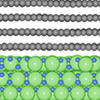
| a) This bar chart shows the “energy cost” for a single water molecule to sneak underneath graphene. For a single-atom-thin sheet (monolayer), the energy is negative, meaning water naturally prefers to hide underneath. For a four-layer stack, the energy reaches a high positive value, making it extremely difficult for water to squeeze into the gap. b) This illustration shows that on a single layer of graphene, water molecules would rather slip into the tiny space between the graphene and the water-loving surface below than stay on top. c) Once graphene is stacked four layers thick, the “door” underneath is effectively locked, and water molecules are forced to stay on the surface. (Atom colors: Ca=green, F=blue, C=black, O=red, H=light gray). (Image: Institute for Basic Science)
|
|
Resolving the disagreement experimentally proved difficult. Conventional techniques such as contact angle measurements capture only macroscopic averages and cannot reveal what individual water molecules do at the interface. Atomic-scale detail was needed, but standard quantum-chemical simulations are too computationally expensive to model these systems at realistic scales.
|
|
“Our results show that the apparent hydrophilic behavior of supported graphene does not originate from graphene itself. Instead, it arises from water trapped beneath the graphene layer, which alters the measured signal,” said Professor Stefan Ringe.
|
|
The IBS team, led by Director Cho Minhaeng and Professor Ringe at the Center for Molecular Spectroscopy and Dynamics, overcame the computational barrier by building machine-learning interatomic potentials trained on quantum-chemical data. These potentials reproduce near-quantum accuracy at a fraction of the cost, enabling large-scale molecular dynamics simulations of water on graphene surfaces.
|
|
Water molecules near graphene adopted arrangements typical of hydrophobic surfaces in these simulations. Many displayed dangling O–H bonds, where one hydrogen atom points toward the graphene sheet without forming a hydrogen bond. This hydrophobic signature grew stronger as more graphene layers were added, confirming that thicker graphene is even more strongly water-repellent.
|
|
The critical insight explaining the contradictory data involves intercalated water — molecules that slip into the nanoscale gap between monolayer graphene and the substrate beneath it. On hydrophilic substrates, water spontaneously migrates underneath monolayer graphene because doing so is energetically favorable. These hidden molecules form a confined interfacial layer with its own distinct molecular structure.
|
|
When spectroscopic techniques probe such a system, they detect signals from water both above and below the graphene sheet. The signals from these two populations partially cancel each other. This cancellation suppresses the hydrophobic spectral features of the top water layer, creating an apparent hydrophilic signature that does not reflect graphene’s actual surface properties.
|
|
The team also mapped how the energetics of water intercalation change with graphene thickness. For a single graphene layer on a hydrophilic substrate, the energy cost of inserting a water molecule beneath the sheet is negative, meaning intercalation happens spontaneously. Adding more layers steadily raises this energy barrier. By four layers, the cost becomes prohibitively high, effectively preventing any water from entering the gap beneath the stack.
|
|
This thickness dependence provides a unified explanation for the seemingly incompatible results across earlier studies. Monolayer graphene can appear hydrophilic under conditions that allow water to infiltrate beneath the sheet, while multilayer graphene consistently appears hydrophobic because intercalation is suppressed. The graphene itself does not change character; only the measurement artifacts differ.
|
|
“This work provides a unified microscopic framework for understanding graphene–water interactions. By identifying the role of confined water, we can now reconcile previously conflicting experimental results,” said Director Cho Minhaeng.
|
|
Technologies including desalination membranes, nanofluidic devices, energy storage systems, and hydrogen fuel cells depend on precisely controlling how water behaves at graphene interfaces. The study reveals that even a thin, undetected layer of trapped water can substantially alter interfacial properties, meaning engineers must account for possible water intercalation when designing graphene-based devices.
|
|
Experimental conditions also require more care than previously appreciated. Even if graphene is cleaned or heat-treated before measurement, water can re-enter beneath monolayer graphene during the experiment itself, driven by capillary forces. Sealing graphene edges may be necessary to prevent this ingress and obtain measurements that reflect the material’s intrinsic wettability.
|
|
The work also illustrates how machine-learning interatomic potentials can untangle interfacial phenomena that resist purely experimental analysis. By combining quantum-level accuracy with the scale needed to capture realistic water behavior, the researchers isolated the individual contributions of substrate effects, graphene thickness, and confined water — factors that are deeply entangled in any single experiment.
|
|
Graphene, rather than acting as a passive, transparent membrane that transmits the wetting properties of whatever lies beneath it, is an active, inherently water-repellent surface whose measured behavior can be distorted by nanoscale water hidden at the interface.
|