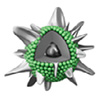
Bismuth-doped gallium nanoparticles transform into cell-puncturing spikes under freezing, killing drug-resistant lung, colorectal, and ovarian cancer organoids through mechanical disruption rather than biochemistry.
(Nanowerk Spotlight) Water expanding as it freezes can split rock and burst steel pipes. The force is purely physical. It requires no chemical reaction, no biological process. It simply results from a material taking up more space as it solidifies.
At the cellular level, the same principle applies: mechanical force can destroy any cell. But directing it precisely enough to kill only the cells you want to eliminate is a different problem entirely. Drugs work through biochemistry, binding to molecular targets and triggering cell death pathways. Radiation damages DNA. Both approaches fail when tumors evolve resistance, but neither was ever mechanical to begin with.
One clinical technique does use cold against tumors. Doctors insert probes into solid cancers and cool them with liquid nitrogen, destroying tissue through ice crystal formation. This method, called cryoablation, is minimally invasive and already approved for several cancer types. But it often leaves surviving cells at the frozen zone’s margins, and those cells can regrow. Previous studies have explored liquid metal particles coated with biological materials to target tumors, but these relied on light or heat to activate the particles.
A study published in Advanced Science (“Liquid Metal Nanotransformers for Drug‐Resistant Pan‐Cancer Therapy in Patient‐Derived Organoids”) takes a different approach. Rather than relying on ice formation alone, the research team developed liquid metal nanoparticles made from a bismuth-doped gallium alloy that amplify freezing’s destructive power at the single-cell level. These particles enter tumor cells, sit inside lysosomes, and upon freezing, transform from smooth spheres into spiked structures that puncture the cell from within.
Schematic illustration of LM nanotransformer-assisted pan-cancer cryotherapy across PDOs. (A) Multiple primary tumor organoids from patients, including lung cancer (LC), colorectal cancer (CRC), and ovary cancer (OC). (B) LM particles were mixed with organoids and co-incubated on the InSMAR-chip, where they entered tumor cell lysosomes via endocytosis. (C) When applying cryogenic stimulation to the InSMAR-chip, LM particles entered the organoids could transform into spike-like structures, puncturing the endosomal membrane and enabling endosomal escape. (D) Organoid matched peripheral blood mononuclear cells (PBMCs) were added in the microwells after cryo-treatment to assess immune activation. This setup demonstrated that LM-facilitated cryoablation effectively triggered anti-tumor immune responses. (E) Transcriptomic analyses were performed on treated organoids, revealing the potent tumor-killing effect of Bi-Ga and its ability to overcome drug resistance when combined with chemotherapy, as observed by phenotype. High-throughput RNA-seq further elucidated the underlying anti-tumor mechanisms, while cytokine assays indicated enhanced antigen presentation and elevated levels of IFN-γ and IL-2. (F) The LM nanotransformer-assisted pan-cancer cryotherapy strategy could enable efficient tumor eradication in a drug-free manner, overcoming the side effects of conventional chemotherapy and radiotherapy, and advancing a universal, non-toxic, and broadly applicable cancer treatment approach. (Image: Reproduced from DOI:10.1002/advs.202521041, CC BY) (click on image to enlarge)
The approach worked across 11 patient-derived tumor organoid models spanning lung, colorectal, and ovarian cancers. Several of these were drug-resistant, meaning they had stopped responding to standard chemotherapy. The liquid metal particles killed them regardless.
The material at the center of the strategy is gallium, a metal that behaves unusually during phase transitions. Most metals expand when they melt. Gallium does the opposite: it contracts upon melting and expands upon freezing. At the nanoscale, though, gallium particles resist solidification far below their expected freezing point, a phenomenon called supercooling. This limits their ability to deform under cryogenic conditions.
To overcome this, the team doped gallium with a small fraction of bismuth, which shares gallium’s anomalous expansion. During cooling, bismuth separates into distinct phases within the alloy and provides nucleation sites that lower the energy barrier for gallium crystallization. This reduced gallium’s supercooling from 16.1 °C to 13.3 °C and raised the proportion of fully deformed particles from 2% to roughly 10%.
The team tested these particles using patient-derived organoids, three-dimensional cell clusters grown directly from patient tumors. Unlike traditional cell lines, organoids preserve the genetic architecture, structural complexity, and drug-resistance features of the original cancer. A high-throughput microwell chip called InSMAR-chip enabled simultaneous culture and testing of hundreds of samples at nanoliter scale.
Across all organoid models, co-incubation with both pure gallium and bismuth-gallium particles caused no reduction in viability, no changes in growth rate, and no disruption to the cell cycle. Confocal microscopy confirmed that the particles entered tumor cells through endocytosis and accumulated in lysosomes, positioning them where deformation would do the most damage.
The team also simulated a clinical delivery scenario by injecting particles directly into freshly resected patient tumor tissue. Initially the particles clustered at the tissue periphery. After three days of culture, they had spread throughout the tissue and entered individual cells, supporting intratumoral injection as a viable clinical delivery route.
Once the team applied freezing, the bismuth-gallium particles consistently outperformed both pure gallium and standard chemotherapy. In lung cancer organoids that resisted cryo-induced damage on their own, with control groups retaining above 80% viability, bismuth-gallium cryotherapy drove viability down to as low as 15%. Pure gallium also enhanced killing over controls, but bismuth-gallium produced stronger effects in several organoid models, confirming that the doping translated into a measurable therapeutic advantage.
Adding chemotherapy on top of liquid metal cryotherapy strengthened the effect further. The physical membrane disruption caused by the transforming particles enhanced intracellular drug delivery, partially overcoming the barriers that shield resistant tumors from chemical agents. In a 14-day regrowth experiment, liquid metal-treated groups showed near-complete cell death, while control and chemotherapy-only groups retained residual living cells.
One organoid line illustrated the drug-resistance problem with particular clarity. LC6 lung cancer organoids expressed high levels of MALAT1, a gene associated with chemotherapy resistance. When the team applied drug treatment alone to these organoids, the transcriptional response was muted compared to other treatments. Bismuth-gallium cryotherapy, by contrast, drove strong upregulation of DNA damage, cellular stress, and antigen presentation genes even in this resistant background.
RNA sequencing across multiple cancer types revealed a consistent molecular signature. Liquid metal cryotherapy activated genes tied to necroptosis, oxidative stress, and glutathione biosynthesis while suppressing pathways that govern cell adhesion and extracellular matrix organization. Endocytosis-related genes were upregulated as well, consistent with the particles piercing endosomal membranes during their transformation.
These transcriptomic shifts converged on a few genes with broader biological significance. DKK1, which promotes cell junction disassembly, showed elevated expression especially under combined liquid metal and chemotherapy treatment. FTH1 and SLC7A11, both involved in ferroptosis and metabolic regulation, followed the same pattern. The team confirmed all three findings independently by quantitative PCR in a human lung cancer cell line.
The treatment also engaged the immune system. Treated tumors displayed hallmark features of immunogenic cell death: calreticulin migrated to the cell surface, and cells released elevated levels of HMGB1, a late-phase immune signaling molecule. In immune-competent organoid models co-cultured with patient-matched immune cells, bismuth-gallium cryotherapy triggered secretion of IFN-γ, IL-2, and CCL-2 while reducing immunosuppressive signals such as TGF-β1.
This combination of tumor destruction and immune activation suggests the strategy could complement liquid metal-based cancer immunotherapy approaches in future clinical settings. In drug-resistant lung cancer organoids, bismuth-gallium cryotherapy alone boosted immune-activating cytokines more effectively than combinations involving chemotherapy, suggesting that physical disruption may prime the immune system more cleanly than chemical intervention.
The study does not include in vivo experiments, so the biodistribution and tumor-targeting efficiency of the particles after systemic administration remain unknown. The cryogenic delivery method also restricts the approach to accessible tumors, and the mechanisms behind bismuth segregation and its role in immune activation need further investigation.
These constraints aside, the platform converts freezing energy into targeted mechanical destruction at the cellular level. It sidesteps the biochemical escape routes that make drug-resistant cancers so difficult to treat, offering a strategy built not on molecular specificity but on the physics of phase transitions.
For authors and communications departmentsclick to open
Lay summary
Prefilled posts
Nanowerk Newsletter
Get our Nanotechnology Spotlight updates to your inbox!
Thank you!
You have successfully joined our subscriber list.
Become a Spotlight guest author! Join our large and growing group of guest contributors. Have you just published a scientific paper or have other exciting developments to share with the nanotechnology community? Here is how to publish on nanowerk.com.