A three-terminal light-emitting memristor lets display pixels store memory, process signals, and emit light for faster local edge AI responses.
(Nanowerk Spotlight) The role of a display in edge AI systems, which process data close to where it is collected, is expanding from passive presentation to active response. In vehicles, wearables, robots, and surveillance systems, the display can become part of a local loop that detects motion, identifies what matters, and alerts a user almost instantly. Yet the pixels themselves still behave like obedient light bulbs. They brighten, dim, or change color only after memory and processors elsewhere decide what should happen. Data still has to shuttle between separate memory, computing, and display blocks, adding delay and energy cost before a pixel can change.
Making the display part of a near-instant response loop requires changing the pixel itself. The light-emitting element can no longer remain only the endpoint of a decision made elsewhere. It would need to become a small memory-compute-display unit, able to store recent signals, retain longer-lived states, and convert its internal electrical state into visible output.
Conventional two-terminal devices make that hard because the same contacts must handle memory writing, state retention, readout, and light emission. Those functions place conflicting demands on the device. A pixel should shine predictably, while a memory element should change according to what signals it has already received. Short-term memory should fade, while long-term memory should persist.
The researchers present it as the first single-device platform to combine reconfigurable short-term and long-term memory with visible light emission. Instead of assembling separate storage, processing, and display components, they use a memristive quantum-dot light-emitting structure that changes function depending on which terminals receive voltage.
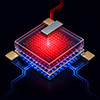
The third terminal is what makes this separation possible. In a two-terminal device, writing, reading, switching, and emission all share the same contact pair. In the TRV-LEM, different electrode combinations assign different jobs to the same physical cell. One pathway programs memory. Another drives light emission. A time-multiplexed operating mode links the two so stored electrical states can influence visible output without requiring a separate display module.
Schematic illustration of integrated processing display architecture based on three-terminal reconfigurable volatile/nonvolatile light-emitting memristor. (a) Schematic of conventional display system architecture. (b) Schematic of neuromorphic display system architecture. (c) Structure of TRV-LEM and performance variations arising from volatile and nonvolatile mechanisms. (d) Block diagrams of conventional video processing display architecture and TRV-LEM-based integrated processing display architecture. (Image: Reproduced with permission from Wiley-VCH Verlag) (click on image to enlarge)
The device builds on a quantum-dot light-emitting platform. Quantum dots are nanoscale semiconductor particles that emit specific colors when electrical charges recombine, a property already important to quantum-dot display technologies. In this work, CdSe@ZnS quantum dots provide red emission. Patterned bottom electrodes define planar light-emitting regions, while a silver bridging electrode above the stack helps control both emission location and memory operation.
The memory behavior comes from two physical processes that operate on different time scales. Volatile memory, which fades after stimulation, arises when charges become trapped and later escape from an organic transport layer. Nonvolatile memory, which lasts longer, comes from conductive filaments formed by silver ions and oxygen vacancies in tantalum oxide. The geometry matters because it lets the device activate and read these processes through different electrical routes.
That separation lets the same structure switch among functional modes. When voltage is applied between the silver bridge and one bottom electrode, conductive filaments alter resistance and store information. When voltage is applied across the two bottom electrodes, charges enter the quantum-dot layer through separate pathways and recombine in regions controlled by the electrode configuration. Reversing the polarity shifts where the light appears. By coordinating these operations in time, the device can update a memory state and translate that state into light output.
The researchers then tested whether the device could reproduce behaviors used as hardware analogs of neural signaling. Repeated pulses produced leaky integrate-and-fire behavior, in which signals accumulate until the device produces a sharp response. Closely spaced pulses produced paired-pulse facilitation, where the second response grows because the device retains a trace of the first. These effects matter for visual data because video is temporal. The timing and order of signals help define what counts as normal motion or an anomaly.
The optical output tracked the electrical state, which is the key link between computation and display. As conductance changed, brightness changed with it. That means the device can map a memory-related electrical state directly into visible light, rather than sending a result to a separate display module. This extends the broader push in memristor-based neuromorphic computing from memory and logic toward direct visual signaling.
At the system level, the paper reports a 69.23% reduction in data-transfer volume and a 40% reduction in component count compared with separated memory, computing, and display architectures. Those numbers should not be read as commercial performance claims. They are architecture-level estimates that quantify the value of collapsing several functions into one device. Fewer handoffs mean fewer places where time, control complexity, and energy can accumulate.
To test the idea in a visual-computing task, the researchers built an anomaly-detection system based on future-frame prediction. A neural network predicted upcoming video frames from earlier frames, then compared those predictions with actual frames. When the predicted and real scenes diverged, the system treated the mismatch as an anomaly. The TRV-LEM’s light output served as the visual signaling element for the resulting anomaly map.
The demonstration used the UCSD Ped1 and Ped2 pedestrian-scene datasets. The system reached area-under-the-curve scores of 82.67% on Ped1 and 95.24% on Ped2. These benchmarks do not show that the device outperforms conventional digital neural networks. Their value is more specific. They place the hardware concept inside a realistic workflow where memory, temporal prediction, anomaly detection, and optical feedback need to interact quickly.
Several engineering barriers remain. Conductive-filament devices must prove endurance under repeated filament formation and rupture. Display applications also demand uniform brightness across many cells, making device-to-device variation a central issue. Future versions would need lower-voltage operation, full-color integration beyond red emission, array-level uniformity, and compatibility with display backplanes. The present work demonstrates a functional architecture, not a finished display panel.
The TRV-LEM does not make today’s display pixels intelligent by itself. It shows that a light-emitting element can carry short-term memory, long-term memory, and history-dependent response when its control pathways are separated. For vehicles, wearables, robots, and surveillance systems, the payoff would be faster local alerts with less data movement between chips. Instead of serving only as the last component to light up, the display could help reduce the hardware distance between detection and warning.
For authors and communications departmentsclick to open
Lay summary
Prefilled posts
Nanowerk Newsletter
Get our Nanotechnology Spotlight updates to your inbox!
Thank you!
You have successfully joined our subscriber list.
Become a Spotlight guest author! Join our large and growing group of guest contributors. Have you just published a scientific paper or have other exciting developments to share with the nanotechnology community? Here is how to publish on nanowerk.com.