| Apr 25, 2026 |
A phase-change photothermal foam stores solar heat to sustain water evaporation after sunlight fades, producing fresh water from hypersaline brine at low cost.
|
|
(Nanowerk News) A lightweight foam that captures solar energy and stores heat for later use can keep producing fresh water even when the sun goes down, according to researchers at Ocean University of China and Huzhou University (Environmental Science and Ecotechnology, “Phase-change photothermal foam enables continuous hypersaline brine desalination”).
|
|
The phase-change photothermal foam addresses two persistent obstacles in solar-driven desalination: the intermittent nature of sunlight and the corrosive buildup of salt in concentrated brine.
|
Key Findings
- The foam continued to evaporate water after illumination stopped by releasing stored thermal energy from an embedded phase-change material.
- In outdoor tests using natural sunlight, the system produced 9.229 kg m⁻² of fresh water over 10 hours at a material cost of just $0.54 m⁻².
- Treated water met World Health Organization drinking water standards, with major seawater ions reduced by two to three orders of magnitude.
|
|
Solar-driven interfacial evaporation concentrates heat at the water surface rather than heating an entire body of water, making it an energy-efficient route to both fresh water recovery and brine concentration. But expanding desalination capacity also means producing more concentrated brine. That waste can carry heavy salt loads alongside residual treatment chemicals, heavy metals, and other contaminants, posing serious disposal and ecological challenges.
|
 |
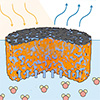
| Schematic of Continuous Solar Brine Desalination. This schematic illustrates the working principle of the phase-change photothermal foam during hypersaline brine desalination. Under illumination, the foam absorbs solar energy and converts it into heat to drive interfacial water evaporation, while part of the heat is stored within the phase-change component. When light is removed, the stored energy is released to sustain evaporation, enabling continuous freshwater production under fluctuating solar conditions. (Image: Reproduced from DOI:10.1016/j.ese.2026.100696, CC BY)
|
|
Sunlight, however, is not constant. Cloud cover, seasonal variation, and nightfall all interrupt energy input. Most phase-change materials tested in previous solar evaporators have struggled with high melting points, physical leakage over time, and rapid breakdown when exposed to highly saline water. A system that could store daytime heat and release it gradually would keep evaporation running through those gaps.
|
|
The device, designated PPy-CS/PF@DDA, embeds dodecylamine within a polypyrrole-coated chitosan and phenolic resin foam. Polypyrrole serves as the solar absorber, converting incoming light to heat. The porous foam structure wicks water efficiently toward the evaporation surface. Dodecylamine, acting as the phase-change component, absorbs excess thermal energy during illumination and releases it once the light drops, sustaining vapor production rather than letting the system idle.
|
|
“This work suggests a future in which solar desalination is not limited to bright, steady sunshine,” the findings indicate. “By integrating heat capture, heat storage, and salt resistance into one lightweight evaporator, the system moves closer to real continuous operation in harsh brine conditions.”
|
|
The foam held up through repeated light-dark cycles without losing performance, a durability gap that has limited earlier phase-change approaches under hypersaline conditions. Beyond removing salt from seawater, the material sharply reduced heavy metal concentrations in model wastewater and separated clean water from methyl orange solution without carrying over the dye. A single device, in other words, handled several distinct water treatment tasks.
|
|
Outdoor testing on a platform at Ocean University of China confirmed the laboratory results under real conditions. The system generated 9.229 kg m⁻² of fresh water over a 10-hour run, with peak evaporation between 11:00 and 13:00 but continued output outside those hours. The authors report a material cost of $0.54 m⁻² and a fabrication process simple enough to support scale-up.
|
|
Potential applications extend to zero-liquid-discharge treatment, brine concentration, and wastewater purification, particularly in areas where clean water is scarce and sunlight is plentiful but inconsistent. What sets this foam apart from many laboratory-stage evaporators is not higher peak output under ideal light, but steadier production when conditions shift.
|