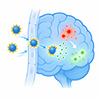
Glucose-coated nanoparticles carry CBD across the blood-brain barrier, trigger release in inflamed tissue, and reduce neuroinflammatory signs in mice.
(Nanowerk Spotlight) Some drugs fail not because they lack biological activity, but because their chemistry makes them difficult to deliver. They may affect the right pathways in cells, yet still make poor medicines because they arrive in the body in the wrong form. They dissolve poorly, clear too quickly, or spread through tissues where they are not needed. In brain disease, that problem becomes more severe because the brain admits only selected molecules from the blood.
CBD, short for cannabidiol, is a non-intoxicating compound found in cannabis. It illustrates this delivery problem. CBD has anti-inflammatory and neuroprotective activity, but its poor solubility and weak blood-brain barrier penetration limit its usefulness for brain inflammation. Its pharmacokinetics are also unfavorable, meaning the body does not absorb, distribute, and clear the molecule in ways that support efficient brain exposure.
For disorders shaped by chronic neuroinflammation, including Parkinson’s disease and depression, the central challenge is not only whether CBD can influence immune signaling. It is whether enough of the molecule can reach inflamed brain tissue in a usable form. That question places CBD within a larger effort to improve nanoparticle transport across the blood-brain barrier, where delivery often determines whether a therapy can work at all.
In a study published in Advanced Materials (“Non‐Invasive Brain Targeted Delivery of Cannabidiol for Alleviating Neuroinflammatory Disease”), the researchers address CBD’s limitations by changing the vehicle that carries it. The nanoparticle holds the poorly soluble molecule in a polymer core and carries glucose on its surface. That glucose coating helps the particle engage GLUT-1, a transporter that moves glucose from blood into the brain. The carrier also responds to the chemical stress found in inflamed tissue, giving it a way to release CBD where inflammation is active.
Those design choices changed what CBD could do in mice. In the glucose-coated carrier, CBD reached the brain at far higher levels than free cargo, associated preferentially with microglia, and shifted these immune cells toward a less inflammatory state. In mouse models of Parkinson’s disease and depression, that delivery advantage translated into improved behavior, reduced inflammatory markers, and evidence of neuronal recovery.
Glucose-targeted nanoparticles effectively deliver CBD into brain, reducing neuroinflammation and achieving therapeutic effects in both PD and depression mouse models. (a) Key steps in the fabrication of GNPs@CBD nanoparticles. Molecular computational screening for molecules and polymers, the PEG-PHB polymer was screened out for loading and delivering CBD via the experimental drug loading and molecular calculation. (b) Traversal of GNPs@CBD nanomedicine across the BBB via GLUT-1 receptor cycling. Depiction of inflammatory disease states where M0-type microglia are differentiated into a small number of M2 (anti-inflammatory) microglial, while the majority of microglia are M1 (pro-inflammatory) phenotype and secrete inflammatory factors. CBD release from GNPs in high ROS environment promotes the conversion of M1 microglia to M2 type. Secretion of anti-inflammatory factors by M2 type microglia acts to alleviate inflammation. (c) Depiction of neuronal cell damage in neuroinflammatory environment, where tyrosine hydroxylase (TH) is decreased, resulting in increased alpha-synuclein (α-syn) in cells and decreased 5-HT secretion that also contributes to depression. After CBD treatment, levels of TH and 5-HT are increased, which directly relieves PD and depressive symptoms accompanied by improved behavioral performance. (Image: Reproduced from DOI:10.1002/adma.202518697, CC BY) (click on image to enlarge)
Before CBD could be targeted to inflamed brain tissue, the researchers had to make it easier to formulate and carry. They screened several polymers and selected PEG-PHB, a diblock polymer that could interact strongly with CBD and form stable particles. Once modified with glucose, the carrier greatly improved CBD dispersal, reaching 300 µg/mL where free CBD barely dissolved at 1 µg/mL.
Drug loading alone would not make the system useful. A carrier also needs to hold its cargo during circulation and release it under the right conditions. The PEG-PHB carrier responded to reactive oxygen species, or ROS, which are chemically active oxygen-containing molecules that rise during inflammatory stress. Under ROS-mimicking conditions, the particles released far more CBD than they did under normal physiological conditions.
That release behavior matters because neuroinflammatory lesions create a different chemical environment from healthy tissue. The carrier uses that difference as a cue. Rather than leaking CBD broadly before it reaches the brain, the nanoparticle remains more stable under ordinary conditions and releases more of its cargo when it encounters oxidative stress associated with inflammation.
The glucose coating addressed a separate obstacle: entry into the brain. Brain endothelial cells use GLUT-1 to import glucose from blood. By presenting glucose on the particle surface, the researchers aimed to borrow that transport route. Cell models built from both mouse and human endothelial cells supported this mechanism, with glucose-coated particles crossing barrier layers more effectively than particles without glucose.
Mouse imaging showed the same trend in living animals. After intravenous injection, glucose-coated nanoparticles accumulated in the brain at more than 20 times the level of free cargo. The experiments used fasting followed by glucose administration to increase GLUT-1-associated transport before dosing. That step helped confirm the delivery mechanism, but it also marks a translational caveat because glycemic manipulation may not suit all patients.
After crossing the barrier, the particles needed to reach the right brain cells. The study found that they preferentially associated with microglia, the resident immune cells of the central nervous system. Microglia can amplify inflammation by releasing damaging cytokines, but they can also adopt a more protective state that helps resolve inflammation and support tissue repair. Related work on nanoparticle delivery to microglia in neuroinflammation points to the same cellular target as a central focus for brain nanomedicine.
The researchers describe this as a shift from an M1-like pro-inflammatory state toward an M2-like protective state. In cell experiments, treatment reduced inflammatory cytokines such as IL-1β and IL-6 and increased anti-inflammatory factors including TGF-β and IL-10. Gene and protein analyses pointed in the same direction, showing broad changes in immune and inflammatory signaling.
The first disease model tested whether those cellular effects mattered in a living brain. In an MPTP mouse model of Parkinson’s disease, which produces dopaminergic injury and neuroinflammation, mice received repeated intravenous treatments. Animals treated with CBD-loaded glucose nanoparticles moved better and performed better on tasks linked to coordination, learning, and motor function. Free CBD did not produce comparable benefits.
Brain tissue analysis connected those behavioral changes to disease-related biology. Treated mice showed more markers of protective microglial polarization and less inflammatory signaling. They also showed higher tyrosine hydroxylase, an enzyme needed for dopamine production, and lower alpha-synuclein, a protein associated with Parkinson’s pathology. The data suggest that better CBD delivery reduced inflammatory pressure and supported neuronal recovery.
The second model tested chronic unpredictable mild stress, a mouse model used to study depressive-like behavior connected to stress biology and neuroinflammation. Nanoparticle-treated mice showed improved sucrose preference, reduced immobility, and more exploratory movement. These results do not establish an antidepressant effect in humans. They show that the delivery system altered inflammation-linked behavior in another preclinical model.
The hippocampus also showed changes consistent with reduced inflammatory burden. Serotonin increased, anti-inflammatory IL-10 increased, and several inflammatory cytokines decreased after treatment. The researchers also reported higher brain-derived neurotrophic factor, a protein that supports neuronal survival and plasticity. Tissue staining showed better organization in hippocampal regions affected by stress and fewer activated microglia in the dentate gyrus.
Safety data stayed within the limits of short-term animal testing. In the tested mice, CBD-loaded glucose nanoparticles caused no obvious damage in major organs and no major blood chemistry changes. Encapsulation also appeared to reduce toxicity compared with higher exposure to free CBD. Still, long-term degradation, immune activation, clearance, repeat dosing, and chronic exposure remain important questions for future work.
The authors also compared their polymer system with the lipid nanoparticle formulation tested in the study. The glucose-coated polymer particles showed stronger CBD loading, ROS-triggered release, brain entry, and microglial targeting. The comparison does not rule out lipid nanoparticles as a class, but it shows why brain inflammation places specific demands on carrier design.
The broader lesson is that brain drug delivery needs alignment between chemistry and biology. CBD alone brings anti-inflammatory activity, but poor access limits its use. The nanoparticle adds solubility, a glucose-linked route across the blood-brain barrier, microglial targeting, and ROS-responsive release in inflamed tissue. The evidence remains preclinical, but the study shows that, for difficult brain drugs, the carrier can be as important as the cargo.
For authors and communications departmentsclick to open
Lay summary
Prefilled posts
Nanowerk Newsletter
Get our Nanotechnology Spotlight updates to your inbox!
Thank you!
You have successfully joined our subscriber list.
Become a Spotlight guest author! Join our large and growing group of guest contributors. Have you just published a scientific paper or have other exciting developments to share with the nanotechnology community? Here is how to publish on nanowerk.com.