Evaporation-assisted chip cooling lowers LED temperatures while preserving heat flow for small but useful waste-heat energy recovery.
(Nanowerk Spotlight) A high-power chip can overheat itself into failure. Conventional chip cooling keeps devices alive by moving heat into air or coolant, where it is lost unless a larger recovery system captures it later. Those environmental systems can reuse heat from equipment rooms, data centers, or industrial processes, but they do not solve the chip-level problem: how to protect a device from heat while recovering part of that energy at the source.
That source-level recovery is difficult because cooling and heat harvesting place different demands on the same heat flow. A thermoelectric generator needs a temperature difference to produce electricity. A cooler often reduces the temperature difference that makes harvesting possible. Evaporation offers a way around part of that conflict because it can remove heat from one side of a device while also driving ion movement through a wet porous material.
A study in Advanced Energy Materials (“Thermal Recovery System for High‐Power Devices”) uses that shared role of evaporation to link cooling and energy recovery in one chip-scale system. Instead of treating evaporation, thermoelectric conversion, and chip cooling as separate functions, the researchers combine them in one heat path. They test the system on a high-power deep-ultraviolet LED, a device whose light output and reliability both suffer when heat builds up.
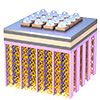
(a) Structure diagram of the AlGaN-LED array. (b) The waste heat of AlGaN-LED array reduces the luminous power. (c) The waste heat of AlGaN-LED array leads to low energy conversion efficiency. (d) Waste-heat recovery system (WHRS) energy conversion paths. (e) Schematic illustration of WHRS including AlGaN-LED, thermoelectric generators (TEG) and water evaporation generator (WEG). (Image: Reproduced with permission from Wiley-VCH Verlag) (click on image to enlarge)
The choice of device matters. Deep-ultraviolet LEDs based on aluminum gallium nitride are useful for sterilization, sensing, and other short-wavelength light applications, but they remain sensitive to self-heating. In the reported tests, an unmanaged LED array reached 160 °C and failed after 225 s because solder melted. With the integrated recovery system attached, the operating temperature fell to about 60 °C and stable operation extended to >200 h.
That result sets the hierarchy for the work. The device first succeeds as a cooler. The energy recovery comes from how it cools. Heat leaving the LED passes through a thermoelectric unit, where the temperature difference between the hot and cold sides can generate electricity. The heat then reaches an evaporation layer, where water removes thermal energy as it turns into vapor.
This second layer does more than behave like a wet heat sink. Evaporation keeps the cold side of the thermoelectric unit cooler, which helps preserve the temperature difference needed for thermoelectric output. At the same time, water moving through the porous layer carries ions and creates a separate electrical output. Nanowerk has previously covered water evaporation as a source of electricity, but here the evaporation process also acts as part of the thermal-control system.
The system therefore organizes heat before it escapes. A protected aluminum heat sink acts as one electrode and conducts heat into the evaporation unit. A carbon-based electrode collects charge on the other side. Between them, a porous hydrated layer holds water and supports ion movement. The design avoids relying on one mechanism alone. Heat drives evaporation, evaporation sustains cooling, and the maintained temperature gradient improves thermoelectric generation.
The materials matter because uncontrolled wet metal surfaces can generate unstable electrochemical signals. The researchers anodized the aluminum heat sink to form an aluminum oxide surface, which helps protect the metal while still allowing it to serve as an active interface. The ion-transport layer contains a charged polymer that releases mobile sodium ions when hydrated. The carbon coating improves charge collection rather than simply adding surface area.
The strongest evidence comes from comparing operating modes. A bare LED overheated quickly. Adding a thermoelectric layer helped, but it did not create the full effect. Adding the complete evaporation-based recovery layer lowered the temperature further and increased the usable temperature difference across the thermoelectric unit. In the full system, the thermoelectric output reached 30.54 mW under the reported conditions.
Cooling also restored the LED’s primary output. The luminous power increased from 61.49 mW without the recovery system to 188.94 mW with it. That number is important because it shows that the gain was not only an added electrical trickle from waste heat. By lowering the LED temperature, the system allowed the device to convert more of its input into light instead of losing performance to heat.
That distinction keeps the energy recovery claim grounded. Overall energy utilization rose from 0.85% to 3.06%, but most of that improvement came from better optical output and heat removal. The thermoelectric generator supplied measurable electrical power, and the evaporation generator added a smaller hydrovoltaic contribution. The system did not turn waste heat into a large power source. It recovered a useful fraction while improving device operation.
This framing also separates the work from larger waste-heat systems. Facility-scale heat recovery can capture energy after heat has already entered coolant loops, exhaust streams, or building infrastructure. The new system targets the source instead. It sits at the device level, where heat is still concentrated and where thermal failure begins. That makes it closer in spirit to earlier work on on-chip thermoelectric energy harvesting than to building-scale heat reuse.
The researchers also confronted the practical weakness of evaporation-based devices: water loss. An open evaporator eventually dries out. In a covered version of the system, vapor condenses within the local enclosure and liquid returns to the porous region through capillary action. The device still requires water management, but the test shows a path toward longer operation than a simple open wet layer could provide.
The team demonstrated that the recovered electrical output could run a temperature and humidity sensor. That example should not be read as a claim that the system can power demanding electronics. Its more realistic use is local support for low-power monitoring. A hot device could cool itself while supplying enough energy to help run sensors that track the conditions responsible for failure.
The broader value lies in the way the system handles the cooling versus harvesting trade-off. It does not compete with every advanced cooler on minimum temperature alone. It uses evaporation to keep heat moving in a form that remains partly useful. Similar thermoelectric concepts have appeared in earlier reports on waste heat powering electronics and sensors, but this work ties that idea directly to chip-level thermal protection.
The rise to 3.06% energy utilization is meaningful for a proof-of-concept device, but it also underscores how much heat still leaves the system unrecovered. Still, the study makes a clear design case. Chip heat does not need to move straight from failure source to discarded waste. With an evaporation-assisted pathway, part of that heat can cool the device, preserve a temperature gradient, and return a small but useful amount of energy before the rest leaves the system.
For authors and communications departmentsclick to open
Lay summary
Prefilled posts
Nanowerk Newsletter
Get our Nanotechnology Spotlight updates to your inbox!
Thank you!
You have successfully joined our subscriber list.
Become a Spotlight guest author! Join our large and growing group of guest contributors. Have you just published a scientific paper or have other exciting developments to share with the nanotechnology community? Here is how to publish on nanowerk.com.