Dynamic liquid crystal elastomer composites enable a 3D-printed soft robot that switches between three propulsion modes on water and reshapes its body for complex tasks.
(Nanowerk Spotlight) Living organisms do not respond to every stimulus the same way. A mild disturbance might trigger a slow, cautious retreat. A sudden threat demands an explosive escape. This graded response to stimulus intensity is one of the most basic survival strategies in biology, and it depends on the ability to switch rapidly between different modes of movement.
Water striders offer a vivid example. Under calm conditions, these insects glide across pond surfaces by rhythmically rowing their middle legs, producing smooth, steady motion. When startled, they depress their legs sharply against the water to launch powerful jumps, covering distance at roughly 1.5 times their gliding speed. The same body executes two distinct locomotion programs depending on the situation.
Tiny robots that could replicate this kind of adaptive surface locomotion at the millimeter scale would open practical possibilities in environmental monitoring, microfluidic manipulation, and operations in confined liquid environments where conventional propulsion systems are too bulky or rigid. But building them has proven difficult. Most small-scale swimming robots that mimic aquatic insects rely on a single propulsion mechanism and perform well only within narrow conditions.
Locomotion of water striders under different stimulation conditions. (a) Sliding motions under mild stimulation; (b) Jumping motions under intense stimulation; displacement (left y-axis) and velocity (right y-axis) as functions of time for (c) sliding locomotion and (d) jumping locomotion. (e) Under the synergistic effects of ultrasonication and mechanical stirring, CNTs are uniformly and stably dispersed on the RM82 crystal surfaces through π–π interactions between the nanotube walls and the aromatic rings of RM82. (f) Chemical structures and schematic illustrations of the components used in the fabrication of the OptiLCE Strider. (g) Schematic illustration of the DIW printing process of the OptiLCE Strider platform and a representative strider-inspired architecture. (Image: Reproduced with permission from Wiley-VCH Verlag) (click on image to enlarge)
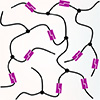
The robot’s body consists of a liquid crystal elastomer, a polymer whose molecular chains lock into an ordered alignment. When heated past a threshold temperature, these chains lose their order and the material contracts along the alignment direction, producing a predictable bending deformation. Cooling reverses the process. The team used direct ink writing, a form of 3D printing, to extrude the elastomer through a fine nozzle, embedding specific molecular orientations along the print path.
Carbon nanotubes dispersed throughout the elastomer at 0.5 wt% act as photothermal converters. They absorb near-infrared laser light and transform it into localized heat, giving the robot a wireless, remotely directed power source.
At low light intensities, the heated spot warms the water beneath the robot, lowering local surface tension. The difference between warm and cool regions creates a gradient that pulls the robot toward the higher-tension zone. This Marangoni effect produces smooth, continuous gliding at speeds of 1.3 to 7.2 mm s⁻¹. Infrared imaging captured U-shaped thermal vortices trailing behind the moving robot, mirroring the wake patterns of real water striders.
Raising the light intensity beyond 180 mW cm⁻² pushes the system into a second regime. The water beneath the irradiated spot reaches boiling, and the rapid expansion of a vapor bubble delivers an impulsive kick. High-speed videography recorded the full cycle from bubble nucleation to collapse in roughly 100 milliseconds. This pulsatile mode reaches peak velocities of 12.5 to 16.8 mm s⁻¹, making it the fastest of the three.
Directing the beam at the center of the robot’s body rather than the water-contact edge activates a third mechanism. The temperature gradient through the material triggers the liquid crystal phase transition, and the upper surface contracts more than the lower. The robot bends upward, then springs back as it exits the illuminated zone. This flapping motion pushes against the water surface, generating propulsion at 4.6 to 6.9 mm s⁻¹.
The researchers mapped these three modes onto two control variables: light intensity and irradiation position. Below 120 mW cm⁻², Marangoni gliding dominates regardless of where the beam falls. Above that threshold, edge illumination triggers vapor propulsion, while center illumination activates flapping. This phase map gives operators a predictive tool for selecting locomotion strategies on demand.
Force calculations revealed a clear trade-off among the modes. Vapor propulsion generates the strongest thrust, one to two orders of magnitude above the other mechanisms, but consumes the most energy per unit distance. Marangoni gliding offers the greatest efficiency. Flapping occupies a middle ground, delivering moderate force with full reversibility.
The robot owes its structural adaptability to dynamic disulfide bonds woven into the elastomer network. These sulfur-sulfur linkages break and reform under heat, allowing the team to reshape the printed body into new geometries after fabrication. An arrow-shaped configuration navigated a maze, then thermally reconfigured its legs to squeeze through a narrow channel. A spider-shaped variant shifted from an open stance into a gripping posture to capture and transport cargo.
Multifunctional and environment-adaptive applications of the OptiLCE Strider. (a) Schematic illustration of reversible disulfide exchange under thermal stimuli. (b) Arrow-like Strider and (c) Spider-like Strider, both capable of thermal shape reconfiguration via dynamic disulfide exchange and light-controlled actuations by selective illumination of different legs. (d) Maze navigation by the arrow-like Strider, where thermal reconfiguration enables leg contraction to pass through confined channels. (e) Targeted cargo transport by the spider-like Strider, which reconfigures into a gripping morphology to capture and transport payloads to designated locations. (Image: Reproduced with permission from Wiley-VCH Verlag)
The team also demonstrated a jumping escape for situations where water-surface propulsion fails, such as when the robot runs aground on a rock. A folded three-leaf panel stores elastic energy as its inner fold tries to unfurl under light but the outer layers hold it back. After about 0.3 seconds, the constraint gives way, launching the robot to a height six times and a distance 3.3 times its body length. Upon landing on the water, it immediately resumed Marangoni-driven gliding.
The combination of three switchable propulsion modes, on-demand structural reconfiguration, and transitions between water-surface and aerial movement in a single untethered device moves soft robotics closer to the graded, environment-sensitive behavior that defines biological locomotion at liquid interfaces. By coupling programmable materials with additive manufacturing, the work shows how material-level intelligence can begin to replace the complex control systems that rigid robots typically require.
For authors and communications departmentsclick to open
Lay summary
Prefilled posts
Nanowerk Newsletter
Get our Nanotechnology Spotlight updates to your inbox!
Thank you!
You have successfully joined our subscriber list.
Become a Spotlight guest author! Join our large and growing group of guest contributors. Have you just published a scientific paper or have other exciting developments to share with the nanotechnology community? Here is how to publish on nanowerk.com.