

Apr 09, 2026 An octopus-shaped nanomachine hijacks tumor ATP leakage to power a self-amplifying cycle of membrane damage, drug delivery, and metabolic collapse in cancer cells. (Nanowerk Spotlight) Cancer cells fuel their survival through continuous production and controlled release of adenosine triphosphate (ATP), the molecule that powers nearly all energy-dependent...
What if dark matter came in two states?

Apr 09, 2026 Dark matter may be two particles that must find each other to annihilate, explaining why gamma-ray signals appear in our galaxy but not in dwarf galaxies. (Nanowerk News) The absence of a signal could itself be a signal. This is the idea behind a new study published...
Optimizing nanopillar sensors by modeling hidden cell membrane folds
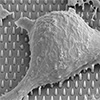
Apr 08, 2026 A physics-based model that accounts for membrane surface folds predicts cell adhesion on nanopillar arrays with 97% accuracy, enabling optimized biosensor design. (Nanowerk Spotlight) Under a microscope, a cell's outer surface looks nothing like the smooth bubble most people imagine. It is crumpled, ridged, and ruffled, covered...
A nanoscale robotic cleaner

Apr 08, 2026 Researchers demonstrate light-driven nanorobots that can selectively capture, transport, and remove bacteria. (Nanowerk News) Tiny robots – around 50 times smaller than the diameter of a human hair – open up fascinating possibilities: they enable the controlled manipulation of objects far too small for human hands. This...
Tumor-inspired microparticles reprogram fat cells and improve insulin sensitivity
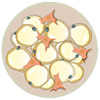
Apr 08, 2026 Mineral casts of cancer cell surfaces reprogram fat cells into stem cells and improve insulin sensitivity in obese mice through purely mechanical cues. (Nanowerk Spotlight) Cancer cells corrupt their neighbors. As a tumor expands, it doesn't merely compress adjacent tissue; it transforms it. Fat cells caught in...
Silver nanowire electrodes achieve 86% efficiency in CO2 to ethylene conversion
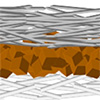
Apr 08, 2026 A three-layer electrode using silver nanowire networks as both conductors and catalysts achieved 86% selectivity for converting CO2 into multi-carbon products. (Nanowerk News) Researchers have developed a novel electrode architecture that uses silver nanowire networks to convert carbon dioxide into ethylene and other multi-carbon chemicals with up...
Momentum-engineered photonic states make bulk silicon shine

Apr 08, 2026 Researchers demonstrate a fundamentally new way to make silicon emit light, overcoming one of the most persistent limitations in modern electronics and photonics. (Nanowerk News) An international team of researchers, led by scientists from the University of California, Irvine, shows that silicon, long considered an inefficient light...
Atomic force microscopy becomes a design tool for ferroelectric materials
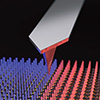
Apr 08, 2026 A review paper presents an integrated AFM framework for observing, manipulating, and engineering ferroelectric materials at the nanoscale for semiconductor applications. (Nanowerk News) Researchers at KAIST have published a review paper that reframes atomic force microscopy (AFM) as an active platform for designing and controlling ferroelectric materials,...
Liquid metals as vital materials for future deep-space missions

Apr 08, 2026 Room-temperature liquid metals could benefit deep-space exploration, enabling advances in propulsion, thermal management, soft robotics, smart spacesuits, and life support systems. (Nanowerk News) A research team led by Prof. LIU Jing from the Technical Institute of Physics and Chemistry (TIPC) of the Chinese Academy of Sciences (CAS)...
Optical control of nuclear spins in molecules points to new paths for quantum technologies

Apr 08, 2026 Researchers optically initialized, controlled, and read out nuclear spins in a molecular material for the first time, showing molecular nuclear spins could advance quantum tech. (Nanowerk News) Researchers at the Karlsruhe Institute of Technology (KIT) have reported important progress in quantum physics and materials science by optically...