| Apr 22, 2026 |
A new method overcomes fundamental resolution limits and may provide insights into high-temperature superconductivity.
(Nanowerk News) The physicist Dr. Sebastian Paeckel has developed a method that can be used to calculate spectral functions of complex quantum systems much more precisely than was possible previously. His approach reconstructs precise energy spectra without requiring lengthy calculations. This reveals previously hidden details, as Paeckel reports in the journal Physical Review Letters (“Spectral Decomposition and High-Accuracy Green’s Functions: Overcoming the Nyquist-Shannon Limit via Complex-time Krylov Expansion”). He conducts research at the Faculty of Physics at LMU and at the Munich Center for Quantum Science and Technology (MCQST).
|
Why spectral functions are so important
|
|
The background: To understand how complex materials behave at the atomic level, physicists calculate what are known as spectral functions. They show which energy states a system can assume and how pronounced they are. This information can be compared directly with experimental results, such as X-ray or neutron scattering measurements. Spectral functions thus form a bridge between theory and experiment.
|
|
However, they are difficult to calculate. As a first step, simulations are conducted to record how a quantum system changes over time. Researchers then convert this time-based information into an energy spectrum. It is precisely this step that has so far limited the level of accuracy.
|
Fourier transform: From behavior over time to the energy spectrum
|
|
Time is converted into energy via what is known as a Fourier transform. In simple terms, this method breaks down a time-dependent signal into its constituent frequencies. One illustrative example of this is music: Each tone can be measured as a temporal signal. The Fourier transform indicates which frequencies – i.e. pitches – it contains.
|
|
A similar approach applies in quantum physics. You simulate how a system develops over time, and the Fourier transform shows which energies occur in this system. The energy is equivalent in mathematical terms to the frequencies of the signal. This means that the Fourier transform is the crucial step in transforming simulations into physically interpretable spectra.
|
Nyquist-Shannon theorem: The resolution limit
|
|
This is where the Nyquist-Shannon theorem comes into play. It states that the resolution of a frequency or energy spectrum depends on how long a signal is observed.
|
|
Following the music analogy, this means that if you only hear a very short excerpt of a sound, it is difficult to determine its precise pitch. If you listen for longer times, the frequency will become clearer. This is the very principle that also applies in quantum simulations.
|
|
As simulations can only run for a finite period of time, the energy resolution is limited. Fine details in the spectrum will become indistinct or remain invisible. This is a crucial problem, especially in the case of complex quantum systems, because physical effects are often hidden in these fine structures.
|
The new idea: More information without lengthy simulation
|
|
Paeckel’s approach: Rather than letting the simulation run for a longer period, he expanded the existing data mathematically. To do this, he reformulated the Fourier transform and systematically supplemented the time-dependent data with states generated using so-called complex time evolutions. They contain information about relevant ranges in relation to energy.
|
|
This makes it possible to reconstruct the behavior of the system as if researchers had observed it for a very long time, even though they in fact only conducted a brief simulation. The previous resolution limit is thus effectively overcome.
|
|
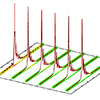
The advantages are revealed in test systems. In the Heisenberg model, for instance, artificial fluctuations in the calculated spectra disappear, and the agreement to reference data is almost exactly. The Heisenberg model is one of the most important theoretical models in solid-state physics. It describes how atomic spins – which are the magnetic moments of electrons – influence each other in a material.
|
|
This allows significantly finer structures to be resolved in the test systems shown. At the same time, the computational effort required remains manageable as there’s no need to conduct lengthy simulations.
|
Prospects for research and application
|
|
All in all, this method opens up new possibilities for studying complex quantum systems. It could also help us gain a better understanding of the microscopic mechanisms of high-temperature superconductivity. In a joint study with the group led by LMU professor Fabian Grusdt, Paeckel’s new method is already being used to combine a new theory for explaining high-temperature superconductivity with experiments.
|