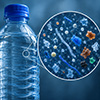
Single-particle infrared imaging reveals bottled-water nanoplastics differ in source, shape, and molecular structure beyond what particle counts can show.
(Nanowerk Spotlight) A bottle of water can look clean while carrying particles that differ in size, shape, source, and molecular structure. A count can show that contamination exists, but it cannot show where the particles came from or how they might behave.
That distinction matters because microplastic and nanoplastic monitoring often turns exposure into a small set of labels. Researchers count particles, sort them by size, and identify the main polymer when possible. Those measurements remain essential, but they can make a mixed population of fragments look like a uniform contaminant.
The problem becomes sharper at the nanoscale. Bulk chemical methods can identify polymers, but they average many particles together. Size-based methods can count small objects, but they cannot prove what each object is made of. Conventional infrared imaging reads chemical bonds, but it usually lacks the resolution needed for particles smaller than 1 µm.
Conceptual framework for chemical mapping of nanoplastics in bottled water using MIP microscopy. The approach uncovers molecular and morphological heterogeneity essential for exposure and risk assessment. (Image: Reproduced from DOI:10.1002/advs.202524291, CC BY)
Bottled water makes that question tractable. The likely particle sources include the PET bottle, the cap, water-treatment membranes, prefilters, and the source water itself. In a more complex environmental sample, those inputs can blur together. In bottled water, single-particle chemical and shape measurements can begin to separate them.
The researchers used mid-infrared photothermal microscopy, a method that combines chemical specificity with submicron imaging. Infrared light makes molecular bonds vibrate in characteristic ways. When a tiny particle absorbs that light, it warms slightly and changes how it interacts with a visible probe beam. That photothermal signal reveals chemical identity without relying only on appearance.
The practical challenge was finding sparse nanoplastics across large filters. Recording a full spectrum everywhere would be inefficient. The team first scanned at selected infrared wavelengths that mark common polymer bonds, using those signals to locate likely particles. They then collected detailed spectra from the particle locations, turning broad screening into targeted chemical analysis.
Across three major Chinese bottled-water brands, the researchers estimated 9.9 × 10⁴ particles L⁻¹. Nanoplastics accounted for 64 % of the total particle burden. That result reinforces a basic monitoring problem: methods that focus on microplastics alone can miss much of the particle population that consumers may ingest.
The polymer identities pointed first to packaging. Polyethylene terephthalate, or PET, accounted for 88.2 % of detected particles. PET is the main bottle material, so its dominance supports bottle breakdown as a major source. Polypropylene, the main cap material, appeared only rarely, which argues against cap abrasion as the main contributor in these samples.
The minor polymers added a more complex source map. Polyamide particles fit a likely contribution from reverse osmosis membranes, while cellulose particles matched debris from cellulose-based prefilters. Polyether carbonate appeared only in one brand, which points away from a universal packaging source and toward a source-water or watershed-specific input.
That source tracing matters because each pathway suggests a different intervention. A bottle material problem calls for changes in packaging, storage, or transport. A membrane problem points to water-treatment infrastructure. A source-water problem requires upstream monitoring. A single particle count cannot distinguish among those routes.
Shape provided another fingerprint. At the nanoscale, categories such as fiber and fragment become difficult to assign consistently. The researchers instead measured circularity, where 1.0 represents a perfect circle and lower values indicate more elongated or irregular shapes. Different polymers occupied different size-shape regions, making morphology part of the source-attribution evidence.
The shape differences also matter for exposure science. Cells do not necessarily handle a spherical particle and an elongated fragment in the same way. Shape can influence surface contact, uptake route, and persistence. Irregular particles can also offer different surface areas for carrying other contaminants. These concerns connect with wider research into the biological risks of nanoplastics, although the new study does not measure toxicity directly.
The strongest evidence for hidden heterogeneity came from PET itself. The released PET particles did not look, spectrally, like simple miniatures of the bottle wall. Their infrared spectra showed narrowed and split bands in regions linked to carbonyl and ester groups, which are key parts of the PET molecular structure.
Those narrowed bands are important because they suggest more uniform local molecular environments within the particles. The split peaks point to structural states that bulk measurements can blur together. In PET, polymer chains can pack with different degrees of order, known as crystallinity. The bottled-water particles showed a continuous range of these spectral states rather than one fixed PET signature.
That continuum changes the interpretation of the particles. They are not just generic PET debris. Particles with the same polymer identity and comparable size can occupy different molecular states, likely reflecting different release, degradation, or rearrangement histories during contact with water, storage, or transport.
The researchers also checked whether the imaging process created the spectral changes. Thermal modeling showed only a small and brief temperature rise during measurement. Repeated measurements on the same PET particle did not generate new peak narrowing or splitting. Those controls support the conclusion that the molecular fingerprints belonged to the particles themselves.
The broader message is that bottled-water nanoplastics need description as particle populations with histories, not just as counted objects. A PET fragment from the bottle wall, a polyamide fragment from a membrane, and a particle carried in from source water do not represent the same exposure simply because they fall into a similar size range.
That shift also changes what better monitoring should mean. A lower particle count would be useful, but it would not reveal whether manufacturers had reduced bottle shedding, improved filtration materials, or controlled source-water contamination. Chemical identity, morphology, and molecular structure can turn a contamination measurement into a source map.
The work still leaves part of the smallest particle range unresolved because the 20 nm filtration membrane set a lower size boundary. Sparse particles also make large-area imaging a practical challenge. Even so, the main point is clear: bottled-water nanoplastics are not interchangeable specks. They are fragments with different origins and molecular states, and exposure science will need to treat them that way.
For authors and communications departmentsclick to open
Lay summary
Prefilled posts
Nanowerk Newsletter
Get our Nanotechnology Spotlight updates to your inbox!
Thank you!
You have successfully joined our subscriber list.
Become a Spotlight guest author! Join our large and growing group of guest contributors. Have you just published a scientific paper or have other exciting developments to share with the nanotechnology community? Here is how to publish on nanowerk.com.