| May 21, 2026 |
Researchers used an advanced high-resolution optical microscopy technique to observe, for the first time, the individual behaviour of nanoparticles over time. The results reveal that, within the same population, nanoparticles can release their therapeutic cargo in very different ways, a key aspect for the development of precision medicine.
(Nanowerk News) Precision medicine aims to transport therapeutic agents, such as molecules, proteins or RNA, to the exact place where they need to act within the body. One of the most promising strategies is the use of nanocarriers: nanoparticles capable of encapsulating the drug, protecting it, transporting it and releasing it in a controlled manner where it is needed. At present, however, their behaviour is usually analysed using techniques based on average measurements of large populations, which conceal the differences between individual particles.
|
|
Now, a team led by the Institute of Materials Science of Barcelona (ICMAB-CSIC), in collaboration with the Institute for Advanced Chemistry of Catalonia (IQAC) and the University of Parma, has demonstrated that it is possible to follow the release process particle by particle.
|
|
“Within the same population, behaviour is not homogeneous: some nanoparticles release the cargo very quickly, others more slowly, and some barely release it. If we only analyse the average, these extremes remain hidden,” explain researchers Anna Solé and Anna Roig.
|
|
The study has been published in the journal Nanoscale Horizons (“STORM as a tool to track cargo release from polymeric nanocarriers at the single-particle level”) in co-leadership with Sílvia Pujals from IQAC.
|
 |
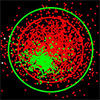
| Release of the protein in the nanocapsule over time. (Image: Courtesy of the authors)
|
Particle-by-particle tracking
|
|
The team worked with nanocarriers based on a biodegradable polymer called PLGA, widely used in medical applications. This material can encapsulate various biomolecules, such as proteins and RNA. In this study, a common protein called albumin was encapsulated and used as a model drug.
|
|
In the future, however, other therapeutic biomolecules with real medical objectives could be used. Conventional techniques used to study cargo release require manipulating the samples and provide only global information, without capturing the individual behaviour of each nanoparticle.
|
|
To overcome this limitation, the researchers applied the microscopy technique known as dSTORM, which allows individual fluorescent molecules to be localised with high precision. By using different fluorescent labels of the nanocarrier and the encapsulated protein, they were able to observe both components simultaneously and follow their evolution over 30 days.
|
|
This tracking made it possible to observe how each nanoparticle changes and to quantify the rate of protein release over time. The results show an initial rapid release during the first days, followed by a more sustained phase until the polymer’s final degradation. At the same time, the nanoparticles show an increase in diameter and a decrease in number, indicating processes of hydration, swelling and degradation.
|
|
One of the most relevant results is the identification of large differences between individual nanoparticles. While some release a significant part of the cargo quickly, others retain most of it for longer. These differences, invisible in studies based on averages, could play a determining role in therapeutic efficacy and possible adverse effects.
|
|
“There is increasing evidence that the clinical response depends on when, where and how much cargo is released in each part of the body,” point out the researchers.
|
A new tool for nanomedicine
|
|
This new approach opens the door to a better understanding of the complexity of drug delivery systems. “It opens two research directions,” the researchers state: “on the one hand, the methodology used in this study can be applied to other types of nanocarriers; on the other hand, it provides a more accurate view of nanoparticle populations, contributing key information to optimise the design of future therapies.”
|
|
The work forms part of Anna Solé’s doctoral thesis, which, together with medical teams, seeks to develop nanocarriers for targeted administration to organs such as the lungs or the brain, with the aim of improving the regeneration of damaged tissues.
|