| Jun 09, 2026 |
Radical molecules on superconductors self-assemble into chains with bistable charge and spin states, offering a route to controllable quantum materials.
(Nanowerk News) The intrinsic angular momentum, or spin, of electrons has a wide range of applications in science and technology. However, controlling the spin and maintaining its stability is difficult but this is important for applications such as spintronics and other quantum technologies.
|
|
Basel and Bern researchers succeeded in precisely controlling the charge and spin of specific molecules on a surface (ACS Nano, “Individual Assembly of Radical Molecules on Superconductors: Demonstrating Quantum Spin Behavior and Bistable Charge Rearrangement”).
|
|
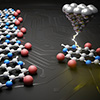
To this end, the team of scientists synthesized a special molecule, a tetrabromo-tetraazapyrene derivative. Using scanning tunneling microscopy (STM), the researchers probed this molecule on a lead surface and constructed dimers or chains of up to five molecules to study their quantum properties.
|
 |
| Using the tip of a scanning tunneling microscope, the spins of individual tetrabromo-tetraazapyrene derivative molecules can be “toggled” (between 1 and 0). Chains of these molecules exhibit regular patterns of quantum states. (Image: R. Pawlak, Department of Physics, University of Basel)
|
|
Of particular interest are the interactions of the spins with the lead surface, a material that exhibits superconducting properties at extremely low temperatures near absolute zero. This means that it conducts electric current without resistance. These interactions cause the molecules to exhibit different properties depending on their arrangement.
|
|
In gas phase, the molecules have no charge nor spin. On the lead surface, however, a charge transfer occurs from the substrate to the molecule. Molecules acquire an unpaired electron and exhibit magnetic properties (state I), while some others may remain neutral and non-magnetic, even on the lead surface (state 0).
|
Targeted changes are possible
|
|
“To put it simply, each molecule can accommodate exactly one electron, including its spin,” explains Dr. Rémy Pawlak of the Meyer team, who played a key role in the study. “Using a scanning tunneling microscope, we can now probe the spin of these electrons and selectively control the charge-state, much like flipping a switch between two states: magnetic for charged molecules (state I) and non-magnetic for neutral ones (state 0).”
|
|
When multiple molecules come together, their interactions with the surface are compounded by the mutual influence of the spins. This results in complex quantum states, and depending on the arrangement, regular patterns of charge and spin emerge.
|
|
In certain molecular arrangements, the state can be switched in a manner similar to that of isolated molecules. For example, a chain of four molecules can be switched back and forth between two stable states using the STM tip without destroying the system.
|
|
“The ability to manipulate individual radical molecules on superconductors and switch their quantum states is a milestone in the development of molecular spintronics and quantum devices,” Ernst Meyer summarizes. “This award motivates us to continue pursuing this approach.”
|