| May 08, 2026 |
New molecular design unlocks high photoluminescence efficiency and improved stability, with potential applications in lasers, bioimaging, and quantum technologies
(Nanowerk News) Circularly polarized light is finding uses in technologies ranging from next-generation 3D displays to bioimaging tools that detect signals deep within living tissue. Producing it efficiently in the red and near-infrared range, however, has been difficult.
|
|
Researchers at Kyushu University have now developed a new family of chiral organic radicals that emit bright circularly polarized light in this spectral window while remaining stable under prolonged laser illumination.
|
|
The study appeared in Angewandte Chemie International Edition (“Luminescent Donor‐Acceptor Radical With Propeller Chirality: Bright and Photostable Red Circularly Polarized Luminescence and Whispering Gallery Mode Resonance”).
|
Key Findings
- The new radicals emit circularly polarized light between 650 and 800 nanometers, covering the deep-red to near-infrared range.
- The strongest emitter is roughly 30 times more efficient than conventional chiral luminescent radicals and survives about 100 times longer under continuous laser exposure.
- Embedded in polystyrene microspheres, the radicals produced a pre-lasing optical effect not previously seen in radical-based emitters.
|
|
The work was led by Associate Professor Ken Albrecht of the Institute for Materials Chemistry and Engineering at Kyushu University, with doctoral student Kazuhiro Nakamura and collaborators from the National Institute of Advanced Industrial Science and Technology, the University of Tsukuba, Tokyo Metropolitan University, and Kyoto University.
|
 |
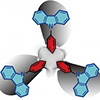
| Structure and emission properties of the proposed luminescent radical. This innovative structure exhibits highly efficient circularly polarized light emission in the red to near-infrared range, as well as the peculiar whispering gallery mode resonance depicted on the right. This property could be leveraged in advanced optics applications and lasers. (Image: Kyushu University)
|
|
One way to generate circularly polarized light is through chiral molecules, compounds that exist as mirror-image forms that cannot be superimposed on each other. Small organic molecules are attractive because their emission wavelengths can be tuned through molecular design.
|
|
Within this category, luminescent radicals have shown promise for red and near-infrared output. The tris(2,4,6-trichlorophenyl)methyl family, known as TTM-based radicals, is inherently chiral and a natural starting point, but earlier versions forced researchers to trade off chirality, brightness, and durability against one another.
|
|
The Kyushu team modified the TTM scaffold to relax those trade-offs. Starting from a bromine-containing variant called TTBrM, they attached a nitrogen-containing unit known as carbazole, abbreviated Cz. The synthesis yielded three new compounds: CzTTBrM, 2CzTTBrM, and 3CzTTBrM. The carbazole groups changed the emission mechanism, replacing a localized electronic transition with charge transfer between the carbazole donor and the TTBrM acceptor. That shift moved the emission into the 650 to 800 nanometer window.
|
|
Photoluminescence quantum yield, the fraction of absorbed light that is reemitted, reached values about 30 times higher in the best-performing compound than in conventional chiral luminescent radicals. Photostability rose by a similar margin. The new radicals withstood more than 1,300 seconds of continuous laser irradiation, compared with 19 seconds for unmodified TTBrM.
|
|
The chirality of all three compounds was stable as well, with high barriers to racemization, the process by which a chiral compound converts into its optically inactive form. Because the radicals did not switch rapidly between mirror-image forms at room temperature, the team could isolate enantiopure samples that produced strong circularly polarized luminescence.
|
|
To probe the optical behavior further, the researchers embedded the radicals in microscopic polystyrene spheres. Under laser illumination, the microspheres produced whispering gallery mode resonance, an effect in which light circulates inside a spherical cavity and amplifies at specific wavelengths. *”This phenomenon, representing a pre-lasing stage, had never before been reported in luminescent radical systems,”* remarks Albrecht.
|
|
The applications extend beyond displays, bioimaging, and lasers. *”These compounds can potentially be used as magnetic field- and microwave-manipulated quantum materials, which are expected to be useful for next-generation quantum information science,”* says Nakamura. Stable chiral radicals with controllable spin properties are of growing interest in quantum information research, where molecular emitters could complement inorganic platforms.
|
|
The Kyushu University result shows that brightness, photostability, and stable chirality can coexist within a single small-molecule design, removing one of the main barriers to using luminescent radicals in practical optical and quantum devices.
|