| May 06, 2026 |
Scientists reveal the first images of the elusive flat bands inside magic-angle graphene – finding that the electrons within behave, simultaneously, as two opposite kinds of particle.
(Nanowerk News) Inside a strange and now-famous material called magic-angle graphene, the electrons have been behaving in ways that shouldn’t be possible.
|
|
Magic-angle graphene is two sheets of carbon, each a single atom thick, stacked and twisted relative to each other by exactly 1.1 degrees. At that one specific angle, and almost no other, the material does things that have astonished physicists for years: it conducts electricity with no resistance, it magnetizes, it becomes an insulator. Twist a tenth of a degree off, and the magic disappears.
|
|
The reason comes down to a single feature of its electrons: they barely move. The precise twist places them into peculiar energy levels called flat bands, in which their natural motion is so suppressed that they can no longer ignore one another. Forced to interact, they organize themselves into all the exotic phases the material is famous for.
|
|
Flat bands are a recurring theme in modern physics — the same principle underlies the celebrated quantum Hall effect — and in magic-angle graphene they sit at the heart of every interesting question.
|
|
But despite their central importance, no experiment had ever directly imaged these bands. Theorists had calculated what they ought to look like, but no tool existed with the energy and momentum resolution to actually see them. Then came the Quantum Twisting Microscope.
|
 |
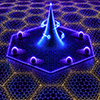
| Artist’s impression of the dual nature of electrons revealed by the Quantum Twisting Microscope in magic-angle graphene’s flat bands — heavy and slow at some momenta, light and fast at others. (Image: Weizmann Institute of Science)
|
The Two-Faced Mystery of Magic Electrons
|
|
Since the discovery of magic-angle graphene, evidence had been accumulating that electrons in its flat bands could behave in two strikingly different ways. Some experiments hinted that the electrons were locked in place, immobilized by their own mutual repulsion. Others revealed topological states — which could only be explained if the electrons were flowing.
|
|
For a while, the contradiction had a comfortable explanation: magic-angle graphene is a complex system with many competing phases, and different experiments were simply catching it in different ones — sometimes the frozen phase, sometimes the flowing phase.
|
|
But then a series of experiments — from a Weizmann–MIT collaboration, with parallel investigations at Princeton and UCSB — revealed something far stranger. The two behaviors weren’t happening in different states. They were happening in the same state, at the same time. The electrons were behaving, simultaneously, as both frozen and flowing. The puzzle was no longer about competing phases. It was about a single phase whose electrons appeared to be two contradictory things at once. The electrons in magic-angle graphene seemed to have a dual nature.
|
|
Faced with this paradox, theorists came forward with a striking proposal: the topological heavy fermion framework. Its central idea was that the topology of the flat bands required them to host two kinds of electron at once — heavy localized electrons across much of the flat bands, and light, extended electrons in other special regions.
|
|
It was a beautiful idea. And it was untestable without a tool that could image the flat bands directly.
|
Seeing the Magic
|
|
In a new paper in Nature (“Imaging the flat bands of magic-angle graphene reshaped by interactions”), the Weizmann team, led by Prof. Shahal Ilani, used their recently developed Quantum Twisting Microscope (QTM) to obtain the first direct images of the flat bands of magic-angle graphene.
|
|
The QTM is a new kind of scanning probe whose tip is itself a layer of graphene. By rotating the tip, the experimenters can select the momentum of the electrons they probe — singling out, at each angle, a different group of electrons within the material. This allows the QTM to directly map the energy bands of layered materials such as magic-angle graphene with orders-of-magnitude better resolution than any previous technique.
|
|
When the team pointed the microscope at magic-angle graphene, the flat bands appeared — directly, for the first time. And the answer to the dual-nature puzzle was right there in the pictures. Across most of the bands, the electrons were heavy and almost frozen, exactly as some experiments had been suggesting. But near one specific momentum, they were light and fast — exactly as other experiments had been seeing. Both kinds of electrons, side by side, in the very same band.
|
|
The puzzle was no longer a paradox: it was a feature of the bands themselves, written into their geometry just as the topological heavy fermion framework had proposed.
|
|
“In the pictures, the duality is right there in front of you,” says Jiewen Xiao, a co-first author of the study. “Across most of the band the electrons are heavy and stuck. At one momentum they are light and fast. The puzzle just dissolves.”
|
|
The QTM did not just take a single picture. It also let the team add or remove electrons from the material and watch the bands respond. The bands did not fill smoothly: instead, they rearranged themselves in a striking staircase pattern, resetting and starting over each time the material absorbed roughly one extra electron per repeating unit of its lattice.
|
|
As filling progressed, the light and heavy electrons were seen to trade population in a coordinated dance — directly explaining previous observations, including the so-called Dirac revivals discovered a few years earlier by the Weizmann and Princeton groups.
|
|
“For years people studied this material without being able to see its flat bands directly,” says John Birkbeck, also a co-first author. “Once you can see them, much of what was confusing in the earlier literature falls into place.”
|
|
But not everything. The pictures also revealed a feature that no current theory predicts — a sharp, robust signature that appears across every region the team measured, at the same energy, in every sample. It does not come from imperfections. Whatever it is, it appears to be intrinsic to magic-angle graphene, and it may be relevant to the still-unsolved mystery of how the material superconducts.
|
|
“Resolving the dual-nature puzzle is satisfying,” says Prof. Ilani, “but what is more exciting is that we keep discovering new things in this system that no theory predicts. Something is still missing from our picture of this material, and it could be the key to its deepest mystery.”
|
|
The flat bands of magic-angle graphene have been seen at last. They are the first of many. Dozens of other layered quantum materials — superconductors, magnets, exotic topological systems — carry their own hidden electronic structures, waiting to be brought into view by the same kind of imaging. With the Quantum Twisting Microscope, an entire frontier of quantum materials is now within reach.
|