| Apr 30, 2026 |
Water molecules at the air-water interface alternate in tilt and in a previously overlooked twist angle across the first four molecular layers.
(Nanowerk News) Researchers in the Department of Physical Chemistry at the Fritz Haber Institute of the Max Planck Society, working with colleagues at Freie Universität Berlin, have mapped how water molecules arrange themselves at the air-water interface, and the picture is more complex than earlier work suggested.
|
|
Using a depth-resolved laser technique paired with computer simulations, the researchers found that water molecules in the first four layers near the surface alternate in both their tilt and in a previously overlooked rotation called the twist angle.
|
|
The result (Science Advances, “The importance of layer-dependent molecular twisting for the structural anisotropy of interfacial water”) revises an established structural model of interfacial water.
|
Key Findings
- Water molecules in the first four layers at the air-water interface alternate in tilt and twist angles, replacing the simpler up or down picture that earlier analyses relied on.
- A combined experimental and computational method delivered structural detail across an interfacial region only about 8 Ångström thick.
- The findings change how chemists interpret reactions at aqueous surfaces and may extend to interfaces inside batteries and other electrochemical devices.
|
Why the air-water interface matters
|
|
Water is arguably the most important molecule on Earth, and the thin region where it meets another phase governs much of its chemistry. Interfacial water shapes physiology, drives reactions at the ocean surface, and influences atmospheric chemistry. The presence of an interface forces molecules into preferred orientations and reorganizes their hydrogen-bond network, producing properties that differ from those of bulk water. Despite the importance of these structures, their molecular details remained inaccessible.
|
 |
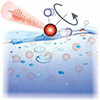
| Schematic of water orientations at the interface to air along with depth-dependent signal contributions. (Image: Fritz Haber Institute)
|
A region only four molecules thick
|
|
The interfacial layer at the air-water boundary spans roughly 8 Ångström, or about four water molecules stacked from the surface inward. Below this depth, water adopts ordinary bulk properties. To map the structure, scientists need to probe each of those four layers separately and recover the orientation of every molecule within them. Despite decades of intensive research, no experiment had achieved that level of depth resolution.
|
Depth-resolved vibrational spectroscopy combined with simulation
|
|
The Fritz Haber Institute group built a vibrational spectroscopy method that addresses this gap. Infrared and visible laser pulses irradiate the water surface and excite nonlinear vibrations in the molecules there. The interaction generates two new laser beams at different visible frequencies, known as sum-frequency and difference-frequency signals (SFG and DFG).
|
|
Subtle differences in the phase and amplitude of these signals encode how deep into the liquid each contribution originates, which allows the researchers to isolate the vibrational response of the interfacial region. Matching those experimental spectra against high-level computer simulations performed by the Freie Universität Berlin group then produced a layer-by-layer picture of how water molecules orient themselves within those four interfacial layers.
|
Adding twist to the structural picture
|
|
The combined data showed that water molecules in the first four layers hold well-defined orientations, with both tilt and twist angles flipping from one layer to the next. The tilt angle is defined as the angle between the water dipole and the surface normal, while the twist angle describes a rotation about the dipole axis.
|
|
Earlier analyses focused almost exclusively on whether molecules pointed up or down, a simplification that masked the role of twist. Adding the depth-dependent twist distribution produces a substantially revised picture of interfacial water with consequences for any process driven by the structure of that surface.
|
Collaboration and next steps
|
|
The work brought together experimental and theoretical expertise from two Berlin institutions, the Fritz Haber Institute and Freie Universität Berlin. The authors plan to apply the same depth-resolved approach to a wider set of aqueous interfaces, including those found inside electrochemical devices such as batteries.
|
|
A more accurate model of water at the air boundary matters wherever chemistry begins in those first few molecular layers, from atmospheric reactions to ocean surface processes to physiology. Adding twist to the structural description gives researchers a more faithful starting point for those questions.
|