| Apr 27, 2026 |
A chlorophyll-based polymer shows stepwise evolution from nonhelical to helical structures, offering a new route to adaptive materials.
|
|
(Nanowerk News) Science has long taken inspiration from the natural world, and few natural designs are as iconic as the helical shape that makes life possible. The best-known example of such a molecule is DNA, a double helix that carries the genetic instructions for all living organisms. Similar helical shapes are also found in proteins. This shape is special in that it imparts a certain adaptability to biological molecules.
|
|
For instance, by changing how tightly they twist or even the direction of their twist, biological systems can respond and adapt to their environment. This helps proteins adjust their shapes to fold correctly and perform essential tasks.
|
|
Inspired by this design, researchers from Chiba University, Shizuoka University, Keele University, Kanazawa University, and Ritsumeikan University, Japan, have developed a chlorophyll-based supramolecular polymer that can gradually transform from nonhelical fibers into well-defined helical structures over time.
|
 |
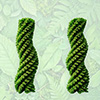
| The figure shows how the material evolves from nonhelical fibers into progressively tighter helices over several days. This stepwise transformation demonstrates dynamic helicity in synthetic systems, where structure develops gradually rather than forming instantly. (Image: Professor Shiki Yagai, Chiba University)
|
|
The study was led by Professor Shiki Yagai at the Institute for Advanced Academic Research, Chiba University, along with Balaraman Vedhanarayanan and Ryoma Tsuchida from the Graduate School of Engineering, Chiba University; Shinnosuke Kawai from Shizuoka University; and Martin J. Hollamby at Keele University, UK. The study was published in the Journal of the American Chemical Society (“Sequential, Multistep, and Cooperative Helicity Evolution in Supramolecular Polymers of Chlorophyll Rosettes”).
|
|
“Examples of synthetic supramolecular polymers in which multiple helicity arises dynamically from kinetically trapped, nonhelical structures are rare,” says Prof. Yagai.
|
|
The developed molecule overcomes this limitation. Instead of forming a helix immediately, it evolves step by step, passing through several intermediate stages before reaching its final helical form. It begins as a nonhelical fiber, then develops two loose helices, and finally tightens into a more twisted structure.
|
|
The researchers synthesized a chlorophyll derivative functionalized with barbituric acid groups and long alkyl chains. These molecules assemble into ring-like structures called rosettes through hydrogen bonding. In low-polarity solvents, the rosettes stack into long, one-dimensional fibers. The large and complex structure of each chlorophyll unit prevents the rosettes from immediately arranging into a stable configuration. As a result, the system first forms nonhelical fibers, which gradually reorganize into helices with tighter twists over time.
|
|
Using atomic force microscopy, the team identified four distinct fiber types: a nonhelical form (NF), in which rosettes are stacked directly without offset, and three helical forms (HF1, HF2, and HF3) that arise from slight translational shifts between stacked rosettes, resulting in twisted structures. All three helices are right-handed but differ in pitch: 26 nm for HF1, 13 nm for HF2, and 8 nm for HF3.
|
|
Using advanced imaging techniques, the team then tracked how these structures evolved over time. Starting with a solution dominated by nonhelical fibers, they observed a gradual transformation into helical structures over the course of several days. Within the first 30 minutes, most nonhelical fibers disappeared, giving way to HF1 and HF2. Over the next few hours, HF1 was converted almost entirely into HF2. The final transformation, from HF2 to the most tightly twisted form, HF3, occurred much more slowly, taking several days.
|
|
The researchers also found that this transformation occurs cooperatively. Once a small region of a fiber adopts a more stable helical structure, it promotes similar changes in neighboring regions, allowing the transformation to spread along the polymer.
|
|
“We demonstrate that helicity in a one-dimensional supramolecular polymer can emerge and mature through discrete, cooperative reorganizations occurring within the polymer backbone across a rugged energy landscape, representing a rare behavior,” says Prof. Yagai.
|
|
These findings also point to a blueprint for designing dynamic helical structures. By creating molecular building blocks that can adopt multiple stable arrangements with only small energy differences, it may be possible to design materials that change their structure over time in a controlled way.
|
|
Looking ahead, the team notes that an important question remains: whether these structural changes occur randomly along the fibers or propagate in a directional manner from specific starting points. Understanding this process could help scientists design materials that more closely mimic the adaptability seen in nature.
|