
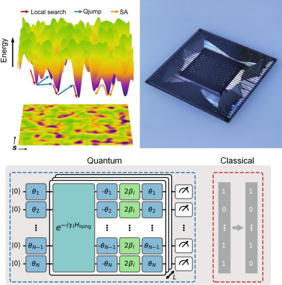
Home > Press > Qjump: Shallow-circuit quantum sampling guides combinatorial optimization On up to 104 superconducting qubits, Qjump assists in searching the ground states of hard Ising problems and might outperform simulated annealing on near-term quantum hardware
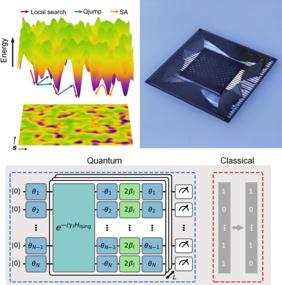 |
| Qjump utilizes shallow quantum circuits to navigate the complex energy landscape and leap between promising regionsor basinsthat often entrap traditional classical methods.
Credit ©Science China Press |
Abstract:
Quantum computing holds the promise of solving complex combinatorial optimization problems by encoding information into the low-energy states of Ising Hamiltonians. However, efficiently navigating these energy landscapes to find optimal solutions remains a formidable challenge for practical applications. To bridge this gap, a research team from Zhejiang University and their collaborators have developed “Qjump” (Quantum-enhanced jumping), a hybrid quantum-classical algorithm. Experimentally demonstrated on a 104-qubit superconducting processor, Qjump employs a strategic quantum sampling technique to accelerate the search for low-energy solutions, offering a new pathway toward practical quantum advantage.
Qjump: Shallow-circuit quantum sampling guides combinatorial optimization On up to 104 superconducting qubits, Qjump assists in searching the ground states of hard Ising problems and might outperform simulated annealing on near-term quantum hardware
Beijing, China | Posted on April 17th, 2026
Qjump employs shallow quantum circuits to navigate the complex “energy landscape” of a problem, enabling the system to leap between promising regionsor basinsthat often entrap traditional classical methods. Once the quantum sampling identifies a candidate zone, a classical local search subroutine takes over to refine the solution. This hybrid strategy preserves high-quality results while drastically lowering the requirements for quantum circuit depth, providing a practical blueprint for achieving speedup on current hardware.
Guided by an analysis of quantum circuit dynamics, the team introduced a circuit truncation technique that streamlines the standard QAOA (Quantum Approximate Optimization Algorithm). This approach drastically reduces circuit depth and minimizes the impact of hardware noise, enabling the algorithm to “escape” suboptimal local minima more effectively. By integrating this streamlined quantum process with a classical local search, the researchers overcame the common trainability and noise-sensitivity issues that often cripple original QAOA performance, steering the search toward the most promising regions of the solution space.
To validate the algorithm, the researchers deployed Qjump on a 104-qubit superconducting processor to solve complex Ising problems. The experimental results demonstrated that Qjump consistently delivers higher-quality solutions than both the fixed-parameter QAOA and a highly optimized classical Simulated Annealing (SA) algorithm. Further efficiency analysis using the “time-to-solution” (TTS) metric reveals that on a near-term superconducting platform, Qjump is expected to achieve a 2.34-fold speedup for 104 qubits over single-core simulated annealing. While the team notes that this comparison focuses on sequential classical processing, the results provide a compelling benchmark for quantum-enhanced optimization on large-scale hardware.
####
About Science China Press
Science China Press is one of the most important professional academic publishers affiliated with China Science Publishing & Media Ltd. Its products include journals such as the Science China Series, Science Bulletin, National Science Review, National Science Open, Journal of Energy Chemistry, and Medicine Plus, as well as the SciEngine platform, which serves a collection of electronic journals. Under the command of the Chinese Academy of Sciences, SCP journals aim to disseminate original, cutting-edge advances in fundamental and applied research, providing communications among the scientists worldwide.
For more information, please click here
Copyright © Science China Press
If you have a comment, please Contact us.
Issuers of news releases, not 7th Wave, Inc. or Nanotechnology Now, are solely responsible for the accuracy of the content.
Bookmark:


News and information

Quantum computer improves AI predictions April 17th, 2026
Flexible sensor gains sensitivity under pressure April 17th, 2026
A reusable chip for particulate matter sensing April 17th, 2026
Detecting vibrational quantum beating in the predissociation dynamics of SF6 using time-resolved photoelectron spectroscopy April 17th, 2026
Quantum Physics
Detecting vibrational quantum beating in the predissociation dynamics of SF6 using time-resolved photoelectron spectroscopy April 17th, 2026
Beyond silicon: Electronics at the scale of a single molecule January 30th, 2026
MXene nanomaterials enter a new dimension Multilayer nanomaterial: MXene flakes created at Drexel University show new promise as 1D scrolls January 30th, 2026
ICFO researchers overcome long-standing bottleneck in single photon detection with twisted 2D materials August 8th, 2025
Superconductivity
MXene nanomaterials enter a new dimension Multilayer nanomaterial: MXene flakes created at Drexel University show new promise as 1D scrolls January 30th, 2026
Possible Futures
A fundamentally new therapeutic approach to cystic fibrosis: Nanobody repairs cellular defect April 17th, 2026
UC Irvine physicists discover method to reverse quantum scrambling : The work addresses the problem of information loss in quantum computing system April 17th, 2026
Quantum Computing
Quantum computer improves AI predictions April 17th, 2026
UC Irvine physicists discover method to reverse quantum scrambling : The work addresses the problem of information loss in quantum computing system April 17th, 2026
Researchers develop molecular qubits that communicate at telecom frequencies October 3rd, 2025
Researchers tackle the memory bottleneck stalling quantum computing October 3rd, 2025
Discoveries
Quantum computer improves AI predictions April 17th, 2026
Flexible sensor gains sensitivity under pressure April 17th, 2026
A reusable chip for particulate matter sensing April 17th, 2026
Detecting vibrational quantum beating in the predissociation dynamics of SF6 using time-resolved photoelectron spectroscopy April 17th, 2026
Announcements
A fundamentally new therapeutic approach to cystic fibrosis: Nanobody repairs cellular defect April 17th, 2026
UC Irvine physicists discover method to reverse quantum scrambling : The work addresses the problem of information loss in quantum computing system April 17th, 2026
Interviews/Book Reviews/Essays/Reports/Podcasts/Journals/White papers/Posters
A fundamentally new therapeutic approach to cystic fibrosis: Nanobody repairs cellular defect April 17th, 2026
UC Irvine physicists discover method to reverse quantum scrambling : The work addresses the problem of information loss in quantum computing system April 17th, 2026
