| Apr 14, 2026 |
A 3D bimetallic MOF electrode on copper mesh kills over 99% of airborne bacteria at low voltage using electroporation and reactive oxygen species generation.
(Nanowerk News) A research team at Ocean University of China has fabricated a three-dimensional bimetallic electrode from metal-organic frameworks (MOFs) — porous crystalline materials assembled from metal ions and organic linkers — that eliminates more than 99% of airborne bacteria through electrocatalytic air sterilization.
|
|
Published in the journal Engineering (“Template-Directed Growth of a 3D Hierarchical Structure of Well-Aligned Bimetallic MOF Arrays for High-Efficiency Electrocatalytic Air Sterilization”), the study shows how the electrode neutralizes bacteria in milliseconds at low voltage by combining electric-field-driven membrane disruption with reactive oxygen species generation.
|
Key Findings
- The optimized electrode, designated 0.3Co-MOF/Cu@Cu, achieved a 99.51% sterilization rate against Escherichia coli at 24 V alternating current with a contact time of only 0.0026 seconds.
- Bimetallic coordination of cobalt and copper improved water stability, charge transfer kinetics, and the density of catalytically active sites compared with single-metal formulations.
- The sterilization mechanism works through a dual pathway of bacterial membrane electroporation and reactive oxygen species attack, driven by the electrode’s three-dimensional architecture.
|
|
Airborne bacterial contamination poses a growing challenge in sealed, densely occupied indoor environments. Conventional approaches such as UV irradiation and chemical disinfection can be energy-intensive, produce secondary pollutants, or struggle with high air throughput.
|
|
MOF-based materials have attracted interest as catalytic alternatives because their tunable porous structures offer large reactive surface areas, but poor electrical conductivity and degradation in humid conditions have restricted practical use.
|
|
To address these limitations, the researchers developed a template-directed growth strategy that produces well-aligned MOF nanorod arrays directly on a copper mesh substrate. Copper mesh serves a dual role, providing both high electrical conductivity and permeability to airflow. Cobalt and copper ions were co-introduced as coordination metals, and density functional theory calculations combined with electrochemical testing identified a cobalt-to-copper ratio of 0.3 as optimal. This composition showed faster reaction kinetics and better water resistance than other ratios, with a higher proportion of Co3+ contributing to structural integrity.
|
|
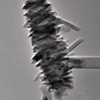
Microscopy and elemental mapping revealed that the electrode surface consists of tapered nanorod arrays sheathed in thin nanosheets, with cobalt, copper, carbon, nitrogen, and oxygen distributed uniformly throughout. The crystal structure is predominantly Co-MOF with minor copper doping. Electrochemical measurements confirmed low charge transfer resistance and high double-layer capacitance, indicating abundant exposed active sites and efficient electron transport. Stability testing over 25 hours at constant current in alkaline solution showed no significant performance degradation.
|
|
The team tested sterilization performance using Escherichia coli as a model Gram-negative bacterium at 65% relative humidity. At an airflow velocity of 1.5 m·s⁻¹ and 24 V alternating current, bacteria passed through the electrode in just 0.0026 seconds. Even at this extremely short contact time, the electrode achieved a kill rate of 99.51%.
|
|
Two complementary mechanisms account for this performance. The three-dimensional MOF superstructure amplifies the applied electric field locally, generating intensities sufficient to cause electroporation — the formation of pores in bacterial cell membranes that compromise their structural integrity. Simultaneously, oxygen vacancies on the electrode surface capture oxygen molecules and catalyze their reduction to superoxide anions, the dominant reactive oxygen species (ROS) produced by the system.
|
|
These exogenous ROS penetrate bacterial cells, while free electrons at the electrode surface interfere with normal bacterial metabolism and trigger additional ROS production inside the cells, leading to cell death. A secondary effect is that the generated ROS raises negative ion concentration in the treated air, which may contribute to improved perceived air quality indoors.
|
|
The electrode’s ability to sterilize air at low voltage and millisecond contact times suggests it could be integrated into existing ventilation hardware such as air conditioning systems.
|